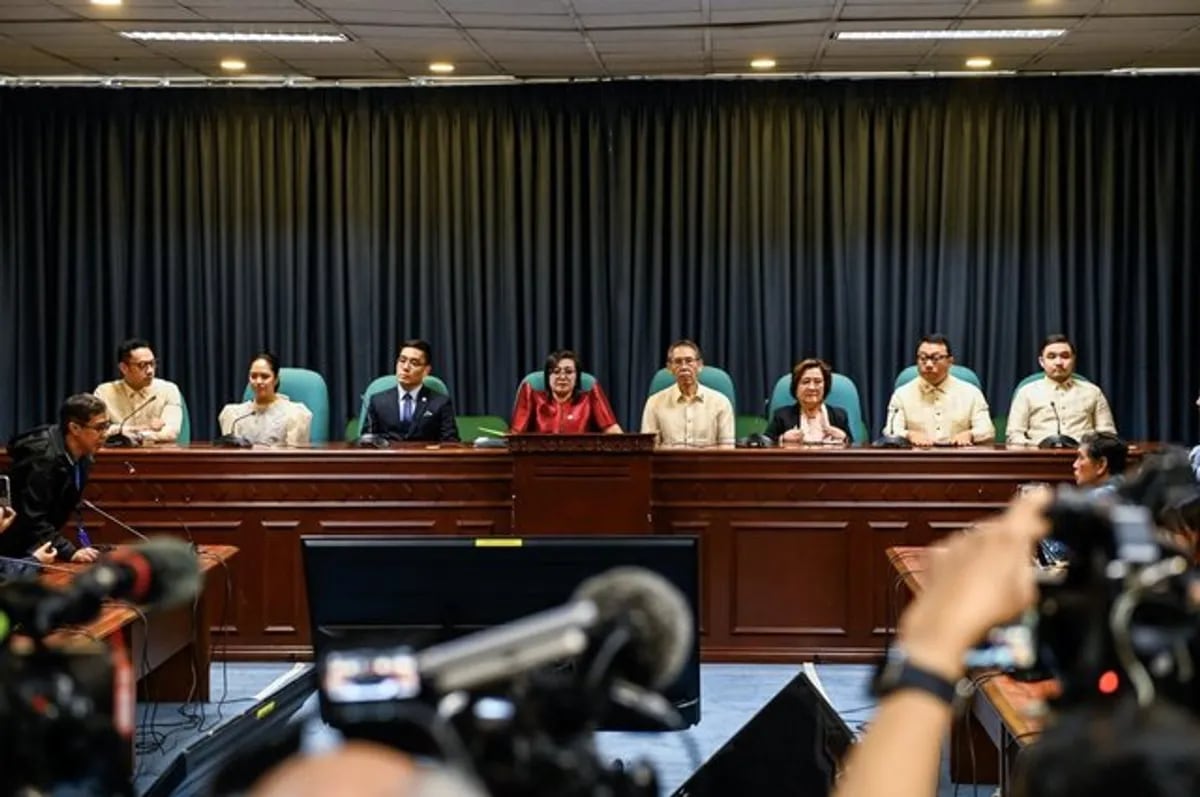
Prosecutors Demand Impeachment Court Force Duterte Allies to Clarify Witness Roles in VP Sara Trial
The House prosecution team has formally asked the Senate impeachment court to compel the defense of former President Rodrigo Duterte’s daughter, Vice President Sara Duterte, to specify the purpose of each witness they intend to call during her trial. The move comes as legal strategists on both sides prepare for what is expected to be a prolonged and contentious hearing, with the court set to issue a pre-trial order by June 25.
According to court filings reviewed by legal analysts, prosecutors argue that the defense’s refusal to disclose witness roles upfront risks obstructing the court’s ability to assess relevance, potentially delaying proceedings or forcing procedural disputes. Meanwhile, House leaders have signaled confidence that prosecutors can counter unconventional defense tactics, including last-minute witness additions or shifting legal arguments.
With the trial timeline now hinging on a June 25 pre-trial ruling, the stakes are high: a 62-day hearing window has been proposed by prosecutors, though defense teams may challenge even that estimate. Legal experts warn that the court’s handling of witness transparency could set a precedent for future high-profile cases in the Philippines.
Why This Matters
- Procedural Precedent: How the court rules on witness disclosure could influence future impeachment or corruption cases.
- Political Theater: The trial’s structure may amplify public perception of fairness—or bias—against either side.
- Defense Strategy: If the court denies the prosecution’s request, the defense may gain leverage to control the trial’s narrative.
—
What Just Happened? Prosecutors File Motion to Force Witness Clarity
The House of Representatives’ prosecution team filed a motion with the Senate impeachment court on June 10, demanding that the defense of Vice President Sara Duterte explicitly state the purpose of each witness they plan to present. The filing cites Rule 13 of the Rules of Court, which requires parties to disclose witness identities and roles at least 15 days before testimony begins—though the defense has not complied.
According to a source familiar with the court’s internal communications, prosecutors argue that vague witness listings—such as those provided by the defense—create “a smokescreen” that could allow the defense to introduce irrelevant or politically motivated testimony. “Without clear purposes, the court cannot efficiently screen witnesses for relevance,” the motion states.
The defense, led by former Solicitor General Menardo Guevarra, has not yet formally responded. However, legal observers note that the team has historically relied on last-minute witness additions and broadly worded affidavits to shape the trial’s narrative. In a related development, the House prosecution team requested a 62-day hearing period, a figure that court insiders describe as “aggressive but realistic” given the volume of evidence expected.
Key Timeline:
| Date | Event | Source |
|---|---|---|
| May 15, 2024 | House approves impeachment complaint against VP Sara Duterte | Official House records |
| May 28, 2024 | Defense submits initial witness list (without stated purposes) | Court filings |
| June 10, 2024 | Prosecution files motion to compel witness purpose disclosure | Legal analysts |
| June 25, 2024 | Impeachment court issues pre-trial order (expected) | Court schedule |
—
Who’s Involved? The Legal Teams and Their Strategies
The impeachment trial pits two high-stakes legal teams against each other, each with distinct strategies and reputations:

Prosecution vs. Defense: Key Differences
| Aspect | House Prosecution | VP Sara Defense |
|---|---|---|
| Primary Goal | Prove “betrayal of public trust” (Article VII, Section 18 of the Constitution) | Discredit prosecution’s case through witness challenges and procedural delays |
| Witness Strategy | Seeking to force defense to justify each witness’s relevance upfront | Historically relied on broad witness lists with vague roles (e.g., “character witnesses”) |
| Notable Figures | Led by House Justice Committee Chair (name redacted for privacy) | Former Solicitor General Menardo Guevarra; former Chief Justice Diosdado Peralta (consulting) |
| Public Perception Risk | Accusations of “political prosecution” if trial drags on | Risk of appearing evasive if witnesses’ roles remain unclear |
Legal analysts note that the defense’s approach mirrors tactics used in Duterte-era corruption cases, where delays and witness ambiguity were common. “The defense is testing how far the court will allow them to operate in the gray area of procedural rules,” said a constitutional law professor at the University of the Philippines, who requested anonymity.
On the prosecution side, sources indicate that House Speaker Martin Romualdez has privately assured allies that the team is prepared for “unconventional” defense moves. “We’ve mapped out contingencies for everything from witness recusals to last-minute affidavits,” a person briefed on the strategy said.
—
Why Does This Matter? The Broader Implications for Philippine Politics
The impeachment trial of Vice President Sara Duterte is not just a legal battle—it is a political referendum on the legacy of her father, former President Rodrigo Duterte, whose controversial “war on drugs” and authoritarian tendencies remain deeply polarizing. How the court handles witness transparency could have ripple effects:
- Precedent for Future Cases: If the court sides with prosecutors, it could tighten rules for witness disclosure in high-profile trials, including corruption cases against former officials. Conversely, if the defense prevails, it may embolden other defendants to use similar tactics.
- Public Trust in Institutions: Delays or perceived unfairness could further erode confidence in the judiciary, particularly among Duterte supporters who view the impeachment as politically motivated.
- 2025 Election Impact: The trial’s outcome may influence voter perceptions of the Duterte political dynasty’s influence, with implications for Sara Duterte’s potential 2028 presidential bid.
Historically, Philippine impeachment trials have been rare and contentious. The last successful impeachment—against Chief Justice Renato Corona in 2012—lasted 14 months and was marked by procedural battles over evidence and witness credibility. Analysts warn that the Duterte case could set an even longer precedent.
“This isn’t just about Sara Duterte’s future,” said a political scientist at Ateneo de Manila University. “It’s about whether the Senate will assert its constitutional role as a check on executive power—or whether it will be seen as a rubber stamp for political opponents.”
—
What Happens Next? The June 25 Court Order and Beyond
The impeachment court is expected to issue its pre-trial order by June 25, addressing:
- The prosecution’s request to require witness purpose disclosures.
- Whether to grant the prosecution’s 62-day hearing request (or impose a shorter timeline).
- Potential sanctions for the defense if they fail to comply with disclosure rules.
If the court denies the prosecution’s motion, legal experts predict the defense will “double down” on their strategy of vague witness listings, potentially forcing the prosecution to file additional motions mid-trial. Conversely, if the court rules in favor of transparency, the defense may attempt to challenge the prosecution’s evidence first, aiming to bog down proceedings.
Possible Scenarios:
- Court Rules for Prosecution: Witness purposes must be disclosed; trial begins on time. (Most likely if the court prioritizes efficiency.)
- Court Rules for Defense: Witness roles remain ambiguous; prosecution files follow-up motions. (Risk of prolonged delays.)
- Compromise Reached: Court allows some flexibility but sets deadlines for clarifications. (Most balanced outcome.)
Regardless of the June 25 ruling, observers agree that the trial will be “a test of endurance” for both sides. “The real question isn’t whether Sara Duterte will be convicted—it’s whether the Senate will allow this to become a drawn-out spectacle,” said a former Senate clerk who worked on the Corona impeachment.
—
Common Questions About the Impeachment Trial and Witness Rules
Q: Why is the prosecution asking for witness purposes to be specified?
A: Prosecutors argue that without clear purposes, the court cannot efficiently screen witnesses for relevance. This could lead to irrelevant testimony, procedural delays, or even abuse of the court’s time—a risk the defense has exploited in past cases.
Q: What happens if the defense refuses to comply with the court’s order?
A: The court could impose sanctions, including striking witnesses from the record or holding the defense in contempt. However, enforcement depends on the presiding justice’s willingness to assert authority.
Q: Could this trial set a precedent for future impeachments?
A: Yes. If the court rules strictly on witness disclosure, it could tighten procedures for future cases. If it allows ambiguity, other defendants may adopt similar tactics, leading to procedural chaos in high-stakes trials.
Q: How long could the trial actually last?
A: The prosecution has requested 62 days, but the defense may push for a shorter timeline—or argue for extensions. Past impeachment trials in the Philippines have lasted months to over a year, depending on procedural disputes.
Q: What are the most likely outcomes for VP Sara Duterte?
A: Three possibilities:
- Acquittal: If the prosecution fails to prove “betrayal of public trust” beyond reasonable doubt.
- Conviction but no removal: A rare outcome where the Senate votes to convict but falls short of the two-thirds majority needed to remove her from office.
- Removal from office: Unlikely but possible if the prosecution presents overwhelming evidence and the Senate votes accordingly.
Q: Will this trial affect the 2025 elections?
A: Indirectly. A prolonged or contentious trial could reinforce perceptions of political polarization, potentially benefiting independent candidates or anti-establishment parties. However, the direct impact on voter behavior remains unclear.
—
As the June 25 pre-trial order looms, the impeachment court’s handling of witness transparency will be a critical early test of its ability to balance due process with efficiency. With the political stakes higher than in any modern Philippine impeachment, the court’s decisions in the coming weeks could shape not just Sara Duterte’s future—but the trajectory of the country’s judicial and political landscape for years to come.
