S-E Asia’s Diplomatic Pushback Against US Defence Spending Calls – The Straits Times
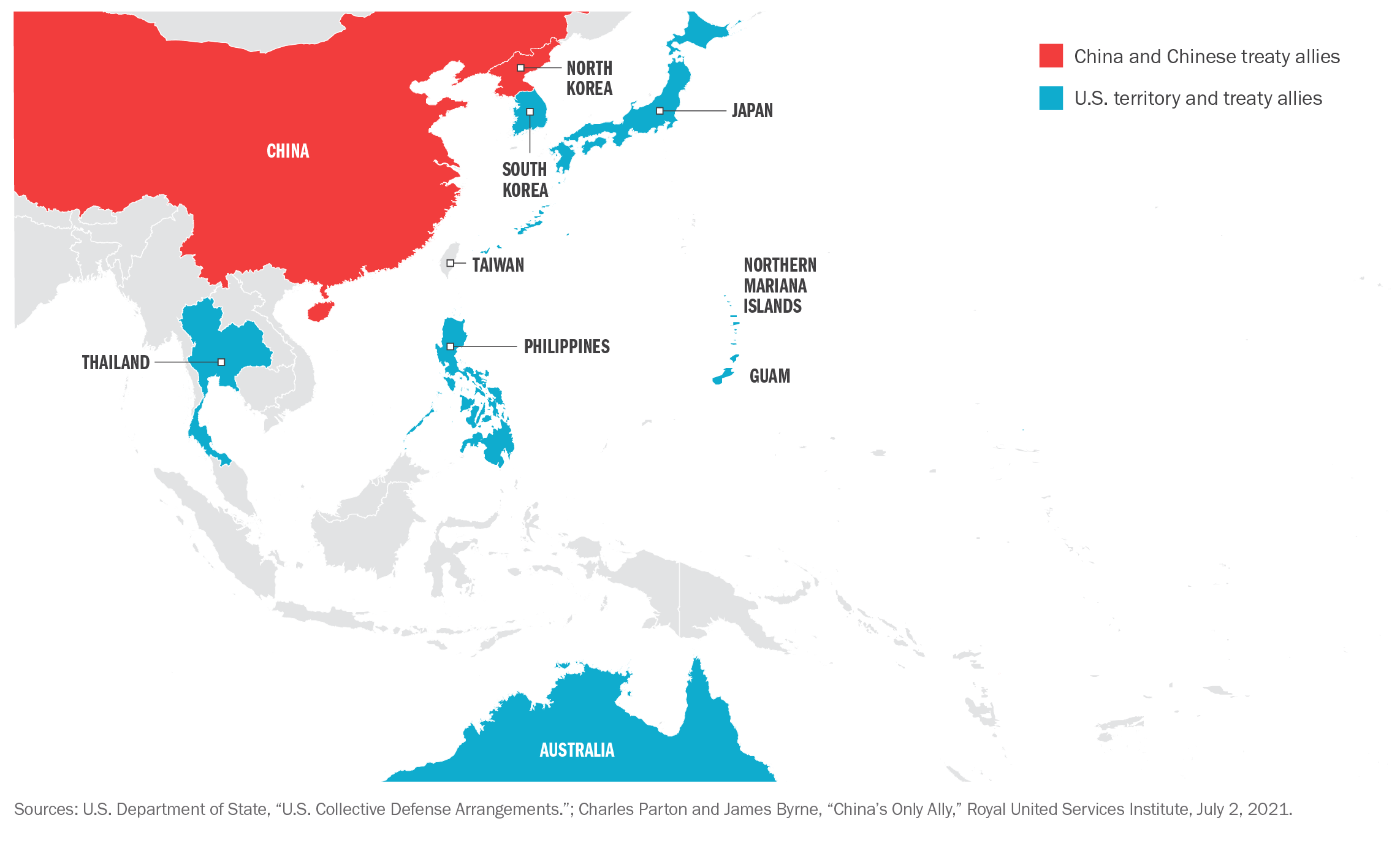
The geopolitical equilibrium of the Indo-Pacific is facing a critical stress test as a fundamental disagreement emerges between Washington and its Southeast Asian partners. At the heart of this friction is a growing tension over “burden-sharing,” where the United States is increasingly demanding that its regional allies shoulder a larger portion of the financial and logistical costs of maintaining security in the face of China’s ascent. This shift in American strategy has triggered a sophisticated diplomatic pushback from Southeast Asian nations, who find themselves caught between the desire for a US security umbrella and the necessity of maintaining economic ties with Beijing.
The discourse surrounding S-E Asia’s diplomatic pushback against US defence spending calls – The Straits Times reflects a broader systemic clash: the US view of security as a transactional partnership versus the ASEAN view of security as a delicate balance of neutrality and regional autonomy. As the US signals that its commitment to the region remains steadfast but comes with a steeper price tag, Southeast Asian capitals are questioning whether such demands ignore the local economic realities and the risk of escalating regional tensions.
The Transactional Turn: Washington’s New Security Mandate
For decades, the US presence in Asia was viewed as a public quality—a stabilizing force that allowed regional economies to flourish without the need for massive internal military expenditures. However, the arrival of a more transactional approach to foreign policy, epitomized by recent directives from US War Secretary Pete Hegseth, has altered this dynamic. The current US administration is operating under a clear premise: the era of the “security free-rider” is over.
Secretary Hegseth has been vocal about the expectation that allies must boost their own defense budgets to demonstrate commitment and capability. From the US perspective, this is not an abandonment of the region, but rather a call for a “mature” partnership. The argument is that for a collective defense strategy to be viable against a peer competitor like China, the partners must be capable of contributing meaningful resources—not just providing basing access, but investing in high-end capabilities and sustainable logistics.
“The United States is not turning its back on its allies in Asia, but the nature of the partnership must evolve. True security is a shared responsibility, and that requires a tangible investment in defense capabilities from every partner involved.”
The Core Demands of the US Strategy
- Increased GDP Percentage: Pushing allies to move closer to a standardized percentage of GDP spent on defense.
- Modernization of Hardware: Encouraging the purchase of advanced US-made weaponry to ensure interoperability.
- Logistical Self-Sufficiency: Expecting partners to manage their own sustainment and maintenance during prolonged crises.
- Strategic Alignment: Linking defense spending to a clearer geopolitical alignment against regional hegemony.
The Anatomy of Southeast Asian Pushback
The response from Southeast Asian nations has not been one of open defiance, but of calibrated diplomatic resistance. The “pushback” is rooted in three primary concerns: economic capacity, political risk, and the principle of ASEAN Centrality.
Economic Constraints and Domestic Priorities
For many nations in Southeast Asia, the call to increase defense spending is not merely a political choice but a fiscal impossibility. In the wake of global economic volatility and internal development goals, diverting billions of dollars toward military hardware is often seen as a gamble with domestic stability. Governments must balance the need for naval patrols in the South China Sea with the need for infrastructure, healthcare, and education.
The Risk of Provocation
There is a profound fear among ASEAN members that a sudden, US-mandated spike in military spending will be interpreted by Beijing as the creation of a “containment ring.” By aggressively ramping up defense budgets, these nations risk provoking the very instability they seek to avoid. The diplomatic pushback is therefore a signal to China that these countries are not merely puppets of US strategic interests, but independent actors seeking a peaceful equilibrium.
Preserving ASEAN Centrality
ASEAN Centrality—the idea that the Association of Southeast Asian Nations should be the primary driver of regional security architecture—is under threat. When the US demands specific spending increases, it implicitly asks these nations to adopt a US-led security framework. The pushback is a way of asserting that regional security should be decided in Jakarta, Bangkok, and Hanoi, rather than being dictated by a directive from Washington.
| Perspective | United States Position | Southeast Asian Position |
|---|---|---|
| Security Model | Transactional / Burden-Sharing | Balanced / Neutrality-Based |
| Spending Goal | Higher % of GDP for deterrence | Sustainable growth & internal stability |
| China Relation | Strategic Competition/Containment | Economic Partnership / Managed Friction |
| Primary Risk | Security Vacuum / “Free-Riding” | Regional Escalation / Economic Ruin |
The Shadow of Ukraine: Lessons for the Indo-Pacific
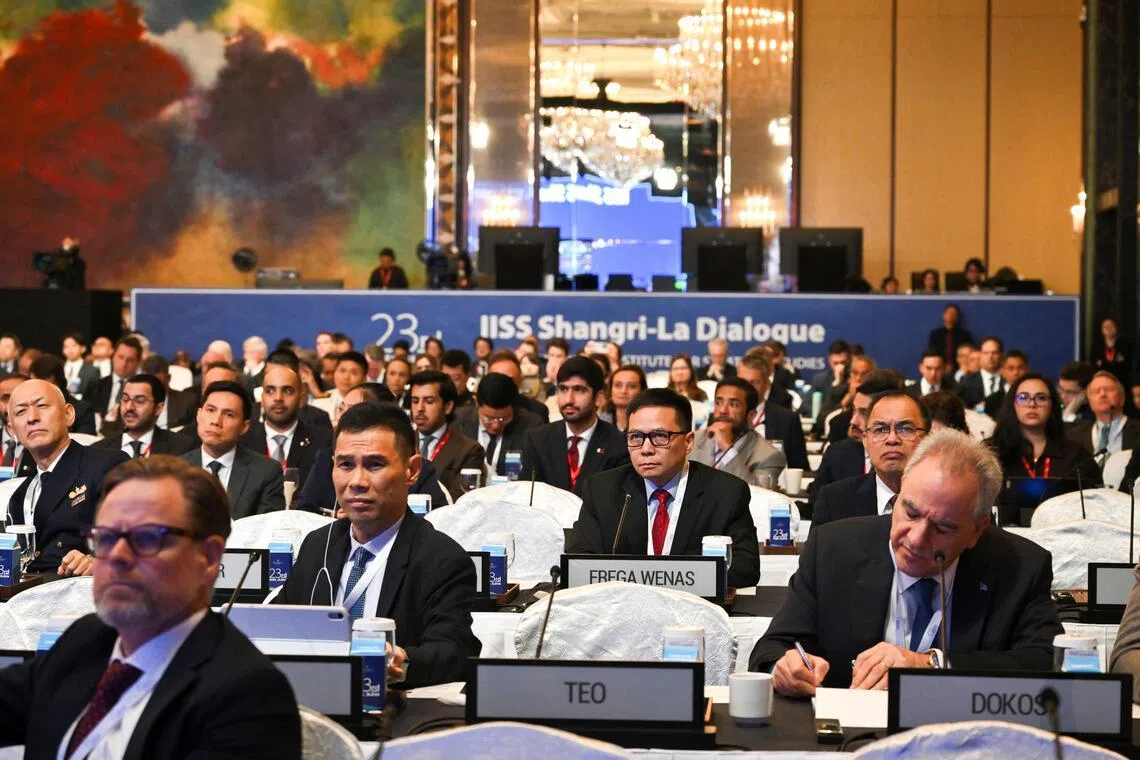
The ongoing conflict in Ukraine has served as a grim case study for defense planners at the IISS Shangri-La Dialogue and beyond. The war has highlighted a critical flaw in modern defense planning: the gap between “deterrence” and “sustainment.”
Many Southeast Asian nations have observed that high-tech weaponry is useless if the supply chain for ammunition and parts collapses under the pressure of a war of attrition. This has led to a nuanced shift in how these countries view the US calls for spending. While they resist the political demand to spend more for the sake of US strategy, they are privately recognizing the practical need to increase stockpiles and resilience.
Key Takeaways from the European Conflict:
- The Attrition Reality: Modern wars consume munitions faster than they can be produced. This makes the US demand for “boosted defense” logically sound, even if diplomatically unpopular.
- Interoperability Failures: The difficulty of integrating various Western weapon systems in Ukraine warns Asia that mismatched hardware can be a liability.
- The Role of Drones: The democratization of precision strike capabilities via low-cost drones has changed the cost-benefit analysis of defense spending.
some nations are pivoting their spending toward “asymmetric” capabilities—investing in drones and missile systems rather than expensive platforms like aircraft carriers, which may not be sustainable or appropriate for their specific geography.
The China Factor: The Silent Participant
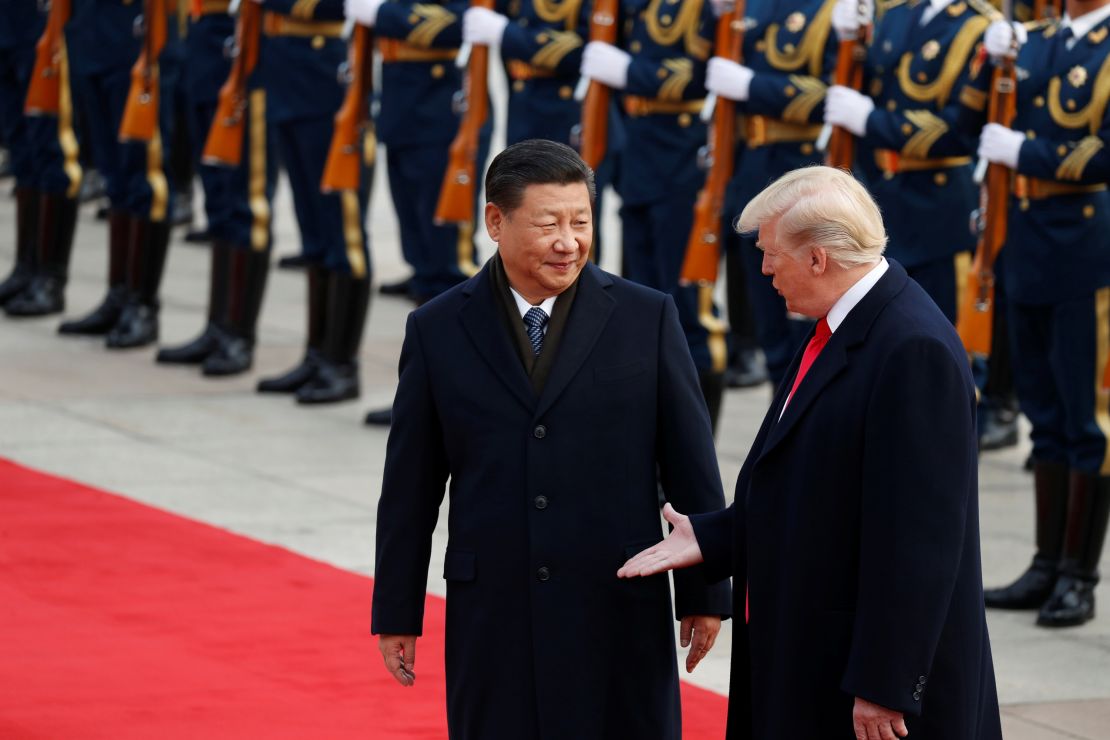
A recurring theme in regional defense forums is the question: “Where is China?” The absence or perceived distance of Chinese leadership at certain key dialogues often heightens the tension. When the US pushes for higher spending, it does so in the context of China’s rapid naval expansion and assertive claims in the South China Sea.
However, the diplomatic pushback from SE Asia is also a message to China. By resisting the US mandate, ASEAN states are attempting to signal that they are not choosing sides. They seek a “third way”—one where they can benefit from US security guarantees without becoming an outpost for US aggression, and engage in Chinese trade without becoming vassals to Beijing’s political will.
The complexity lies in the fact that China’s own “Belt and Road Initiative” has created deep economic dependencies. For a nation like Cambodia or Laos, increasing defense spending at the behest of the US could lead to immediate economic retaliation from China, making the US demands not just difficult, but dangerous.
Strategic Implications and Long-Term Outlook
The current friction over defense spending is a symptom of a larger transition in the global order. The “hub-and-spoke” model of US alliances, where Washington was the central hub providing security to the spokes, is evolving into a “networked” model. In this new system, the US expects the spokes to connect with each other and support their own weight.
If the US continues to press for spending increases without offering corresponding diplomatic flexibility, it risks alienating the very partners it needs to maintain a presence in Asia. Conversely, if Southeast Asian nations refuse to modernize their defenses, they may find themselves unable to protect their sovereign waters, eventually forcing them into a dependency on China by default.
Potential Scenarios for the Near Future
- The Compromise: The US shifts from demanding “spending percentages” to supporting “capability-based” upgrades, providing grants or low-interest loans for specific technologies.
- The Fragmentation: A split emerges within ASEAN, with “frontline states” (like the Philippines) ramping up spending and alignment, while “neutralist states” (like Indonesia) double down on non-alignment.
- The Pivot: A significant shift where SE Asian nations move toward indigenous defense production to avoid being beholden to either the US or Chinese military-industrial complexes.
The discourse surrounding S-E Asia’s diplomatic pushback against US defence spending calls – The Straits Times underscores that security in the 21st century is no longer just about the number of missiles or ships; This proves about the political will to sustain those assets without compromising national sovereignty.
Frequently Asked Questions
Why is the US asking Southeast Asian countries to spend more on defense?
The US is pursuing a “burden-sharing” strategy. Given the rise of China’s military capabilities, Washington believes that regional allies must contribute more to their own defense to ensure a sustainable and collective deterrence strategy, rather than relying solely on US resources.
Why are Southeast Asian nations pushing back against these calls?
The pushback is primarily due to economic constraints, the fear of provoking China, and a desire to maintain “ASEAN Centrality.” Many of these nations prefer a policy of neutrality to avoid being forced into a binary choice between the US and China.
How does the war in Ukraine affect defense spending in Asia?
The Ukraine conflict has demonstrated the importance of sustainment and ammunition stockpiles over mere high-tech acquisitions. This has led some Asian nations to reconsider their spending, focusing more on resilience and asymmetric warfare (like drones) rather than just prestige platforms.
Is the US abandoning its allies in Southeast Asia?
No. US officials, including Secretary Pete Hegseth, have stated that the US is not “turning back” on its allies. However, the terms of the relationship are changing from a provider-client model to a more equitable partnership based on shared costs.
What is the role of China in this spending debate?
China is the catalyst. US demands for spending are a direct response to China’s growing influence. At the same time, Southeast Asian nations fear that increasing their military budgets will be seen by China as a hostile act, potentially damaging their vital economic ties with Beijing.
For those interested in how these dynamics affect specific trade routes, a related explainer on South China Sea maritime law may provide further context on why these defense upgrades are being sought in the first place.
