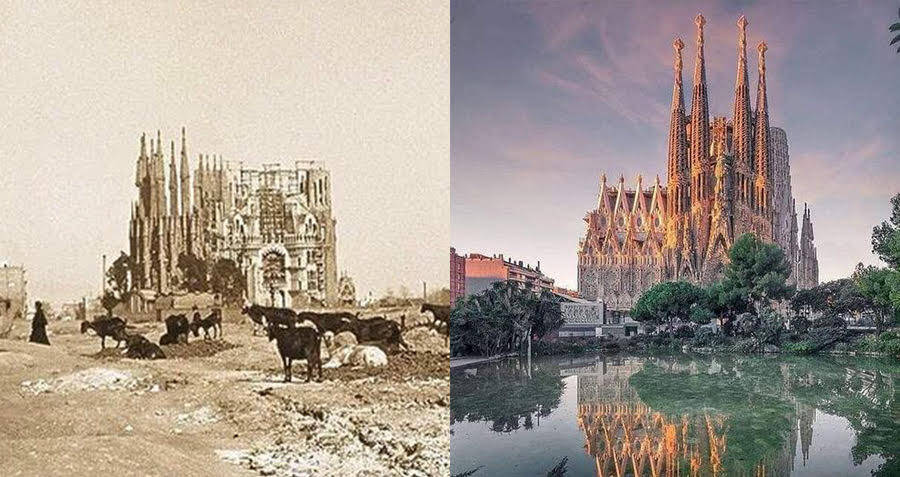
The architectural evolution of the Sagrada Família remains one of the most enduring cultural narratives in modern history, blending spiritual ambition with a singular artistic vision. From its early stages in 1905 to its projected state in 2026, the basilica has transformed from a visionary blueprint into a global icon of design.
A Century of Transformation
The progression of Antoni Gaudí’s masterpiece is often viewed through the lens of its dramatic visual shift over more than a century. Reports highlighting the temple’s “before and after” state illustrate a trajectory that began in 1905, evolving through decades of meticulous construction to reach its current form as it approaches 2026.
The Philosophy of Natural Design
Central to the basilica’s allure is the unique methodology of its creator. Antoni Gaudí is recognized as an architect who drew his primary inspiration from the natural world, integrating organic forms and structures that mimic nature into the stone and glass of the temple. This approach has turned the building into more than just a place of worship, framing it as a study of how nature can inform human engineering.
Faith, Beauty, and Urban Impact
Beyond the structural engineering, the basilica represents a complex intersection of beauty and faith. This spiritual objective has not only defined the interior of the temple but has also shaped the identity of the surrounding neighborhood. The area encircling the icon has evolved in tandem with the building, creating a unique urban ecosystem centered around Gaudí’s work.
The Path to Completion
Despite the progress made over the last 120 years, the project continues to be a work in progress. The perspective of industry experts emphasizes that while the finish line is in sight, the journey is not yet over.
The Sagrada Família: there is still more to do, but it will be finished.
Oscar Tusquets
