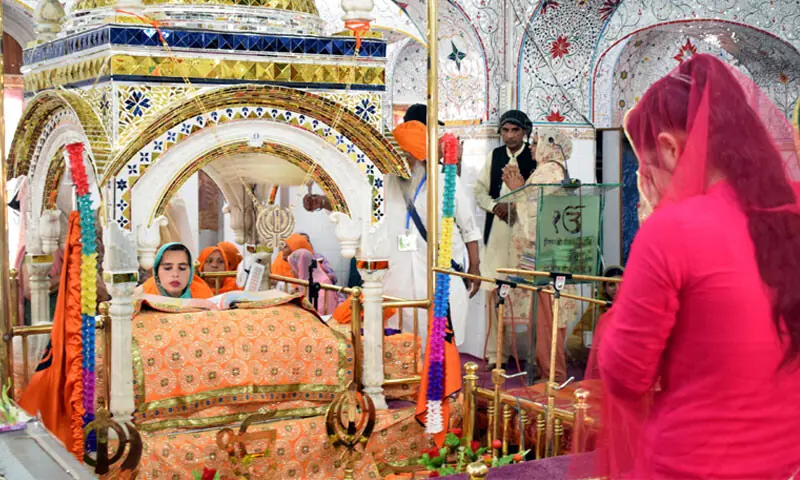
Sikh Pilgrims Offer Rituals at Gurdwara Panja Sahib for Guru Arjan Dev Ji’s Martyrdom Anniversary
Sikh pilgrims performed religious rituals at Gurdwara Panja Sahib to commemorate the martyrdom anniversary of Guru Arjan Dev Ji, according to reports from Dawn and The Nation. These observances occurred amid a complex diplomatic landscape involving visa clearances and calls for expanded corridor access between India and Pakistan.
What happened at Gurdwara Panja Sahib?
Pilgrims gathered at Gurdwara Panja Sahib to observe the martyrdom anniversary of Guru Arjan Dev Ji, the fifth Sikh Guru. According to Dawn, the devotees participated in traditional rituals to honor the Guru’s sacrifice. The Nation reported that religious observances continued at the shrine, which remains a central site for Sikh faith and history in Pakistan.
The anniversary marks a significant event in Sikhism, focusing on the themes of sacrifice and steadfastness in faith. At Panja Sahib, these rituals typically include the reading of the Guru Granth Sahib, the singing of hymns (Kirtan), and the distribution of community meals (Langar). The shrine is specifically revered for the “Panja” (handprint) of the Guru, which is believed to be imprinted on a rock at the site.
Why did the SGPC jatha enter Pakistan after 14 years?
The Indian Express reports that a deadlock was broken, allowing a jatha (group) from the Shiromani Gurdwara Parbandhak Committee (SGPC) to travel to Pakistan. This development is notable because such a delegation had not made the trip in 14 years.
The SGPC is the primary body managing Sikh shrines in India and maintains a deep interest in the upkeep and accessibility of Gurdwaras located in Pakistan. The resolution of this long-standing deadlock suggests a shift in the administrative or diplomatic coordination required for official religious delegations to cross the border.
Key points regarding the SGPC jatha include:
- Duration of Absence: The 14-year gap highlights the previous diplomatic friction hindering official religious visits.
- Organizational Role: The SGPC’s presence is often tied to the management and oversight of historical Sikh sites.
- Significance: The arrival of the jatha is viewed by many as a step toward normalizing religious exchange between the two nations.
Why were Haryana pilgrims turned back at the Wagah border?
Despite the successful entry of the SGPC jatha, other pilgrims faced significant hurdles. ETV Bharat reported that 94 Sikh pilgrims from Haryana were forced to return from the Wagah border. The reason cited for this reversal was a failure in the clearance process.

The incident underscores the volatility of visa and security clearances for individual pilgrims compared to official delegations. While the SGPC jatha moved forward, the Haryana group lacked the necessary documentation or government approvals to enter Pakistan, leaving them stranded at the border crossing.
The contrast between the SGPC jatha’s entry and the rejection of the Haryana pilgrims illustrates the disparity between official institutional clearances and individual visa approvals.
How is the Kartarpur Corridor being discussed?
In response to the difficulties faced by pilgrims, the Jathedar (head) of the Akal Takht has urged the governments of India and Pakistan to fully open and optimize the Kartarpur Corridor, according to The Times of India.
The Kartarpur Corridor serves as a visa-free passage for Indian pilgrims to visit Gurdwara Darbar Sahib in Pakistan. The Jathedar’s appeal emphasizes that a more robust and open corridor would eliminate the reliance on the unpredictable visa clearance process that led to the Haryana pilgrims’ failure at the Wagah border.
The current status of pilgrimage access can be summarized in the following table:
| Group Type | Entry Status | Primary Requirement | Outcome/Issue |
|---|---|---|---|
| SGPC Jatha | Successful | Official Institutional Clearance | Entered after 14-year deadlock |
| Haryana Pilgrims | Rejected | Individual Visa/Clearance | Returned from Wagah Border |
| Kartarpur Visitors | Facilitated | Corridor Permit (Visa-free) | Ongoing push for expansion |
The historical significance of Guru Arjan Dev Ji’s martyrdom
To understand why the rituals at Gurdwara Panja Sahib are of such high importance, one must look at the history of Guru Arjan Dev Ji. As the fifth Guru of the Sikhs, he compiled the Adi Granth, the primary scripture of Sikhism, and constructed the Harmandir Sahib (Golden Temple) in Amritsar.
His martyrdom is a cornerstone of Sikh identity. He was executed under the orders of Mughal Emperor Jahangir, making him the first Sikh martyr. This event is viewed not as a defeat, but as a testament to the faith’s commitment to truth and justice regardless of the cost. The anniversary of this event draws thousands of devotees to shrines across the globe, particularly those in the Punjab region of both India and Pakistan.
For those seeking more context, a related explainer on Sikhism history may provide further insight into the lineage of the Gurus.
Comparing reports on pilgrimage access
There is a distinct difference in how the various news outlets framed these events. Reports from Dawn and The Nation focused on the spiritual and ritualistic aspects of the observances at Gurdwara Panja Sahib, emphasizing the continuity of faith within Pakistan.
Conversely, The Indian Express and ETV Bharat highlighted the bureaucratic and political frictions. While one outlet reported a “breakthrough” with the SGPC jatha, the other reported a “failure” with the Haryana group. This contrast reveals a fragmented system where religious access is not uniform but depends heavily on the status of the traveler—whether they are part of an official body or an independent group of devotees.
The Times of India bridged these two narratives by reporting the Jathedar’s call for a systemic solution via the Kartarpur Corridor, suggesting that the only way to avoid the “clearance failures” mentioned by ETV Bharat is to remove the visa requirement entirely for religious sites.
Common misconceptions about Sikh pilgrimage to Pakistan
- Misconception: All Sikh shrines in Pakistan are accessible via the Kartarpur Corridor.
Fact: The corridor only leads to Gurdwara Darbar Sahib. Other shrines, like Gurdwara Panja Sahib, still require traditional visas and security clearances. - Misconception: Visa processes for religious pilgrims are streamlined.
Fact: As seen with the 94 pilgrims from Haryana, clearance failures are still common and can result in immediate deportation from the border. - Misconception: The SGPC has constant access to Pakistani shrines.
Fact: The Indian Express reports a 14-year gap before the recent jatha was allowed entry, indicating significant intermittent restrictions.
The friction at the Wagah border remains a critical point of failure for many devotees. For those traveling to sites outside the Kartarpur zone, the process involves rigorous background checks and coordination between the Indian and Pakistani ministries of foreign affairs. When these communications break down, pilgrims are often the first to suffer the consequences.
For a broader view of regional tensions, see a related explainer on India-Pakistan diplomatic relations.
Frequently Asked Questions
Where is Gurdwara Panja Sahib located?
Gurdwara Panja Sahib is located in the Hassan Abdal region of Punjab, Pakistan. It is one of the most significant Sikh shrines in the country, known for the handprint of Guru Nanak Dev Ji and visited during the anniversaries of various Gurus, including Guru Arjan Dev Ji.

Who is the SGPC?
The Shiromani Gurdwara Parbandhak Committee (SGPC) is the representative body of the worldwide Sikh community. It is responsible for the management of historical Gurdwaras in India and often coordinates with the Pakistani government regarding the maintenance of Sikh sites in Pakistan.
What is the difference between a visa and the Kartarpur Corridor permit?
A visa is a legal document issued by a government allowing a foreign national to enter a country for a specific period and purpose. The Kartarpur Corridor permit is a specialized, visa-free travel document that allows Indian citizens to visit one specific shrine in Pakistan without needing a full visa, though it is limited to that specific location.
Why is Guru Arjan Dev Ji’s martyrdom anniversary significant?
The anniversary commemorates the sacrifice of the fifth Sikh Guru, who was executed for his faith. It serves as a day of reflection on courage, sacrifice, and the struggle against oppression, drawing pilgrims to historical sites associated with the Gurus.
Why were the Haryana pilgrims turned back?
According to ETV Bharat, 94 pilgrims from Haryana were forced to return from the Wagah border due to a failure in the clearance process, meaning they did not have the necessary government approvals required for entry into Pakistan.
