Funguy project uses AI and lasers to control fungal growth patterns
The Funguy project uses an AI-driven system and laser-based containment to control fungal growth for bio-art. This approach allows users to direct biological patterns using consumer-grade hardware.
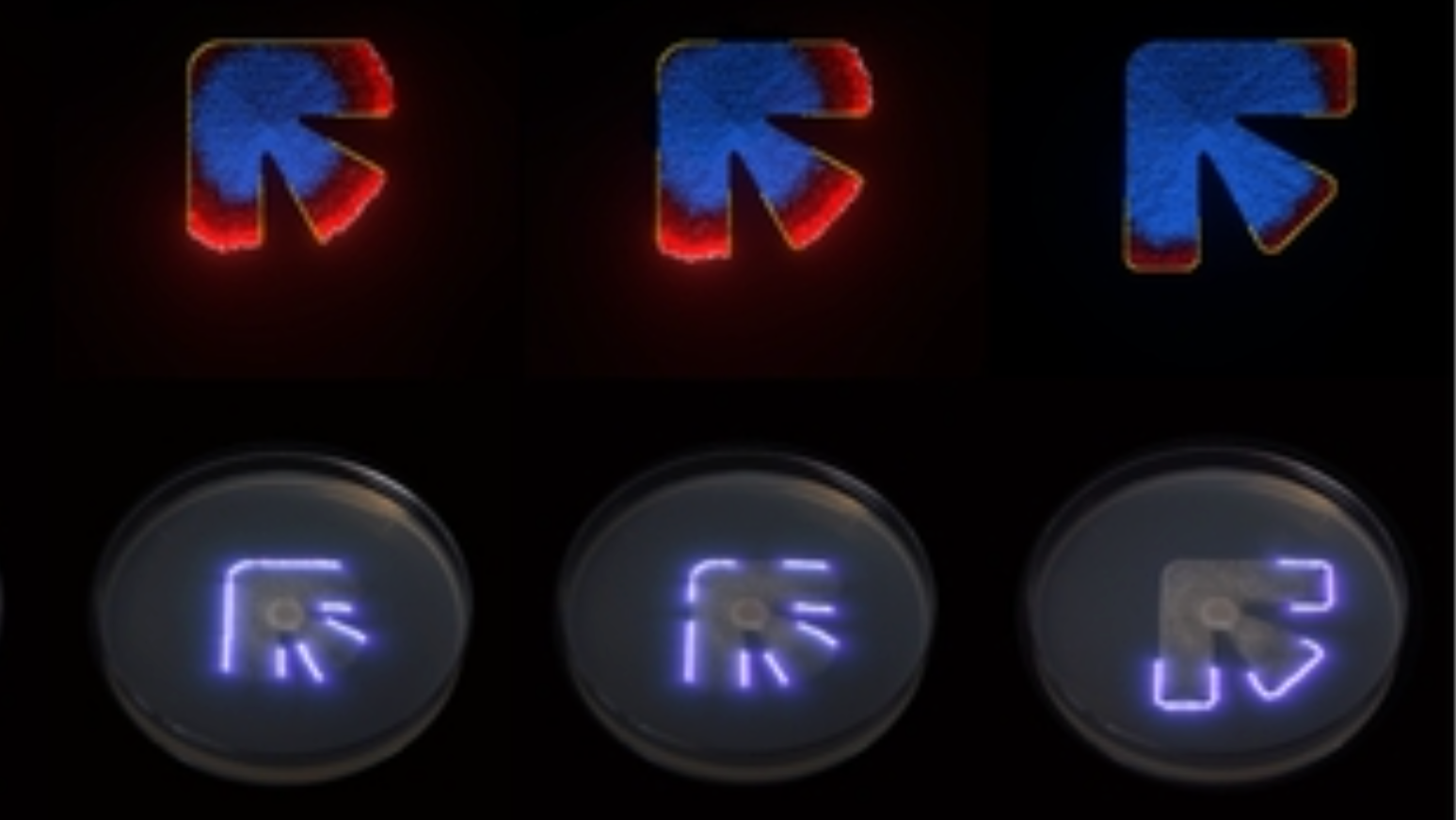
The Funguy project has established a new technological framework to direct the physical growth patterns of fungi. By combining artificial intelligence with laser-based containment, the system transitions fungi from passive laboratory subjects into an active, "printed" medium for biological art. This approach addresses a long-standing challenge in Bio-Art: the complexity of predicting and controlling biological development without requiring deep expertise in computer programming.
The system treats fungal spread as a two-dimensional graphic time-series generation problem. It employs a pipeline that begins with an image segmentation model, specifically the Efficient-ViT (E-ViT) model, which was fine-tuned to handle blurred edges of fungal contours. This visual data informs a specialized Temporal Convolutional Network (TCN). The TCN processes sequential images to predict growth patterns, which then acts as a training supervisor for a neural network-driven cellular automaton. In this architecture, each individual cell operates its own small neural network, allowing the system to learn and replicate the complex, adaptive behaviors of various species, such as Rhizopus oligosporus, Phanerochaete velutina, Physarum polycephalum, and Aspergillus niger.
Related media
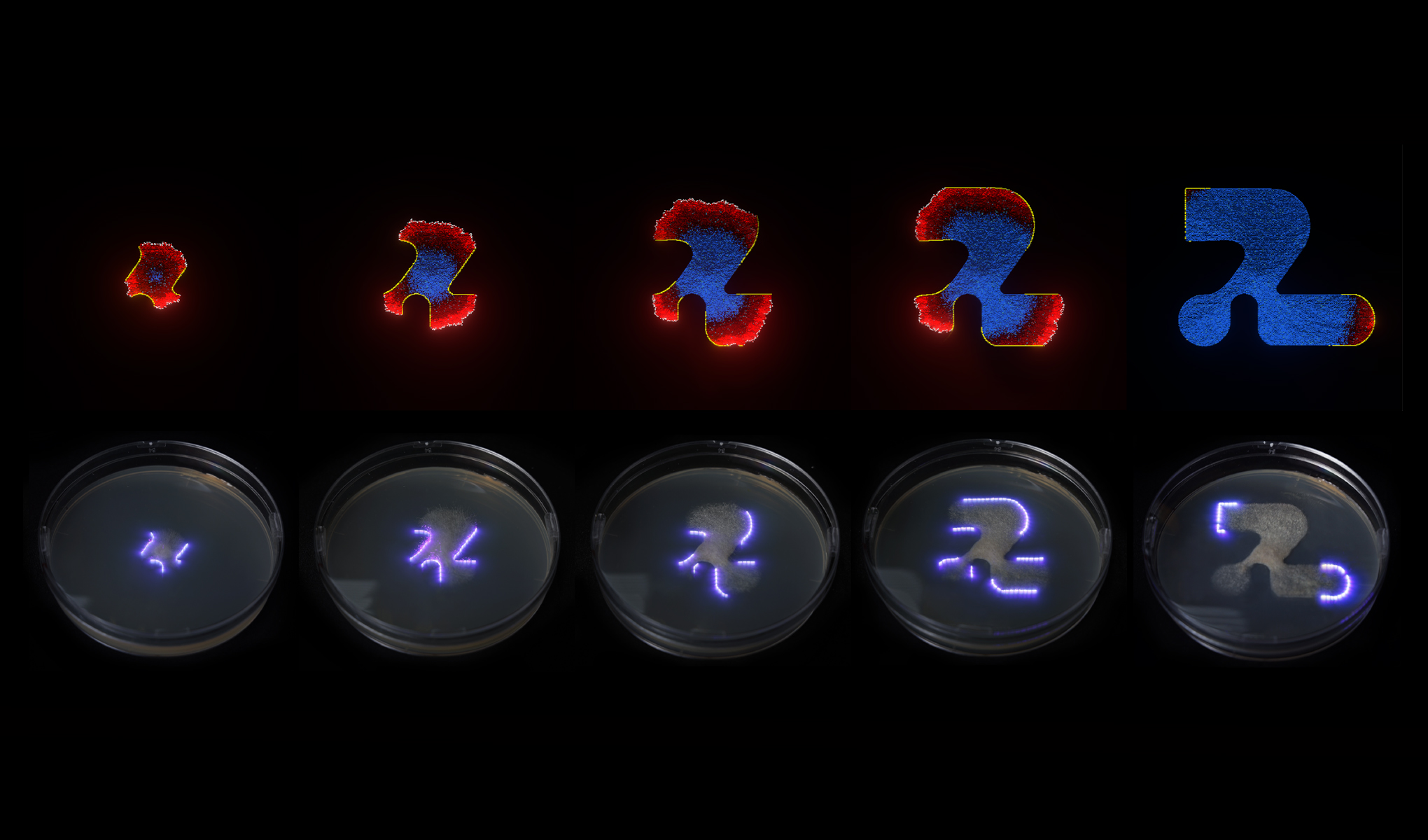
To move from virtual simulation to physical reality, the project integrates a laser system, with an XY-kinematic system seemingly built from a DVD drive frame. Because the chosen fungi are photophobic, they naturally avoid intense light. The system traces the perimeter of a desired design with a laser, creating dynamic boundaries that the fungus refuses to cross. Through empirical testing, researchers identified that a 405 nm laser operating at 20 mW provided the most effective containment. By synchronizing the laser output with the cellular automaton’s predictions, the device automatically updates its boundaries to match the fungal growth stage. This allows the laser to focus only on active, nutrient-rich regions, optimizing energy efficiency.
Fungal Growth Control Comparison
| Method | Mechanism | Primary Control Factor |
|---|---|---|
| Optical Tweezers | Microscopic manipulation | Individual hyphae guidance |
| Chemical Attractants | Nutrient gradients | Attraction-based behavioral shifts |
| Dynamic Laser Containment | Photophobic response | Boundary-based macro-scale shaping |
The project’s architecture emphasizes low-latency performance through a custom 2D engine built on the Entity-Component-System (ECS) architecture in Rust. Performance testing on a laptop with an RTX3070 GPU demonstrated that the system maintained a refresh rate of 30Hz while simulating one million individual cells. This scalability confirms that consumer-grade hardware is sufficient for managing complex biological simulations.
This project contributes to the broader development of Bio-Art, a field that integrates biology with artistic expression to spark inquiries into aesthetics, ethics, and social issues. While previous artistic attempts to use fungal morphology required deep theoretical knowledge of biology or complex programming, the Funguy project allows for a "zero-coding" experience. Artists can simply provide a video of fungal spread to train the model.
Looking ahead, the project suggests a trajectory toward diverse functional applications beyond the aesthetic. The ability to dictate fungal morphology through software may eventually support the production of flexible circuit boards, sustainable food design, or the construction of biological structures in environments such as outer space. As research continues to refine these AI-driven pipelines, the line between traditional manufacturing and biological cultivation continues to blur, positioning the fungus itself as a medium for both art and engineering.
Archypedia is dedicated to independent, evidence-backed reporting. This briefing was synthesized from primary source reporting, corroborated across independent newsrooms, and verified against our Editorial Standards.
Transparency record
Evidence behind this report
This report synthesizes 7 distinct sources. Open the source ledger below to compare the underlying coverage.
Prepared under the Archypedia Editorial Policy by the Niko Vale editorial desk profile. AI-assisted tools may support drafting and verification; public accountability remains with Archypedia. Report an error.