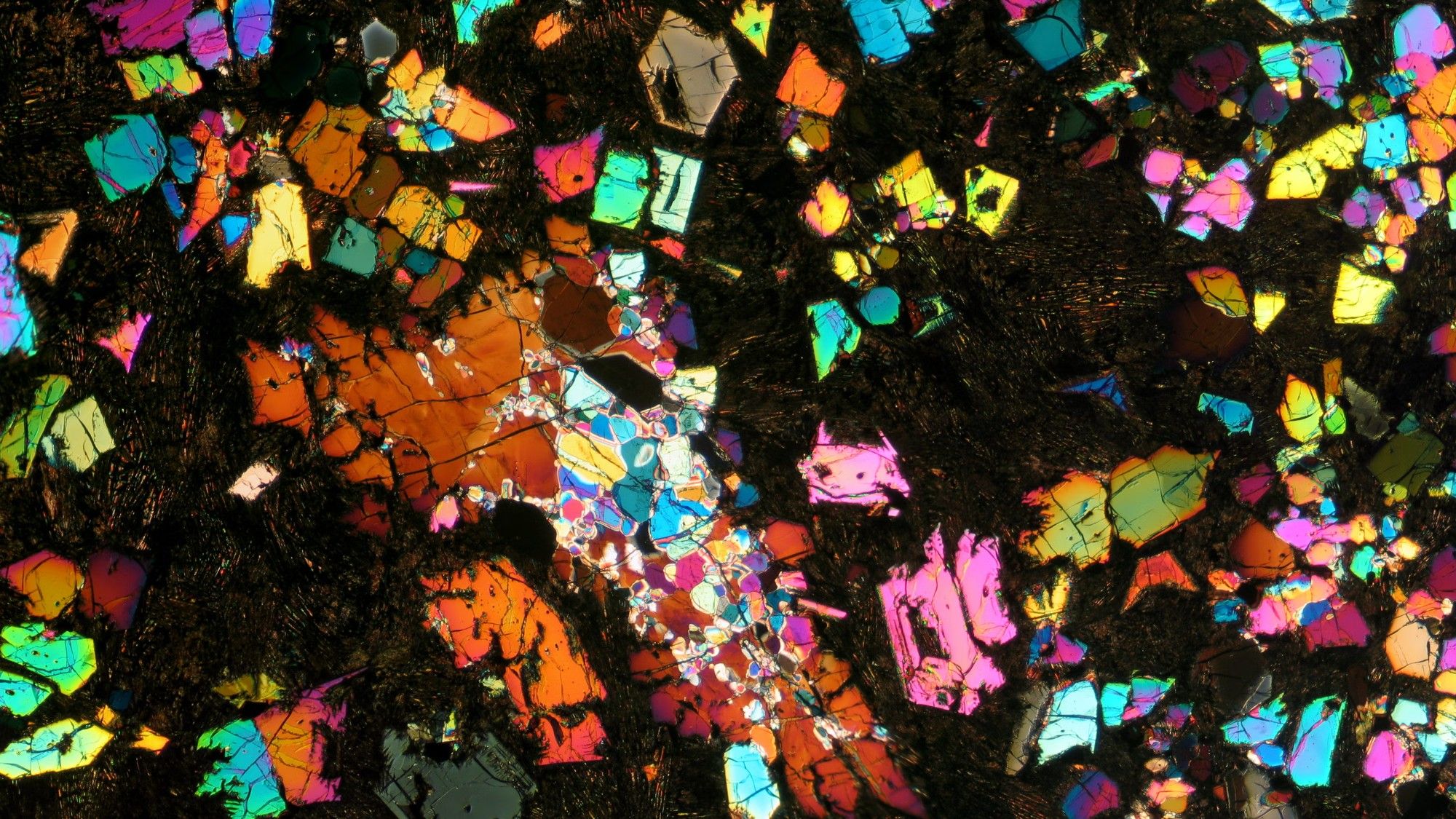
Meteorite Found in Sahara Desert May Be 1st Evidence of Lost Solar System World – Space
In a discovery that challenges our fundamental understanding of the early solar system, a rare meteorite recovered from the arid expanses of the Sahara Desert has provided scientists with a tantalizing clue: the existence of a “lost world.” This celestial fragment, an ancient piece of cosmic debris, suggests that a giant planet—one that does not exist in our current planetary inventory—may have once orbited the Sun before being violently ejected or destroyed billions of years ago.
The implications of this find are profound. For decades, astronomers have modeled the evolution of our solar system as a relatively stable progression from a cloud of gas and dust to the eight planets we recognize today. However, the chemical signature of this specific meteorite suggests a history of chaos, planetary collisions, and the existence of a massive protoplanet that acted as a gravitational wrecking ball in the early stages of our neighborhood’s development.
The Sahara Discovery: A Cosmic Time Capsule
The Sahara Desert has long been a premier location for meteorite hunting. Its vast, open landscapes and light-colored sands make the dark, fusion-crusted surfaces of fallen space rocks remarkably easy to spot. Yet, the object recovered in this instance is far from ordinary. While most meteorites are categorized as chondrites (stony) or irons, this specimen exhibits a mineralogical composition that does not align with any known planetary body in our solar system, including Mars, the Moon, or the asteroid belt.
Initial analysis reveals that the meteorite contains isotopic ratios—specifically involving oxygen and chromium—that are “alien” to the current planetary distribution. In the realm of planetary science, isotopes act as a chemical fingerprint. Every region of the early solar nebula had a distinct isotopic signature based on its distance from the Sun and the materials available during its formation.
“When we look at the isotopic makeup of this rock, we aren’t seeing a variation of Earth or Mars. We are seeing a signature that suggests a massive body formed in a region of the solar system that is now empty. It is, for all intents and purposes, a piece of a ghost planet.”
Key Characteristics of the Rare Meteorite
- Anomalous Isotopic Ratios: Oxygen and chromium levels that differ significantly from Earth and known asteroids.
- High-Pressure Mineral Phases: The presence of minerals that only form under the extreme pressures found in the cores of giant planets.
- Ancient Age: Dating back to the very dawn of the solar system, approximately 4.5 billion years ago.
- Fragmentary Nature: Evidence of a catastrophic impact event that shattered the parent body into millions of pieces.
The Theory of the Lost Giant: What Happened to the Planet?
The existence of a “lost world” is not merely a speculative leap; it is a hypothesis supported by the dynamics of orbital mechanics. In the early stages of the solar system, the environment was far more crowded and volatile than it is now. Dozens of “planetesimals”—the building blocks of planets—competed for mass and orbital space.
Astrophysicists suggest that this lost planet may have been a “Super-Earth” or a “Mini-Neptune,” a class of planet common in other star systems but mysteriously absent from our own. The theory posits that this giant planet formed in the region between Mars and Jupiter or perhaps further out, beyond Neptune.
The Mechanism of Ejection
How does a planet simply vanish? The most likely culprit is gravitational instability. In a young solar system, the migration of gas giants like Jupiter and Saturn can create gravitational resonance. If the lost planet drifted too close to Jupiter, the massive gravity of the “King of Planets” could have acted as a slingshot, accelerating the smaller body to escape velocity and flinging it into the interstellar void.

Alternatively, the planet may have been the victim of a colossal collision. A “giant impact” between two protoplanets could have pulverized the body, leaving behind a debris field. Over eons, most of this debris would have been swept up by other planets or ejected, but a few fragments—like the one found in the Sahara—survived to eventually fall to Earth.
| Scenario | Mechanism | Likely Outcome | Evidence in Meteorite |
|---|---|---|---|
| Gravitational Ejection | Interaction with Jupiter/Saturn | Planet becomes a rogue planet in interstellar space | Pristine isotopic signatures from a distant region |
| Catastrophic Collision | Impact with another protoplanet | Planet shattered into asteroids/meteoroids | Shock-metamorphosed minerals and fragmentation |
| Solar Absorption | Orbital decay due to gas drag | Planet consumed by the Sun | Less likely to produce surviving meteorites on Earth |
Decoding the Chemical Fingerprint
To understand why this meteorite is considered evidence of a lost world, one must delve into the chemistry of the early solar nebula. The solar system began as a rotating disk of gas and dust. Because the Sun’s heat varied depending on the distance from the center, different materials condensed at different temperatures—a concept known as the “frost line.”
Materials inside the frost line were primarily rocky and metallic, while materials outside were rich in volatiles and ices. The meteorite found in the Sahara possesses a blend of characteristics that suggests it formed in a transitional zone that no longer hosts a major planetary body.
The Role of Nucleosynthesis
The specific isotopes of chromium and titanium found in the rock are markers of the stellar environment from which our solar system formed. The fact that this meteorite’s signature deviates from the “terrestrial” and “carbonaceous” reservoirs suggests it originated from a distinct reservoir of material. This implies the parent body was large enough to have its own distinct chemical evolution, separated from the materials that formed Earth and Mars.
For those interested in how these materials are categorized, a related explainer on isotopic analysis in planetary science provides a deeper dive into the laboratory techniques used to date these objects.
The Chaos of the Early Solar System
This discovery lends weight to the “Nice Model” and the “Grand Tack” hypothesis, which suggest that the giant planets did not form where they are now. Instead, they migrated inward and outward in a violent dance that reshaped the solar system.
The Grand Tack Hypothesis
The Grand Tack suggests that Jupiter migrated inward toward the Sun, potentially clearing out much of the material in the inner solar system, before being pulled back out by Saturn. This movement would have been devastating for any smaller protoplanets in its path. The “lost world” may have been one of the casualties of Jupiter’s migration, either crushed or flung away.
The Late Heavy Bombardment
The presence of such meteorites also connects to the Late Heavy Bombardment (LHB), a period roughly 4.1 to 3.8 billion years ago when the inner solar system was pelted by an unprecedented number of asteroids. If a giant planet had been shattered or its orbit destabilized, the resulting debris would have contributed to this cosmic rain of fire, potentially delivering water and organic molecules to the young Earth.

Why the Sahara is a Scientific Goldmine
It is no coincidence that this evidence was found in the Sahara. The desert’s unique geology makes it a natural “collector” for the cosmos. To understand the significance of the location, we must look at the intersection of geology and astronomy.
- Visual Contrast: The pale, sandy terrain makes dark-colored meteorites stand out, allowing hunters to find specimens that would be invisible in a forest or grassland.
- Aridity: Water is the enemy of meteorite preservation. In humid environments, the iron and minerals in a meteorite oxidize (rust) and degrade quickly. The extreme dryness of the Sahara preserves the chemical integrity of the rock for thousands of years.
- Wind Erosion: Constant wind strips away overlying sediment, “cleaning” the meteorites and exposing them on the surface.
However, the discovery is also a race against time. As meteorites are exposed to the elements, they undergo “terrestrial weathering.” The faster a specimen is found and sealed in a laboratory, the more accurate the isotopic data remains.
Common Misconceptions About “Lost Planets”
When headlines mention a “lost world,” it often sparks a variety of misconceptions. It is important to clarify what this discovery does and does not mean.
Is this “Planet Nine”?
No. Planet Nine is a theoretical planet that astronomers believe is currently orbiting far beyond Neptune, based on the gravitational anomalies of Kuiper Belt objects. The “lost world” suggested by the Sahara meteorite is a former inhabitant of the solar system—a body that existed billions of years ago but is no longer here.
Was it an alien civilization?
There is no evidence of artificial structures or technological signatures in the meteorite. When scientists refer to a “world,” they mean a planetary-mass object—a sphere of rock, metal, or gas. The interest is in the geological and astrophysical history of the solar system, not biological life.
Could the planet come back?
If the planet was ejected into interstellar space, the odds of it returning are infinitesimal. The gravitational pull of the galaxy is far stronger than the pull of our Sun once an object reaches escape velocity. If the planet was destroyed, it exists now only as a scattered belt of asteroids and the occasional meteorite falling to Earth.
Broader Implications for Astronomy and Planetary Science
The confirmation of a lost giant planet would force a rewrite of textbooks regarding the “architecture” of our solar system. If our system once had a Super-Earth, it means that the “missing” class of planets—those between the size of Earth and Neptune—was not always missing. This suggests that our solar system is more typical of the galaxy than we previously thought, as Super-Earths are the most common planets found around other stars.
Impact on the Search for Life
The destruction or ejection of a giant planet would have sent massive amounts of material flying toward the inner solar system. This “cross-contamination” is vital for the theory of panspermia—the idea that the building blocks of life (amino acids, water, organic compounds) were delivered to Earth via impacts from other worlds.
If the lost planet was rich in water or organics, its demise may have been the very event that made Earth habitable. In a poetic twist, the destruction of one world may have provided the ingredients for the rise of life on another.
Future Research and the Path Forward
The Sahara meteorite is the starting point, not the end. To confirm the “lost world” theory, researchers will now look for “sister” meteorites—other fragments with the same anomalous isotopic signature. If multiple meteorites from different fall sites all point to the same alien origin, the evidence becomes undeniable.
space agencies may adjust their mission targets. Instead of focusing solely on the main asteroid belt, there may be a renewed interest in searching for “remnant” debris in the outer reaches of the solar system or analyzing the composition of the Trojan asteroids that share Jupiter’s orbit.
Scientists are also utilizing advanced computer simulations to “rewind” the solar system. By plugging the chemical data from the Sahara meteorite into orbital models, they can attempt to calculate exactly where the lost planet formed and the precise moment it was ejected.
Summary of the Discovery’s Significance
- Challenges Stability: Proves the early solar system was far more chaotic than previously modeled.
- Fills a Gap: Explains why our solar system lacks the “Super-Earths” common in other star systems.
- Chemical Evidence: Uses isotopic “fingerprints” to prove the existence of a body that no longer exists.
- Earth’s History: Links the demise of a distant world to the potential delivery of life-essential materials to Earth.
Frequently Asked Questions
What exactly makes this meteorite “rare”?
Most meteorites are chemically similar to the asteroids in our solar system. This specific meteorite has an isotopic composition—specifically in its oxygen and chromium levels—that doesn’t match any known planet or asteroid, suggesting it came from a massive body that is no longer present in our solar system.

How do scientists know it’s from a “lost planet” and not another star system?
While it is possible for “interstellar objects” (like ‘Oumuamua) to enter our system, the specific chemical signatures of this meteorite still align closely enough with the solar nebula’s general composition to suggest it formed within our solar system, but in a region or on a body that has since vanished.
Where in the Sahara was the meteorite found?
While specific coordinates are often kept private to prevent unregulated “treasure hunting” that can damage scientific sites, these finds typically occur in the hyper-arid regions of North Africa, where the lack of vegetation and moisture preserves the rocks.
Could there be more than one lost planet?
Yes. Many astrophysical models suggest that the early solar system may have had several protoplanets that were either absorbed by the gas giants or ejected into space. This meteorite may be the first evidence of one, but it likely isn’t the only one that existed.
Does this change how we view the “Goldilocks Zone”?
It suggests that the “Goldilocks Zone” (the habitable zone) was more dynamic in the past. A migrating giant planet could have pushed other smaller, potentially habitable worlds out of the zone, altering the course of evolutionary history in our solar system.
As we continue to analyze the fragments of the cosmos, the Sahara meteorite serves as a reminder that the history of our home is written in the stars—and sometimes, it is delivered directly to our doorstep in the form of a lonely, ancient rock.
