
Europe’s second extreme heatwave in two months: how a ‘heat dome’ is turning the continent into a furnace
A high-pressure system known as a heat dome has trapped scorching air over Europe for a second time this summer, pushing temperatures toward record levels and forcing emergency measures across the continent. Forecasts predict some regions will exceed 44°C (111°F) this week, as meteorologists warn the phenomenon—linked to climate change—is becoming more frequent and intense.
From France’s red-alert school closures to Spain’s wildfire outbreaks and Italy’s power grid strains, the heatwave is testing infrastructure, public health systems, and daily life. Experts say this is not an isolated event but part of a broader pattern where extreme heatwaves now occur with alarming regularity.
Here’s what’s happening, why it matters, and what comes next.
—
What is a heat dome, and why is it making Europe so hot?
A heat dome occurs when a high-pressure air mass settles over a region, acting like a lid that traps heat near the surface. In Europe this week, a persistent dome has blocked cooler air from moving in, allowing temperatures to climb well above seasonal norms.
According to the European Centre for Medium-Range Weather Forecasts (ECMWF), some areas in southern France, Spain, and Italy could see temperatures 10–15°C (18–27°F) above average for this time of year. The ECMWF’s global forecasting model shows the dome strengthening over the next 48 hours, with peak heat expected between July 18 and 20.
Key details:
- A heat dome typically lasts 5–10 days but can persist longer if atmospheric conditions remain stable.
- This is the second major heatwave in Europe since June, following a similar dome-driven event that caused widespread power outages and heat-related deaths.
- Climate scientists link the increasing frequency of heat domes to rising global temperatures, which make such systems more likely to form and intensify.
The current system is particularly dangerous because it coincides with Europe’s summer solstice—the longest day of the year—when solar radiation is at its peak. Meteorologists at the World Meteorological Organization (WMO) note that the combination of prolonged heat and high humidity in some regions increases the risk of heat stress and wildfires.
“We’re seeing heat domes become more persistent and more extreme,” said a WMO spokesperson. “The difference between a heatwave in the 1990s and today is like night and day.”
—
Where is the heatwave hitting hardest, and what’s the impact?
The most severe conditions are expected in:
| Region | Forecast Highs (°C) | Key Risks | Emergency Measures |
|---|---|---|---|
| Southern France (Provence, Occitanie) | 42–44°C (108–111°F) | Heat exhaustion, power grid strain | Red alerts in 12 departments; schools closed; outdoor work restricted |
| Spain (Andalusia, Madrid) | 40–43°C (104–109°F) | Wildfires, drought | Evacuations in high-risk areas; water restrictions expanded |
| Italy (Sicily, Rome) | 38–41°C (100–106°F) | Heatstroke, transport delays | Cooling centers opened; train schedules adjusted |
| Portugal (Alentejo, Lisbon) | 39–42°C (102–108°F) | Air quality deterioration | Smog alerts; mask recommendations |
| Germany & Benelux (Rhine Valley) | 35–38°C (95–100°F) | River traffic disruptions | Canal closures; cooling stations activated |
In France, where half the country faces red-level heat alerts—the highest warning—authorities have ordered schools to close in affected areas and restricted outdoor work for vulnerable populations. The French health ministry reported 1,500 heat-related deaths during the June heatwave, a figure officials say is likely to rise again this week.

Spain’s meteorological agency, AEMET, has issued wildfire warnings for 12 provinces, where dry conditions and strong winds could turn grasslands into tinder. Meanwhile, Italy’s national civil protection agency has activated emergency protocols for Rome and Sicily, where temperatures are expected to surpass 40°C (104°F) for three consecutive days—a threshold that triggers health alerts.
“This isn’t just another hot summer,” said Carlo Buontempo, director of the Copernicus Climate Change Service. “It’s a preview of what Europe will face more often if we don’t curb emissions.”
—
Why is this heatwave different from past ones?
Three factors set this event apart from earlier heatwaves:
- Speed of onset: Unlike gradual warming, this heat dome developed rapidly, giving regions little time to prepare. In June, temperatures in France jumped from 30°C (86°F) to 40°C (104°F) in 48 hours.
- Geographic spread: While past heatwaves often confined extreme heat to southern Europe, this dome is affecting northern areas like Germany and the Netherlands, where infrastructure is less adapted to high temperatures.
- Duration: The current system is expected to linger for nearly two weeks, longer than typical Mediterranean heatwaves.
Climate data from the Intergovernmental Panel on Climate Change (IPCC) shows that Europe has warmed 2.2°C (4°F) since pre-industrial times, twice the global average. This acceleration is making heatwaves more severe. “The probability of such extreme events has increased by a factor of 10 since the 1980s,” said an IPCC report released last year.
Comparing this week’s forecasts to 2003—the year of Europe’s deadliest heatwave, which killed over 70,000—reveals a stark trend. In 2003, Paris hit 38°C (100°F) for five days; this week, the city is expected to reach 40°C (104°F) for seven days straight.
—
How are governments and citizens responding?
Responses vary by country, but a common theme is the strain on public services:
- France: President Emmanuel Macron has urged citizens to “stay hydrated and check on neighbors,” while local governments have opened 5,000 cooling centers. The transport ministry has advised drivers to avoid long trips.
- Spain: Andalusia’s regional government has deployed water tankers to rural areas and banned outdoor burning to prevent fires. Firefighters are on standby with 200 aircraft.
- Italy: Rome’s mayor has suspended construction work and limited access to major tourist sites like the Colosseum to reduce crowds. The health ministry has recommended delaying outdoor activities between 12 PM and 6 PM.
- Germany: Cities like Cologne and Düsseldorf have converted public squares into cooling zones with misting systems. The Rhine River’s low water levels have forced cargo ships to reduce loads, disrupting trade.
Critics argue that many measures come too late. “We need long-term adaptation, not just crisis responses,” said Johan Rockström, director of the Potsdam Institute for Climate Impact Research. “Heat action plans must be updated annually, not just activated during emergencies.”
At the individual level, Europeans are adapting with practical solutions:
- In Paris, rooftop gardens and reflective paint on buildings are being tested to lower urban temperatures.
- Spanish farmers are using drones to spray water on crops, while Italian restaurants offer discounts for early-bird meals to reduce kitchen heat.
- In the Netherlands, “cool corridors”—shaded bike paths—are being prioritized in city planning.
—
What are the long-term consequences of repeated heatwaves?
Beyond immediate health risks, experts warn of cascading effects:
- Infrastructure failures: Power grids in southern Europe are already operating near capacity. A 2022 study by Eurostat found that heatwaves cost the EU €15 billion annually in lost productivity and infrastructure damage.
- Agricultural losses: Spain’s olive and almond crops—worth €3 billion—are at risk from drought. Italy’s wine industry faces grape shriveling, reducing yields by up to 30%.
- Migration pressures: Southern Europe’s heatwaves are pushing climate migrants northward, straining housing and social services in countries like Germany.
- Economic slowdown: Construction projects are halted, tourism declines, and retail sales drop as consumers stay indoors. France’s economy shrank by 0.2% in June due to heat-related disruptions.
“This isn’t just about discomfort,” said Helen Mountford, vice president of climate and economics at the World Resources Institute. “It’s about systemic risk. Every degree of warming increases the likelihood of black swan events—collapses in supply chains, financial markets, or social stability.”
Looking ahead, the European Environment Agency (EEA) projects that by 2050, heatwave days in Europe could triple if emissions continue unchecked. “The question isn’t whether we’ll see more of these events,” said an EEA report. “It’s how quickly we’ll adapt.”
—
What’s next for Europe’s heatwave?
Forecasters expect the dome to weaken by July 22, but relief may be short-lived. The UK Met Office predicts another heatwave in late July, while long-range models suggest a third dome could form in August.
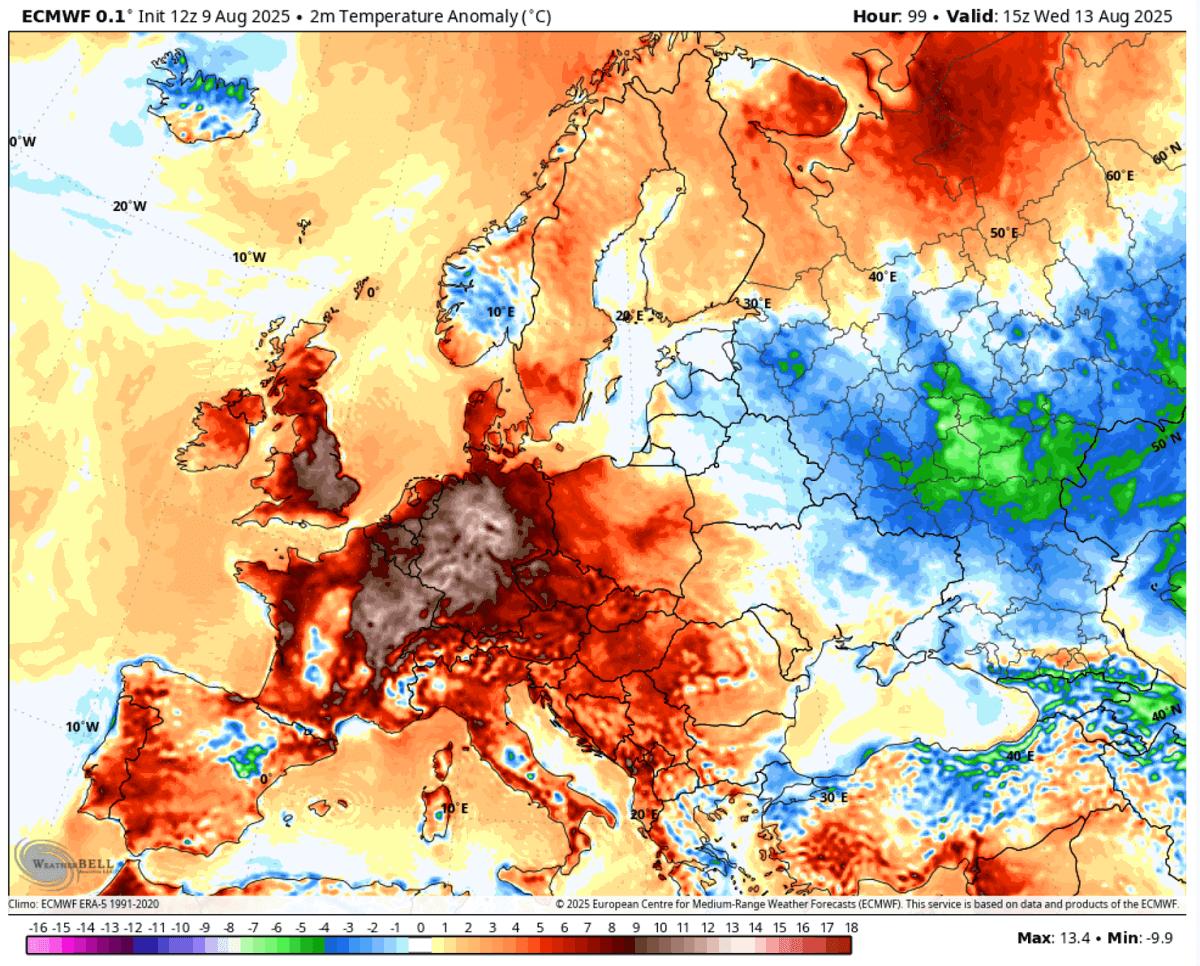
Key developments to watch:
- Wildfire activity: Spain and Portugal are bracing for fires to spread beyond current hotspots, potentially reaching Galicia and the Azores.
- Power grid stress: France’s nuclear plants—already running at reduced capacity—may face further cooling-water shortages.
- Political fallout: The heatwave is fueling debates over Europe’s Green Deal, with some lawmakers calling for faster renewable energy rollouts.
- Tourism adjustments: Major events like the Tour de France and Wimbledon may need to modify schedules or locations.
For now, Europeans are focusing on survival. In Athens, where temperatures are expected to hit 41°C (106°F), a local official urged residents: “Stay indoors during the day. If you must go out, wear a wet cloth and carry water. This isn’t a drill—it’s our reality.”
—
Frequently asked questions about Europe’s heatwave
Q: How does a heat dome form?
A heat dome develops when a high-pressure system traps warm air near the ground, preventing cooler air from moving in. This is often linked to shifts in the jet stream caused by Arctic warming. The current dome over Europe is being reinforced by a blocking pattern in the Atlantic, which meteorologists call an “omega block” due to its shape.
Q: Are heat domes getting worse because of climate change?
Yes. Studies show that human-caused global warming has increased the likelihood of heat domes by 30–50% since the 1980s. The IPCC reports that such events are now 5 times more likely than in the pre-industrial era.
Q: What’s the difference between a heatwave and a heat dome?
A heatwave is a period of unusually high temperatures, while a heat dome is the mechanism causing it—a stagnant high-pressure system. Heat domes often lead to more extreme and prolonged heatwaves because they trap heat like a lid.
Q: How can I stay safe during extreme heat?
Health authorities recommend:
- Avoiding outdoor activity between 10 AM and 6 PM.
- Drinking water even if you’re not thirsty.
- Using fans or air conditioning, and closing curtains to block sunlight.
- Checking on elderly neighbors or those without cooling access.
- Never leaving children or pets in parked cars.
For official alerts, monitor local weather services or apps like Copernicus Emergency Management Service.
Q: Will this heatwave affect travel?
Yes. Airlines in southern Europe are adjusting schedules due to runway softening from heat. In Italy, high-speed trains may reduce speeds to prevent track warping. Ferries between Greece and Turkey have reported delays from passenger heat exhaustion.
Q: Are there any bright sides to this heatwave?
Some regions are seeing temporary benefits, such as:
- Reduced energy demand for heating (though cooling demand spikes).
- Lower air pollution in some areas due to reduced industrial activity.
- Increased interest in heat-resistant crops and urban greening projects.
However, these are short-term and outweighed by the risks.
—
As Europe braces for another week of extreme heat, the question lingering in the air is no longer if such events will return—but when. With temperatures already breaking records, the answer is clear: the continent’s furnace is far from cooling down.
