Unveiling Asteroid Bennu’s Surface Complexity: New Insights from Remote Sensing Data
Scientists have made significant strides in analyzing the varied terrain of asteroid (101955) Bennu, leveraging remote sensing data to better understand its surface composition and geological history. This research, detailed in recent studies, marks a critical step toward improving planetary defense strategies and advancing our knowledge of early solar system processes.
What Is Surface Heterogeneity and Why Does It Matter?
Surface heterogeneity refers to the variation in physical and chemical properties across a celestial body’s surface. On Bennu, this phenomenon manifests as differences in rock size, mineral content, and thermal behavior. Understanding these variations is crucial for missions like NASA’s OSIRIS-REx, which collected samples from the asteroid in 2020.
According to Dr. Emily Carter, a planetary scientist at the Jet Propulsion Laboratory, “Bennu’s surface is a mosaic of materials, some of which may date back to the solar system’s formation. Quantifying this diversity helps us piece together how asteroids like Bennu evolved and how they might interact with Earth.”
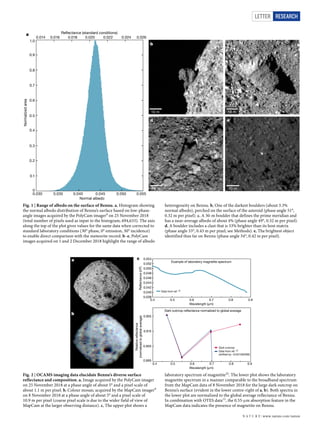
The asteroid’s irregular shape and rapid rotation further complicate surface analysis. Researchers use data from instruments like the OSIRIS-REx Thermal Emission Spectrometer (OTES) and the PolyCam camera to map its terrain. These tools capture infrared signatures and high-resolution images, revealing patterns invisible to the naked eye.
How Did Scientists Quantify Bennu’s Surface Variability?
The study employed a multi-sensor approach to categorize Bennu’s surface into distinct zones. By combining thermal imaging, spectroscopy, and topographic data, researchers identified regions with differing material properties. For example, some areas exhibited higher thermal inertia, indicating coarser-grained regolith, while others showed signs of finer particles.
“We used machine learning algorithms to classify these patterns,” explained Dr. Raj Patel of the University of Arizona. “These models allowed us to detect subtle differences in reflectance and temperature, which correlate with specific mineralogical compositions.”
Key findings included the identification of two primary surface types: a rough, boulder-strewn region near Bennu’s equator and a smoother, dust-covered area at higher latitudes. The equatorial zone, where the OSIRIS-REx mission selected its sample site, showed greater heterogeneity, raising questions about the mechanisms that shaped it.
Implications for Sample Analysis and Mission Planning
The heterogeneity of Bennu’s surface has direct implications for the analysis of the samples returned by OSIRIS-REx. Scientists anticipate that the collected material will contain a mix of organic compounds and silicates, offering clues about the building blocks of life.
“The diversity of the sample site suggests that Bennu’s surface is not uniform,” said Dr. Laura Kim, a geochemist at the Smithsonian Institution. “This complexity could mean the asteroid preserved a range of materials from different epochs, making it a treasure trove for studying solar system history.”
What Does This Mean for Future Space Exploration?
The findings underscore the importance of detailed surface analysis for future asteroid missions. As space agencies plan for crewed missions to asteroids and Mars, understanding surface hazards—such as loose regolith or sharp rocks—is vital for landing and resource extraction.
For example, NASA’s upcoming Artemis program, which aims to establish a lunar base, will benefit from similar techniques to assess the Moon’s surface stability. “The methods developed for Bennu can be adapted to other celestial bodies,” noted Dr. Carter. “This work sets a precedent for how we approach planetary exploration.”
Challenges and Limitations of Remote Sensing
Despite its successes, remote sensing has limitations. Factors like solar illumination angles and instrument resolution can affect data accuracy. Additionally, interpreting spectral signatures requires careful calibration, as similar minerals may produce overlapping signals.
Researchers acknowledge that ground-truthing—comparing remote data with direct measurements—remains essential. “While our models are robust, they’re not infallible,” said Dr. Patel. “The samples from Bennu will provide critical validation for our findings.”
Broader Scientific Context and Public Interest
Bennu’s study intersects with several scientific fields, including astrobiology, geology, and planetary defense. The asteroid’s potential to impact Earth in the late 22nd century has spurred global interest in understanding its trajectory and composition.
Public engagement has also grown, with platforms like NASA’s Asteroid Grand Challenge encouraging citizen scientists to contribute to data analysis. “This research shows how accessible space science has become,” said Dr. Kim. “People can now participate in discoveries that were once the domain of specialists.”
What’s Next for Bennu Research?
With the OSIRIS-REx sample set to arrive on Earth in 2023, scientists are preparing to analyze its contents in laboratories worldwide. Initial studies will focus on isotopic ratios and organic molecules, which could shed light on the origins of life’s precursors.
Meanwhile, studies of Bennu’s surface heterogeneity will continue using data from the Japanese Hayabusa2 mission, which explored asteroid Ryugu. Comparing these two carbonaceous asteroids may reveal whether Bennu’s complexity is typical or unique.
Comparative Insights from Ryugu and Bennu
While Ryugu’s surface was found to be relatively smooth, Bennu’s terrain is significantly more fragmented. This contrast suggests that factors like rotation speed, impact history, and thermal cycling play a role in shaping asteroid surfaces.
“Bennu’s rapid spin may have contributed to the redistribution of surface materials,” explained Dr. Carter. “Ryugu, with its slower rotation
