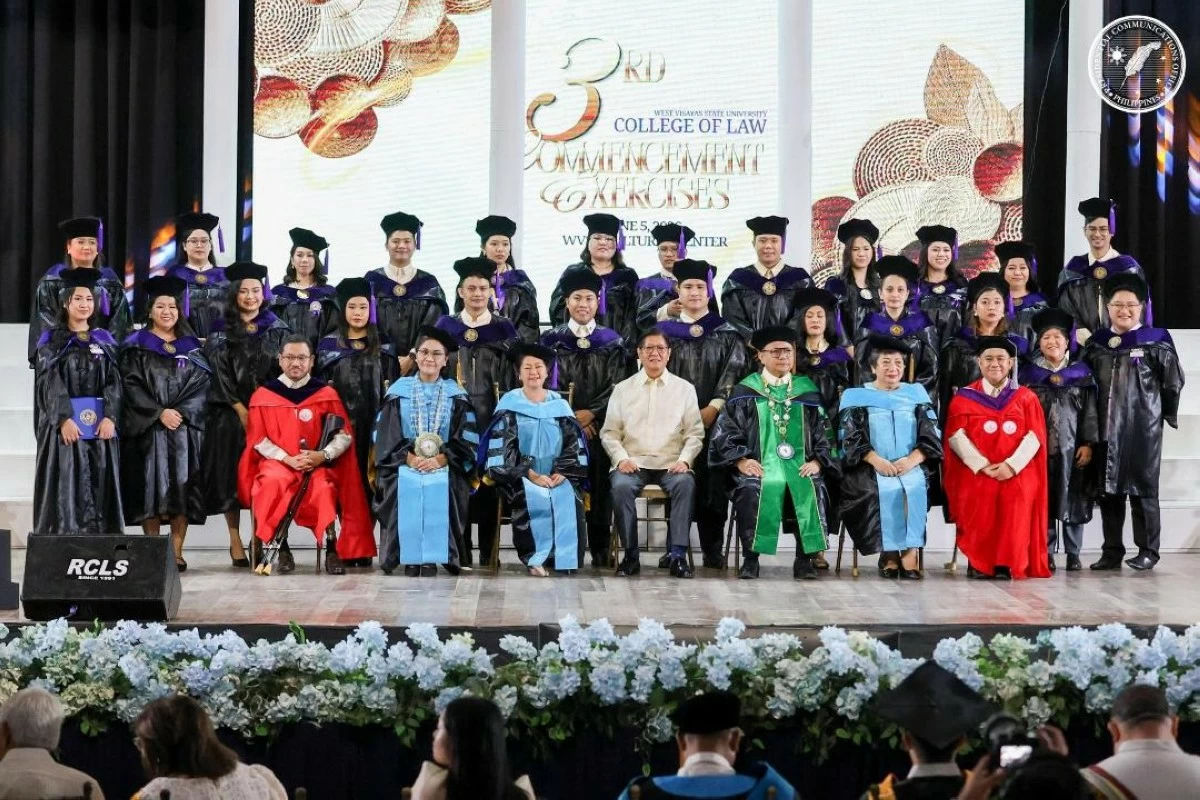
First Lady Gets Emotional at Graduation Rites of Iloilo Law Students: A Moment of Reflection and Reform
In a poignant blend of official state business and raw human emotion, the graduation ceremonies for law students in Iloilo recently became a focal point for discussions on the future of the Philippine legal profession. The event, marked by the presence of the nation’s highest leaders, transcended the typical academic formality, highlighted by a moment where the First Lady became visibly emotional during the rites. This emotional resonance set the stage for a broader conversation led by President Ferdinand Marcos Jr. Regarding the moral imperatives of the legal vocation and the government’s commitment to systemic educational investment.
The occasion was not merely a celebration of individual academic achievement but a strategic demonstration of the administration’s priorities. By combining the graduation rites with the inauguration of a new state university College of Law building in Iloilo City, the government signaled a dual commitment: the cultivation of the next generation of legal minds and the provision of the physical infrastructure necessary to sustain high-quality legal education in the regions.
The Human Element: First Lady’s Emotional Response
While graduation ceremonies are often characterized by rigid protocols and formal speeches, the atmosphere in Iloilo was shifted by the visible emotion of the First Lady. The report that the First Lady gets emotional at graduation rites of Iloilo law students – Manila Bulletin underscores a humanizing aspect of the proceedings, suggesting a deep personal or symbolic connection to the struggles and triumphs of the graduating class.
In the context of a demanding law degree, such a reaction often mirrors the shared understanding of the sacrifices required to reach the finish line. For the students and their families, this display of empathy from the First Lady served as a validation of their perseverance, bridging the gap between the austerity of the law and the emotional reality of the journey toward becoming a lawyer.
Defining Success: Integrity Over Position
A central pillar of the event was the keynote address delivered by President Ferdinand Marcos Jr. In a move that challenged traditional notions of professional ambition, the President offered a stern but inspiring directive to the new law graduates. He emphasized that the true measure of a legal professional’s success is not found in the titles they hold or the prestigious posts they occupy, but in their unwavering integrity.
“Success is measured by integrity, not posts held.”
This statement addresses a perennial challenge within the legal and political spheres: the temptation to prioritize power and status over ethical practice. By framing integrity as the primary metric of success, the President urged the new lawyers to view their licenses not as tools for social climbing, but as instruments for justice.
The Moral Imperative for New Practitioners
The President’s focus on integrity suggests several key expectations for the incoming members of the bar:
- Ethical Resilience: The ability to maintain moral standards even when faced with the pressures of high-ranking positions.
- Service-Oriented Practice: Shifting the goal of a legal career from personal accumulation of power to the service of the public and the law.
- Accountability: Recognizing that a legal title carries a burden of responsibility toward the truth and the fair application of justice.
Expanding Access: The New State University College of Law Building
Parallel to the graduation rites, the inauguration of a new College of Law building at a state university in Iloilo City marked a significant milestone for regional education. This development is a tangible manifestation of the administration’s goal to decentralize quality legal education, ensuring that students in the Visayas have access to modern facilities without needing to migrate to the capital.
The provision of state-of-the-art infrastructure is critical for several reasons. First, it allows for a larger student intake, potentially increasing the number of qualified legal professionals entering the workforce. Second, it provides a conducive environment for the rigorous study and research required to keep pace with evolving legal landscapes. Third, it reinforces the role of state universities as the primary engines of social mobility for talented students from diverse economic backgrounds.
| Investment Area | Strategic Objective | Expected Outcome |
|---|---|---|
| Physical Infrastructure | Inauguration of State U Law Building | Enhanced regional access to legal education |
| Financial Allocation | PhP1.30 Trillion Education Budget | Systemic improvement of educational quality |
| Professional Ethics | Emphasis on Integrity over Position | A more ethical and accountable legal workforce |
The Macro Perspective: A PhP1.30 Trillion Investment in Education
To understand the inauguration in Iloilo within a larger context, one must look at the administration’s broader fiscal priorities. President Marcos has cited a substantial budget of PhP1.30 trillion dedicated to education. This massive allocation indicates that the government views education not as a mere social service, but as a strategic national investment.
The scale of this budget suggests a multi-pronged approach to educational reform, likely encompassing:
- Infrastructure Modernization: Building and renovating classrooms, laboratories and specialized facilities like the law building in Iloilo.
- Curriculum Enhancement: Updating academic programs to meet the demands of the modern global economy and the specific needs of the Philippine justice system.
- Teacher and Professor Support: Investing in the people who deliver the education, ensuring they are well-compensated and continuously trained.
By linking the Iloilo event to the PhP1.30 trillion budget, the administration is demonstrating that its rhetoric on “educational reform” is backed by significant financial commitment. This approach is designed to address long-standing gaps in the Philippine education system, particularly in the provinces.
Linking Education to Justice System Reform
The events in Iloilo were not isolated to the academic sphere; they were explicitly linked to the broader goal of reforming the Philippine justice system. President Marcos has vowed continued support for the justice system through a strategy of education reform. This connection is logical: a justice system is only as effective as the people who operate within it.
The “education-to-justice” pipeline suggests that by improving how lawyers are trained—both in terms of the facilities they use and the ethical framework they are taught—the government can indirectly improve the efficiency and fairness of the courts.
Key Pillars of Justice Reform through Education
- Standardizing Quality: Ensuring that law graduates from state universities in the regions meet the same rigorous standards as those from elite urban institutions.
- Integrating Ethics: Moving beyond the technicalities of the law to instill a deep-seated culture of integrity, as emphasized in the President’s speech.
- Continuous Learning: Promoting the idea that legal education does not end at graduation but is a lifelong process of reform and adaptation.
This strategic alignment suggests that the administration views the “clogged” or “inefficient” aspects of the justice system as problems that can be partially solved at the root—the classroom.
Analysis: The Symbolism of the Iloilo Visit
The decision to hold these events in Iloilo is symbolically significant. Iloilo has long been a center of education and culture in the Visayas. By focusing on a state university, the administration emphasizes the democratization of professional success. When the First Lady displays emotion and the President speaks of integrity, they are attempting to shift the narrative of the “legal elite” toward a more accessible and morally grounded image.
the integration of a building inauguration with a graduation ceremony serves as a powerful visual metaphor: the building represents the means of education, while the graduates represent the result. Together, they form a complete picture of state-led development.
For those following the development of the Philippine legal landscape, this event serves as a benchmark. The success of these initiatives will be measured not by the beauty of the new buildings or the size of the budget, but by whether the graduates of these programs actually embody the integrity the President called for when they enter the workforce.
Common Misconceptions Regarding Legal Education Reform
It is often assumed that improving the justice system requires only legislative changes or the hiring of more judges. However, the approach highlighted in Iloilo suggests a different philosophy: that the culture of the law must be changed. Legislative changes are useless if the practitioners lack the integrity to implement them fairly. The investment in education—both physical and ethical—is presented as the most sustainable path to reform.
Another misconception is that regional law schools are inherently inferior to those in Metro Manila. The inauguration of high-quality facilities in Iloilo is a direct challenge to this notion, asserting that excellence in legal training can and should be distributed across the archipelago.
Frequently Asked Questions
Why was the First Lady’s emotional reaction highlighted in the news?
The emotional response of the First Lady was highlighted because it provided a human element to a formal state event. It signaled empathy for the students’ hard work and added a layer of personal connection to the academic achievements of the Iloilo law students, contrasting with the typical rigidity of government protocols.
What did President Marcos mean by “success is measured by integrity, not posts held”?
The President was urging new lawyers to prioritize ethical conduct and honesty over the pursuit of power, titles, or high-ranking government positions. He suggested that a lawyer’s true value to society is found in their moral character rather than their professional rank.
How much is being allocated for education according to the President?
President Marcos cited a budget of PhP1.30 trillion for education, indicating a massive financial commitment to improving the country’s educational infrastructure and systems.
What is the significance of the new law building in Iloilo City?
The new state university College of Law building represents the government’s effort to decentralize quality education. By providing modern facilities in the regions, the administration aims to make high-level legal training more accessible to students outside of the capital.
How does education reform help the Philippine justice system?
The administration believes that by improving the quality of legal education and emphasizing ethics and integrity during training, the government can produce a more competent and honest generation of legal professionals, which will ultimately lead to a more efficient and fair justice system.
For more information on the intersection of government policy and academic growth, you may find a related explainer on Philippine educational infrastructure useful.
