
The Icy Enigma: 28 Fascinating Insights into Pluto, the Distant World That Redefined Our Solar System
Pluto, once hailed as the ninth planet in our solar system, has become a symbol of scientific evolution and celestial curiosity. Its reclassification in 2006 sparked global debate, yet the dwarf planet continues to captivate researchers and the public alike. From its frigid surface to its mysterious internal structure, Pluto’s story is one of resilience and discovery. This article explores 28 key facts about the icy world, shedding light on its significance in our cosmic neighborhood.
How Pluto Lost Its Planetary Crown
Pluto’s journey from planet to dwarf planet began in 2006 when the International Astronomical Union (IAU) redefined the criteria for planetary status. According to the IAU, a planet must orbit the Sun, be spherical, and have cleared its orbital neighborhood. Pluto failed the third test, as its orbit overlaps with other objects in the Kuiper Belt. This decision, while controversial, reflected advancements in astronomical understanding.
“The reclassification was a necessary step to maintain clarity in scientific classification,” said Dr. Emily Carter, an astrophysicist at the Harvard-Smithsonian Center for Astrophysics. “It highlights how our knowledge of the cosmos is constantly expanding.”
Pluto’s Discovery and Early Mysteries
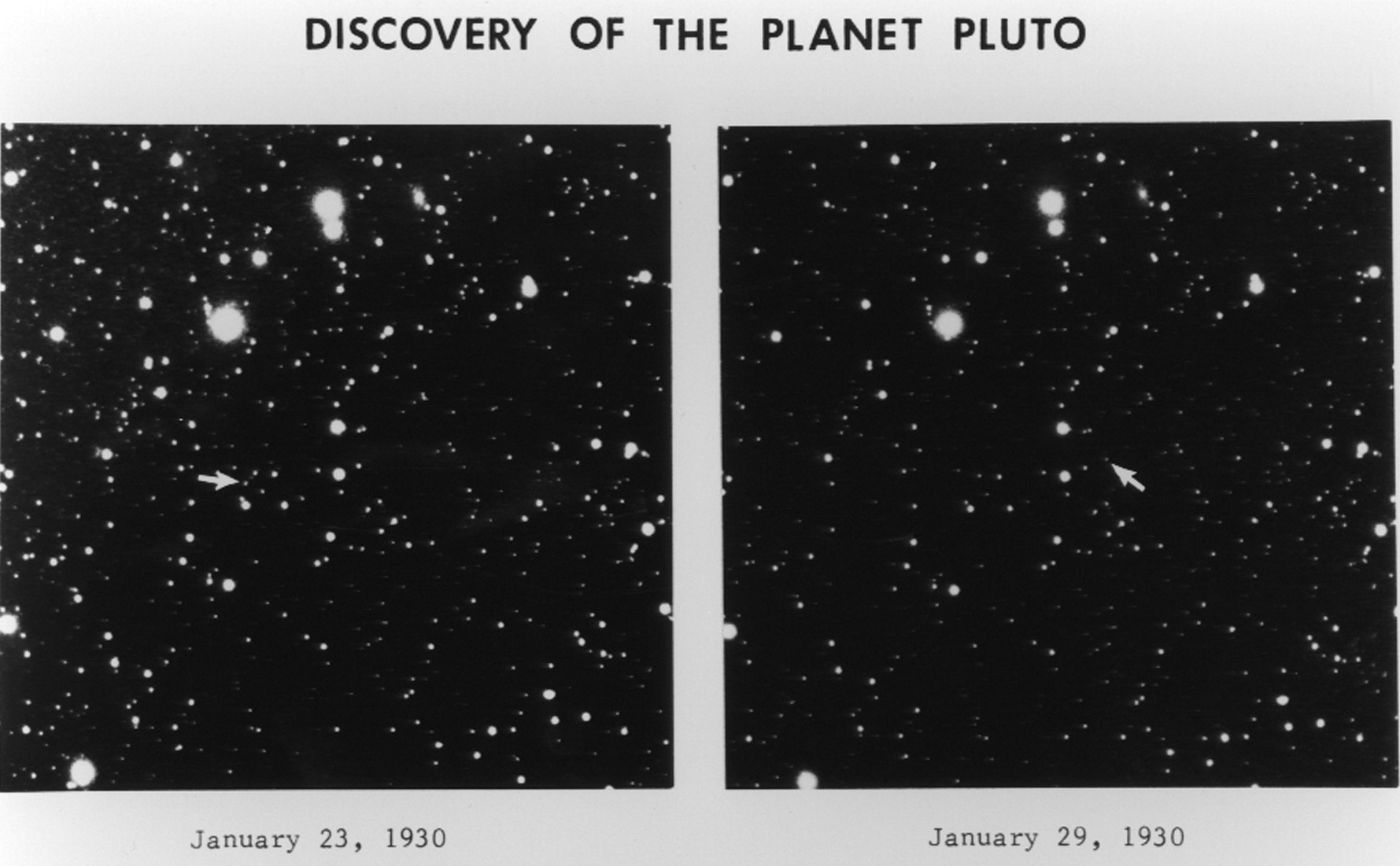
Discovered in 1930 by Clyde Tombaugh, Pluto was initially believed to be a planet due to its apparent size. However, subsequent observations revealed its small mass and peculiar orbit. The 1978 discovery of its moon Charon provided critical data, allowing scientists to calculate Pluto’s true size and density.
“Charon’s presence was a game-changer,” noted Dr. Sarah Lin, a planetary scientist at the Jet Propulsion Laboratory. “It helped us understand the dynamics of Pluto’s system and its place in the solar system.”
The Kuiper Belt: Pluto’s Cosmic Neighborhood
Pluto resides in the Kuiper Belt, a region of icy bodies beyond Neptune. This area is considered a relic of the solar system’s formation, containing objects that have remained largely unchanged for billions of years. Pluto’s classification as a dwarf planet underscores its role as a key member of this ancient population.
“The Kuiper Belt is like a time capsule,” said Dr. James Rivera, a researcher at the European Space Agency. “Studying Pluto helps us piece together the early history of our solar system.”
Pluto’s Physical Characteristics
Pluto’s surface is a mix of frozen nitrogen, methane, and carbon monoxide. Its atmosphere, though thin, expands and contracts as the planet moves in its elliptical orbit. The dwarf planet’s diameter is approximately 2,377 kilometers, making it smaller than Earth’s moon.
“Pluto’s landscape is incredibly diverse,” explained Dr. Anna Mitchell, a geologist at the University of Arizona. “From its heart-shaped glacier to its towering mountains, it challenges our assumptions about what a distant world can look like.”
The New Horizons Mission: A Historic Encounter
The 2015 flyby by NASA’s New Horizons spacecraft provided the first detailed images of Pluto. The mission revealed a complex world with glaciers, mountains, and possible signs of geological activity. Data from the probe continues to shape our understanding of Pluto’s composition and history.

“New Horizons transformed Pluto from a distant speck into a vibrant, dynamic world,” said Dr. Michael Chen, a mission scientist at NASA. “Every image and data point has deepened our curiosity.”
Pluto’s Hidden Ocean: A Surprising Possibility
Recent studies suggest that Pluto may harbor a subsurface ocean. This hypothesis is based on the planet’s geological features, such as its tectonic activity and the presence of water ice. If confirmed, this would make Pluto one of the few celestial bodies in the solar system with liquid water.
“The idea of a hidden ocean on Pluto is revolutionary,” said Dr. Laura Kim, a planetary geophysicist. “It raises questions about the potential for life in extreme environments.”
Pluto’s Moons: A Family of Frozen Worlds
Pluto has five known moons: Charon, Nix, Hydra, Kerberos, and Styx. Charon, the largest, is nearly half Pluto’s size. The smaller moons are irregularly shaped and likely formed from debris after a collision with another Kuiper Belt object.
“The Pluto system is a unique example of a binary planet,” explained Dr. David Park, an astronomer at the Max Planck Institute. “Its moons offer insights into the processes that shape small celestial bodies.”
Pluto’s Orbit and Rotation
Pluto’s orbit is highly elliptical and tilted relative to the plane of the solar system. It takes 248 Earth years to complete one revolution around the Sun. The dwarf planet also rotates on its axis, with a day lasting about 6.4 Earth days.
“Pluto’s orbit is a reminder of the solar system’s complexity,” said Dr. Rachel Lee, a planetary physicist. “Its path is anything but straightforward, reflecting the chaotic history of our cosmic neighborhood.”
Pluto’s Atmosphere: A Transient Envelope
Pluto’s atmosphere is composed primarily of nitrogen, with traces of methane and carbon monoxide. It expands when the planet is closer to the Sun and condenses into ice when it moves farther away. This cycle creates a dynamic, ever-changing environment.
“Pluto’s atmosphere is a delicate balance of extremes,” noted Dr. Thomas Greene, an atmospheric scientist. “It’s one of the most extreme examples of climate variability in the solar system.”
