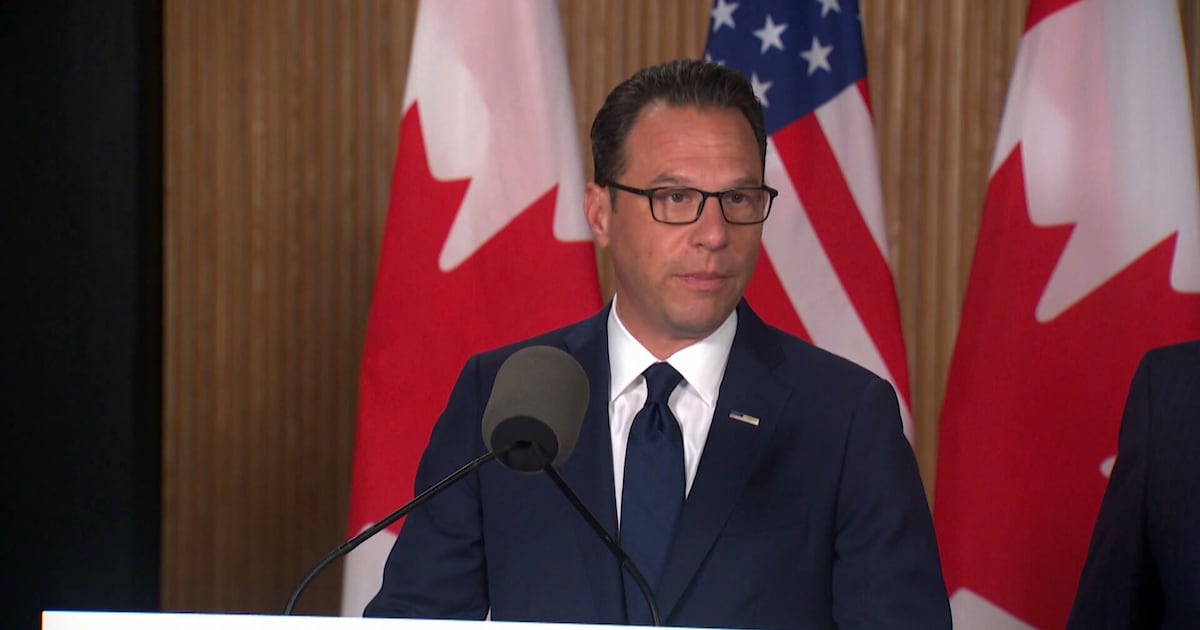
‘Reckless and Disrespectful’: Pennsylvania Governor Slams Trump’s Canada Comments While Signing Ontario Trade Pact
Pennsylvania Governor Josh Shapiro and Ontario Premier Doug Ford signed a memorandum of understanding to expand trade in energy and critical minerals. During the proceedings, Shapiro described former President Donald Trump’s recent comments regarding Canada as “reckless and disrespectful,” according to reports from CP24.
What is the Pennsylvania-Ontario Trade Agreement?
Governor Josh Shapiro and Premier Doug Ford formalised a memorandum of understanding (MOU) designed to deepen economic ties between the Commonwealth of Pennsylvania and the province of Ontario. According to official documentation from ontario.ca, the agreement focuses on increasing trade and cooperation across several strategic sectors, most notably energy and critical minerals.
The agreement functions as a framework for the two jurisdictions to align their industrial strategies. By focusing on critical minerals, the pact aims to secure supply chains that are essential for modern technology and green energy transitions. This cooperation occurs at a sub-national level, allowing a U.S. state and a Canadian province to bypass federal bottlenecks to facilitate direct business-to-business and government-to-government partnerships.
Key pillars of the agreement include:
- Energy Cooperation: Joint efforts to enhance energy security and explore new energy technologies.
- Critical Minerals: Streamlining the movement and processing of minerals required for electric vehicle (EV) batteries and semiconductors.
- Trade Facilitation: Reducing barriers for companies operating across the Pennsylvania-Ontario corridor.
| Agreement Component | Primary Objective | Targeted Sector |
|---|---|---|
| Memorandum of Understanding (MOU) | Increase bilateral trade and cooperation | General Trade/Economy |
| Energy Framework | Enhance regional energy stability | Power & Fuel |
| Critical Minerals Pact | Secure supply chains for high-tech manufacturing | Mining & Technology |
Why did Governor Josh Shapiro criticize Donald Trump’s comments on Canada?
While signing the trade pact, Governor Shapiro used the platform to address recent rhetoric from former President Donald Trump regarding Canada. Shapiro characterized Trump’s remarks as “reckless and disrespectful,” as reported by CP24. The governor’s comments highlight a tension between the desire for stable North American trade and the unpredictable nature of current U.S. political discourse.
The friction stems from Trump’s suggestions regarding tariffs or trade pressures on Canadian imports. For a governor of a major industrial state like Pennsylvania, such rhetoric represents a risk to economic stability. Pennsylvania relies heavily on the seamless flow of goods across the border, and Shapiro’s public rebuke serves as a signal that state-level leadership prioritizes diplomatic stability over political volatility.
According to the Toronto Star, the timing of the deal—and the accompanying criticism—underscores a strategic move by both Ford and Shapiro to insulate their regional economies from potential federal trade disputes. By locking in a memorandum of understanding, the two leaders are creating a documented commitment to cooperation that persists regardless of the rhetoric coming from national political campaigns.
Which sectors will benefit from the new MOU?
The agreement specifically targets sectors where Pennsylvania and Ontario share industrial synergies. The focus on critical minerals is a primary driver, as both regions possess the geological resources and the manufacturing infrastructure to dominate the North American supply chain for the energy transition.
Critical Minerals and EV Infrastructure
Critical minerals—including lithium, cobalt, and graphite—are the building blocks of the electric vehicle revolution. Ontario has significant deposits of these minerals, while Pennsylvania possesses the industrial capacity for processing and manufacturing. According to ontario.ca, the agreement seeks to create a more integrated pipeline, reducing reliance on overseas suppliers, particularly China.
Energy Security and Innovation
The energy sector is another cornerstone of the pact. Both jurisdictions are navigating the transition from traditional fossil fuels to diversified energy portfolios. The MOU encourages the sharing of best practices in energy efficiency and the development of new energy sources. This is particularly relevant for Pennsylvania’s natural gas industry and Ontario’s nuclear and hydroelectric capabilities.
The benefits of this cooperation include:
- Reduced Lead Times: Faster movement of raw materials from Ontario mines to Pennsylvania factories.
- Job Creation: New opportunities in high-tech mining and green energy manufacturing.
- Investment Certainty: Clearer guidelines for investors looking to build cross-border supply chains.
How does sub-national diplomacy affect US-Canada trade?
The deal between Shapiro and Ford is an example of “paradiplomacy,” where states and provinces conduct their own international relations. When federal relations between Washington and Ottawa become strained, sub-national agreements often act as a stabilizing force. This allows economic momentum to continue even when national leaders are in conflict.
Historically, the U.S.-Canada relationship has been defined by the USMCA (United States-Mexico-Canada Agreement). However, as reported by CHCH, the move to sign a specific MOU between Pennsylvania and Ontario suggests that regional leaders are no longer relying solely on federal treaties to protect their interests. They are instead building “fail-safes” through direct bilateral agreements.
This approach is common in regions with high interdependence. Pennsylvania and Ontario share a similar industrial DNA, rooted in steel, automotive manufacturing, and energy. By formalizing their relationship, they create a bloc of economic interest that can lobby their respective federal governments for more favorable trade policies.
For more on the broader implications of regional trade, see a related explainer on USMCA trade dynamics.
The geopolitical context of the Shapiro-Ford agreement
The signing of this pact does not happen in a vacuum. It occurs amidst a global shift toward “friend-shoring”—the practice of sourcing critical materials from political allies to avoid the risks associated with adversarial nations. By strengthening the Pennsylvania-Ontario link, the two leaders are effectively “friend-shoring” the supply of critical minerals within the North American continent.
The contrast in framing is evident across different reports. While ontario.ca emphasizes the economic and technical cooperation of the MOU, CP24 and the Toronto Star foreground the political clash between Governor Shapiro and Donald Trump. This indicates that the event was as much a political statement as it was an economic transaction.
The agreement serves as a rebuttal to the idea that trade should be used as a weapon of political leverage. By calling Trump’s comments “reckless,” Shapiro is asserting that economic partnerships are based on mutual respect and predictability, not threats of tariffs or diplomatic volatility.
Key Strategic Implications
- Supply Chain Resilience: Decreasing the vulnerability of the automotive sector to global shocks.
- Political Signaling: Demonstrating a preference for multilateralism over unilateral trade threats.
- Regional Leadership: Positioning Pennsylvania and Ontario as the industrial heartland of North America.
Common misconceptions about the MOU
One common misconception is that this MOU replaces federal trade agreements. It does not. The memorandum of understanding is a complementary framework; it operates within the bounds of the USMCA but adds a layer of specific, regional cooperation. It cannot override federal tariffs, but it can streamline how businesses navigate existing rules.
Another misunderstanding is that this is a purely environmental agreement. While the focus on critical minerals and green energy is prominent, the deal is fundamentally about economic competitiveness. The goal is to ensure that the transition to a green economy creates jobs in Pennsylvania and Ontario rather than shifting those jobs to other global competitors.
Finally, some may view Shapiro’s comments on Trump as a purely partisan move. However, from a trade perspective, the “reckless” nature of the comments refers to the potential for market instability. Businesses dislike uncertainty; when a potential future leader suggests drastic changes to trade terms, it can freeze investment. Shapiro’s comments are therefore a defense of market predictability.
Frequently Asked Questions
What exactly did Governor Josh Shapiro sign with Premier Doug Ford?
Governor Shapiro signed a memorandum of understanding (MOU) with Premier Doug Ford to increase trade and cooperation between Pennsylvania and Ontario. The agreement focuses specifically on energy and critical minerals to strengthen North American supply chains.
Why did the Governor call Donald Trump’s comments “reckless and disrespectful”?
According to CP24, Governor Shapiro used these terms to describe former President Trump’s rhetoric regarding Canada. This was a response to suggestions of trade pressures or tariffs, which Shapiro views as detrimental to the economic stability of the region.
What are “critical minerals” and why are they in this trade deal?
Critical minerals are elements like lithium, cobalt, and nickel that are essential for high-tech applications, particularly electric vehicle batteries and semiconductors. The deal aims to secure these materials from Ontario for use in Pennsylvania’s industrial sector, reducing reliance on non-allied nations.
Does this agreement change the USMCA trade rules?
No. The MOU does not change the United States-Mexico-Canada Agreement. Instead, it creates a targeted framework for Pennsylvania and Ontario to collaborate more effectively within the existing legal trade environment.
How will this impact the average citizen in Pennsylvania or Ontario?
The primary impacts are expected to be in the labor market and consumer costs. By securing supply chains for energy and minerals, the agreement aims to support high-paying industrial jobs and potentially lower the cost of green technologies by reducing import dependencies.
The commitment between Pennsylvania and Ontario signals a shift toward regional resilience. As federal politics in the U.S. remain volatile, the reliance on stable, state-to-province partnerships is likely to increase. The success of this MOU will be measured by the volume of new investments in the critical minerals sector and the stability of energy trade across the border.
