
New Biomarker Predicts Gastric Cancer Outcomes from CT Scans
A new imaging biomarker identified through CT scans can predict clinical outcomes for gastric cancer patients, according to reports from News-Medical. This non-invasive approach allows clinicians to forecast patient prognosis and treatment response by analyzing imaging data, potentially reducing the reliance on repetitive invasive biopsies for prognostic tracking.
How CT Scan Biomarkers Predict Gastric Cancer Prognosis
The identification of a specific biomarker within computed tomography (CT) scans marks a shift in how physicians evaluate gastric cancer. While CT scans have traditionally served as tools for anatomical staging—determining the size of a tumor and whether it has spread to lymph nodes or distant organs—this new application focuses on the internal characteristics of the tumor tissue itself. According to News-Medical, the biomarker acts as a predictor for how a patient will respond to treatment and their overall survival probability.
This process relies on the analysis of image features that are often invisible to the human eye. By utilizing quantitative data, researchers can identify patterns in pixel intensity, texture, and shape. These “radiomic” features serve as the biomarker, correlating specific imaging signatures with biological behaviors of the cancer, such as its aggressiveness or its likelihood of recurring after surgery.
- Non-invasive monitoring: Patients no longer require as many invasive tissue samples to determine the status of their disease.
- Quantitative analysis: The biomarker replaces subjective visual interpretation with objective, data-driven measurements.
- Early prediction: Prognostic outcomes can be estimated at the time of the initial staging scan.
The Role of Radiomics in Modern Oncology
The ability to extract a biomarker from a CT scan is rooted in a field known as radiomics. Radiomics treats medical images not just as pictures, but as data. By applying algorithms to these images, clinicians can uncover “phenotypes” of tumors that correspond to specific genetic mutations or protein expressions. In the case of gastric cancer, these imaging biomarkers provide a window into the tumor microenvironment without the need for a needle biopsy.
According to oncology research standards, traditional gastric cancer staging uses the TNM system (Tumor, Node, Metastasis). However, two patients with the same TNM stage can have vastly different outcomes. The News-Medical report suggests that the new biomarker fills this gap by providing a personalized layer of data that explains why some patients respond better to chemotherapy than others despite having similar tumor sizes.
Comparison: Traditional Staging vs. Biomarker-Enhanced CT
| Feature | Traditional CT Staging | Biomarker-Enhanced CT |
|---|---|---|
| Primary Goal | Anatomical location and spread | Biological behavior and prognosis |
| Method | Visual inspection by radiologist | Algorithmic quantitative analysis |
| Data Type | Qualitative (Size, Shape) | Quantitative (Texture, Intensity) |
| Invasiveness | Non-invasive (but often requires biopsy for confirmation) | Non-invasive (provides biological insights) |
| Outcome Prediction | General population statistics | Patient-specific probability |
Why Predicting Gastric Cancer Outcomes is Critically Difficult
Gastric cancer is notoriously difficult to manage because it is often asymptomatic in its early stages. By the time a patient presents with symptoms, the cancer has frequently progressed to an advanced stage. According to global health data, the five-year survival rate for stomach cancer remains lower than that of colorectal or breast cancers, largely due to late diagnosis and the heterogeneity of the tumors.

Tumor heterogeneity means that different parts of the same tumor can have different genetic makeups. A single biopsy may miss the most aggressive part of the cancer, leading to an underestimation of the disease’s severity. The use of a CT-based biomarker solves this by analyzing the entire volume of the tumor rather than a single microscopic sample. This provides a more comprehensive “map” of the cancer’s characteristics.
“The ability to predict outcomes through imaging allows for a more tailored approach to treatment, ensuring that aggressive therapies are directed at those who need them most while sparing others from unnecessary toxicity.”
Impact on Treatment Planning and Personalized Medicine
The integration of this biomarker into clinical workflows changes how oncology teams approach treatment. Traditionally, gastric cancer patients follow a standardized path: surgery followed by chemotherapy, or chemotherapy followed by surgery (perioperative therapy). However, the News-Medical report indicates that this biomarker can help refine these decisions.
Refining Chemotherapy Selection
Not every patient responds to the same chemotherapy regimen. By identifying the biomarker on a CT scan, doctors may be able to predict which patients are likely to exhibit a “poor response” to standard drugs. This allows for the earlier introduction of targeted therapies or immunotherapy, which are more expensive and have different side-effect profiles but may be more effective for specific biomarker profiles.
Surgical Decision Making
For some patients, the biomarker may indicate a high likelihood of rapid recurrence. In these cases, surgeons might opt for more extensive lymph node dissections or combine surgery with more intensive adjuvant therapies. Conversely, for patients with a “low-risk” biomarker signature, the medical team might avoid over-treating, thereby improving the patient’s quality of life during recovery.
For those interested in how these technologies integrate with other diagnostics, a related explainer on liquid biopsies provides a comparison between imaging biomarkers and blood-based cancer detection.
The Technical Process: From Scan to Prediction
The transition from a standard CT image to a prognostic prediction involves several technical steps. It is not a simple matter of a doctor looking at the screen; it requires a computational pipeline.
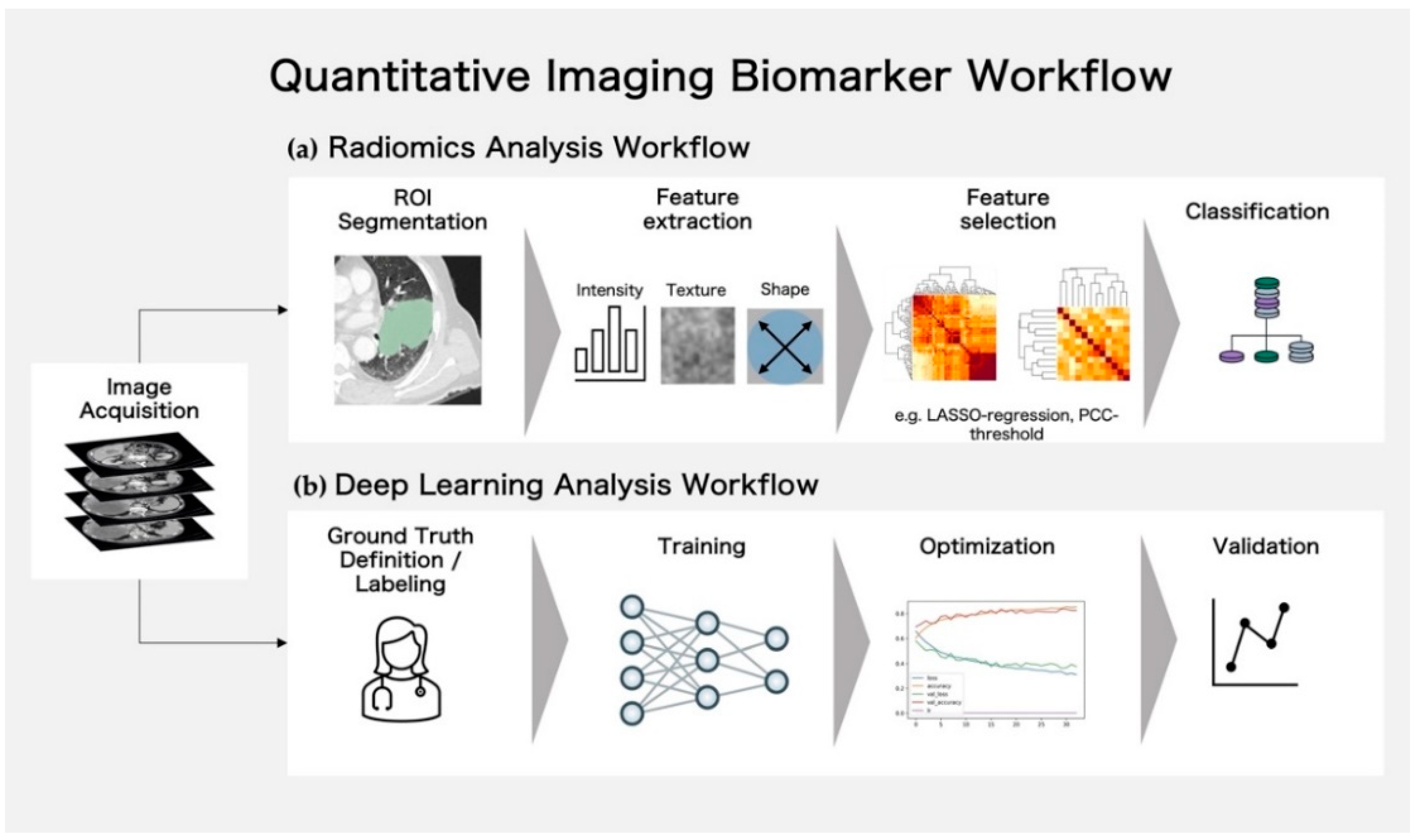
- Image Acquisition: A high-resolution CT scan is performed using standardized protocols to ensure consistency in image quality.
- Segmentation: The tumor is “segmented” or outlined, either manually by a radiologist or automatically by AI software, to separate the cancerous tissue from healthy organs.
- Feature Extraction: Software analyzes the segmented area for thousands of features, including “first-order” statistics (like the average brightness of pixels) and “second-order” statistics (the spatial relationship between pixels, which describes texture).
- Model Application: These features are fed into a predictive model—often a machine learning algorithm—that has been trained on thousands of previous patients whose outcomes are already known.
- Outcome Generation: The model outputs a probability score regarding the patient’s prognosis or likelihood of treatment success.
Addressing Misconceptions About Imaging Biomarkers
There is a common misunderstanding that imaging biomarkers will completely replace tissue biopsies. According to current medical standards, this is unlikely. Biopsies provide the definitive histological diagnosis—confirming that the mass is indeed cancer and identifying the specific cell type (e.g., adenocarcinoma vs. squamous cell carcinoma).
The CT biomarker is a complementary tool. While the biopsy tells the doctor what the cancer is, the imaging biomarker helps tell the doctor how that specific cancer is likely to behave. The primary goal is to reduce the frequency of repeat biopsies used for monitoring, as every invasive procedure carries risks of bleeding or infection, particularly in the fragile tissue of the stomach.
Wider Implications for Other Cancers
The success of this biomarker in gastric cancer suggests a broader application for other solid tumors. The principles of radiomics are currently being explored for lung, liver, and pancreatic cancers. If a CT scan can predict outcomes for the stomach, similar patterns may exist for other organs where biopsy is difficult or dangerous.
The shift toward “virtual biopsies” represents a major trend in oncology. By combining CT data with other imaging modalities like PET scans or MRI, researchers are building multi-modal biomarkers that provide an even more accurate prediction of patient survival. This convergence of radiology and pathology is often referred to as “radiopathomics.”
Potential Challenges in Clinical Adoption
Despite the promise reported by News-Medical, several hurdles remain before this becomes a global standard of care. The most significant is standardization. CT scans produced by a machine in one hospital may look slightly different from those produced by a different brand of scanner in another city. These variations in “noise” or contrast can confuse the algorithms used to identify biomarkers.
Furthermore, the integration of AI-driven predictions into the clinical workflow requires a change in how radiologists and oncologists interact. There is a learning curve associated with interpreting quantitative radiomic data, and medical legal frameworks must evolve to determine who is responsible if an algorithmic prediction differs from a physician’s clinical judgment.
Factors Affecting Biomarker Accuracy
- Scan Resolution: Lower resolution scans may miss subtle texture patterns.
- Contrast Agents: The type and timing of the contrast dye injection can alter the biomarker’s appearance.
- Patient Comorbidities: Other stomach conditions, such as chronic gastritis, may introduce “noise” into the imaging data.
FAQ: Understanding CT Biomarkers in Gastric Cancer
What exactly is a “biomarker” on a CT scan?
Unlike a blood biomarker (like a protein) or a genetic biomarker (like a mutation), an imaging biomarker is a quantitative pattern found in medical images. It consists of data points regarding the texture, density, and shape of a tumor that correlate with a specific biological outcome, such as survival rate or drug response.
Does this mean I won’t need a biopsy for stomach cancer?
No. According to medical protocols, a biopsy is still necessary for the initial diagnosis to confirm the presence and type of cancer. The CT biomarker is used for prognosis (predicting the future) rather than diagnosis (identifying the current state).

How accurate are these predictions?
Accuracy varies based on the study and the specific biomarker used. While these tools significantly improve upon traditional visual staging, they provide probabilities rather than certainties. They are used to guide treatment decisions in conjunction with other clinical evidence.
Is this technology available in all hospitals?
Currently, most of these biomarker tools are in the research or validation phase. While many hospitals have the CT scanners necessary to collect the data, the specialized software required to extract and analyze the biomarkers is not yet universal in standard clinical practice.
Can this biomarker detect cancer earlier?
The primary focus of this specific biomarker is predicting outcomes for patients who already have a diagnosed tumor. However, the underlying technology of radiomics is also being researched to help distinguish between benign polyps and malignant tumors more accurately during screening.
The Future of Non-Invasive Oncology
The development of a biomarker that predicts gastric cancer outcomes from CT scans moves the field closer to a truly personalized oncology model. By extracting deep biological insights from images that are already being taken as part of standard care, the medical community can reduce patient trauma and increase the precision of life-saving treatments.
As these algorithms are validated across larger, more diverse patient populations, the reliance on “one-size-fits-all” chemotherapy protocols is expected to diminish. The focus is shifting toward a system where the imaging data informs the drug choice, the surgical extent, and the frequency of follow-up care, creating a streamlined, data-driven pathway from diagnosis to recovery.
For those monitoring the latest in diagnostic tech, a related explainer on AI in radiology explores how machine learning is automating the detection of anomalies across various organ systems.
