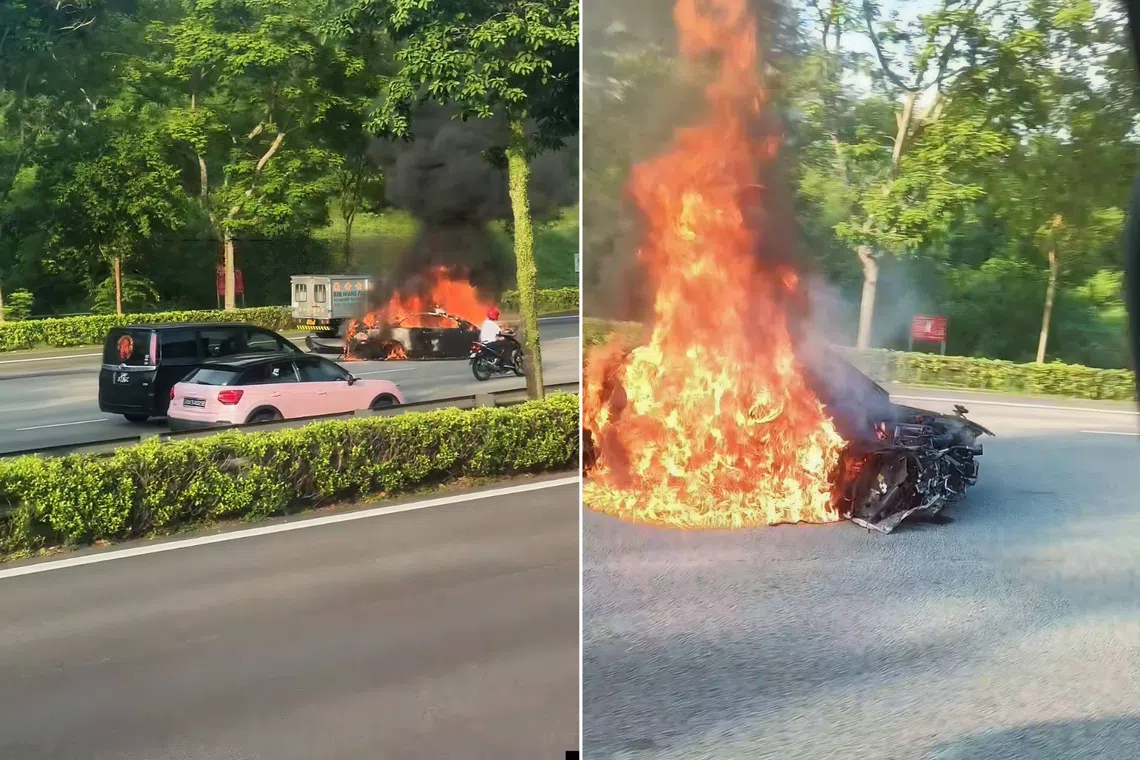
Man Taken to Hospital After Car Catches Fire on SLE: Incident Highlights Highway Safety Concerns
A serious traffic incident on the Seletar Expressway (SLE) has left a motorist hospitalized after his vehicle erupted in flames. The event, which caused significant alarm and disrupted the flow of traffic on one of Singapore’s primary arterial roads, serves as a stark reminder of the volatility of vehicle fires and the critical importance of rapid emergency response in high-speed urban environments.
While the immediate focus remains on the recovery of the injured individual, the incident has sparked a broader conversation regarding vehicle maintenance, the risks associated with expressway travel, and the protocols drivers should follow when faced with a sudden onboard fire. In a city-state characterized by dense traffic and highly urbanized infrastructure, a vehicle fire on a major expressway is not merely a personal tragedy but a public safety hazard that can lead to secondary collisions and widespread congestion.
The Incident: What Happened on the SLE
The event unfolded on the Seletar Expressway (SLE), where a passenger car caught fire while in motion. The intensity of the blaze was sufficient to necessitate the transport of the male driver to a hospital for medical treatment. While the specific nature of the injuries has not been detailed, the requirement for hospital admission indicates that the fire’s impact was immediate and severe.
Expressway fires are particularly dangerous due to the speed at which vehicles travel and the limited space available for drivers to safely exit their cars. In this instance, the rapid escalation of the fire left the driver in a precarious position, highlighting the narrow window of time between the first sign of smoke and a full-scale vehicle inferno.
- Location: Seletar Expressway (SLE), a critical link for traffic moving across the northern part of Singapore.
- Casualties: One male driver transported to the hospital.
- Primary Event: Rapid vehicle ignition leading to a total or partial loss of the car.
Understanding the Seletar Expressway (SLE) Context
The Seletar Expressway is more than just a stretch of asphalt; it is a vital component of Singapore’s transport network. Serving as a primary conduit for commuters and logistics vehicles, the SLE connects various residential hubs and industrial zones. Because of the high volume of traffic and the speeds maintained on this road, any stoppage—especially one involving fire—creates a ripple effect of danger.
When a car catches fire on the SLE, the risks are compounded by:
- High-Speed Traffic: Other motorists may not notice a stopped, burning vehicle until it is too late, increasing the risk of rear-end collisions.
- Limited Shoulders: While Singapore’s expressways are well-maintained, the space available to move a burning vehicle away from active lanes is often limited.
- Environmental Factors: Heat and humidity in Southeast Asia can exacerbate the volatility of certain automotive fluids, potentially accelerating the spread of a fire.
For those unfamiliar with the route, the SLE is known for its efficiency in bypassing the city center, but like all major highways, it requires maximum driver vigilance. A sudden mechanical failure leading to a fire can turn a routine commute into a life-threatening emergency in seconds.
Why Do Cars Catch Fire? Common Causes and Triggers
A vehicle fire is rarely a random occurrence; it is typically the result of a specific mechanical or electrical failure. While the cause of the fire on the SLE is subject to investigation, automotive experts generally categorize vehicle fires into several primary triggers.
Electrical System Failures
The modern car is essentially a computer on wheels, with miles of wiring running through the chassis. A frayed wire, a loose connection, or a faulty aftermarket installation (such as high-powered audio systems or dashcams) can create a short circuit. This short can generate enough heat to ignite nearby plastic insulation or interior fabrics.
Fuel System Leaks
Fuel leaks are among the most dangerous causes of vehicle fires because gasoline is highly flammable. A leak in the fuel line, a faulty fuel injector, or a punctured fuel tank can spray fuel onto hot engine components, such as the exhaust manifold, leading to an instantaneous flash fire.
Overheating and Fluid Ignition
Engine overheating is a common issue, but it can lead to fire if oil or other lubricants leak onto a scorching hot engine block. Oil fires are particularly difficult to extinguish and produce thick, toxic black smoke that can blind the driver and other motorists on the road.
“The transition from a compact electrical spark to a full-vehicle blaze can happen in under two minutes, leaving the driver with very little time to react and evacuate safely.”
Emergency Response and Management in Singapore
The speed with which the driver was transported to the hospital speaks to the efficiency of Singapore’s emergency services. In the event of an expressway fire, a coordinated response is triggered involving several agencies.
The Role of the SCDF
The Singapore Civil Defence Force (SCDF) is the primary agency responsible for firefighting and rescue. Their response to an SLE fire involves not only extinguishing the flames but also ensuring that the vehicle is stabilized so it does not explode or shift into active traffic lanes. The use of specialized foam and water cannons is common to suppress fuel-based fires.
Traffic Management and Police Intervention
The Land Transport Authority (LTA) and the police work in tandem to manage the aftermath. Their priorities include:
- Cordoning the Area: Preventing curious motorists from slowing down to look at the fire, which often causes “rubbernecking” accidents.
- Diversion: Redirecting traffic to alternative routes to allow emergency vehicles clear access to the scene.
- Recovery: Using heavy-duty tow trucks to remove the charred remains of the vehicle to clear the road as quickly as possible.
| Emergency Phase | Primary Action | Goal |
|---|---|---|
| Detection | Call to 995 / Traffic Camera Alert | Rapid notification of authorities. |
| Containment | SCDF Fire Suppression | Prevent fire from spreading to other cars. |
| Rescue | Paramedic Intervention | Stabilize and transport injured parties. |
| Clearance | Towing and Road Cleaning | Restore normal traffic flow on the SLE. |
Critical Safety Guide: What to Do if Your Car Catches Fire
The incident on the SLE serves as a critical lesson for all drivers. Knowing how to react in the first 30 seconds of a vehicle fire can be the difference between a close call and a fatal accident. If you notice smoke or flames coming from your vehicle, follow these steps immediately.
1. Immediate Exit Strategy
The moment you suspect a fire, pull over to the shoulder as safely and quickly as possible. Do not attempt to drive “just a bit further” to find a better spot; every second counts. Turn off the engine immediately to stop the flow of fuel and electricity. Exit the vehicle and move all passengers as far away from the car as possible—ideally behind a guardrail or well off the road.
2. Avoid the “Save the Belongings” Trap
One of the most common mistakes drivers make is attempting to go back into a smoking car to retrieve a phone, wallet, or laptop. Vehicle fires accelerate exponentially. Once the fire reaches the interior upholstery or the fuel system, the car becomes a death trap. Leave everything behind; your life is more valuable than any piece of electronics.
3. Do Not Open the Hood Fully
If the fire is under the hood, do not open the bonnet wide. Opening the hood allows a massive influx of oxygen to reach the fire, which can cause a “backdraft” effect, sending a wall of flame directly into your face. If you have a fire extinguisher, use it through the gaps in the hood or use a fire blanket if available.
4. Alert Other Motorists
Once you are in a safe location, use your phone to call emergency services. If it is safe to do so, warn other drivers to keep clear of the area to prevent further accidents.
For more information on maintaining your vehicle to prevent such incidents, you may find a related explainer on vehicle maintenance helpful.
Preventing Vehicle Fires: A Proactive Approach
While some fires are the result of unpredictable failures, many are preventable through diligent maintenance. To avoid a situation like the one seen on the SLE, drivers should adhere to a strict vehicle health checklist.
Regular Electrical Inspections
Request that your mechanic check for worn-out wiring or signs of corrosion during every service. Be particularly cautious with aftermarket accessories. Ensure that any additional electronics are installed by certified professionals who use appropriate fuses and gauges to prevent overloading the circuit.
Monitoring Fluid Levels and Leaks
Check your driveway or parking spot for spots of oil or fuel. A slow drip today can become a catastrophic leak tomorrow. Ensure that your coolant levels are topped up to prevent the engine from overheating, which can lead to the ignition of surrounding plastic components.
The Importance of Professional Servicing
Avoid “DIY” repairs on critical fuel or electrical systems unless you are a trained professional. A poorly tightened fuel clamp or an incorrectly grounded wire can create the exact conditions necessary for a fire to start while driving at high speeds on an expressway.
consider keeping a small, certified automotive fire extinguisher in your cabin. While not a substitute for evacuation, it can be used to suppress a very small fire before it becomes uncontrollable.
Analyzing the Impact of Expressway Accidents on Urban Mobility
Incidents like the car fire on the SLE have a broader impact than the immediate physical damage. In a compact city-state, the closure of even a single lane on a major expressway can lead to kilometers of congestion, affecting thousands of commuters.
This creates a “cascading failure” in the transport network. When the SLE is blocked, drivers divert to secondary roads, which then become overwhelmed, leading to delays in public transport and emergency service response times across the rest of the city. This highlights why the rapid clearance of the scene is just as important as the firefighting effort itself.
such events often lead to a temporary increase in driver anxiety and “caution-braking,” where drivers slow down excessively to view the accident, inadvertently creating new traffic jams and increasing the risk of further rear-end collisions. This underscores the need for the LTA to utilize digital signage and real-time alerts to warn drivers to keep moving and stay focused on the road.
For those interested in the broader context of road safety, a related explainer on road safety provides deeper insights into how infrastructure is designed to mitigate these risks.
Common Misconceptions About Vehicle Fires
There are several myths regarding car fires that can lead to dangerous decisions during an emergency. It is important to clarify these points to ensure public safety.
Myth 1: “The car will definitely explode like in the movies.”
While fuel tanks can rupture and cause a violent burst of flame, the “Hollywood explosion” where a car flips and explodes instantly is rare. However, the heat and toxic smoke are very real and far more likely to cause injury or death than a cinematic explosion.
Myth 2: “I can put out a car fire with a bucket of water.”
Water can be dangerous if used on an electrical fire or a fuel fire. Water can spread burning gasoline or cause an electrical short that shocks the person attempting to help. Only use a Class B or ABC-rated fire extinguisher designed for vehicles.
Myth 3: “Modern cars are too safe to catch fire.”
While safety standards have improved, the complexity of modern vehicles—including the addition of high-voltage lithium-ion batteries in EVs and hybrids—introduces new types of fire risks. Battery fires, in particular, are notoriously difficult to extinguish and require specialized techniques.
Frequently Asked Questions
What should I do if I see a car on fire on the SLE?
If you are a witness, do not stop your vehicle in a way that blocks traffic or creates a hazard. Slow down safely, move to the left lane, and call 995 immediately. If you can do so without risking your own life, you can alert the driver to exit the vehicle, but never put yourself in the path of oncoming high-speed traffic.
How can I tell if my car is about to catch fire?
Warning signs include the smell of burning plastic or rubber, smoke emanating from the dashboard or hood, or a sudden spike in the engine temperature gauge. If you see any of these signs, pull over immediately and exit the vehicle.
Are electric vehicles (EVs) more prone to fires than petrol cars?
Statistically, EVs may have different fire profiles. While they don’t have flammable gasoline, their batteries can undergo “thermal runaway,” which is a self-sustaining fire that is very hard to put out. Both types of vehicles require regular maintenance to minimize risk.
Will my insurance cover a car that catches fire on the expressway?
Coverage depends on your specific policy. Comprehensive insurance typically covers vehicle fires regardless of the cause, whereas third-party insurance may not. It is always best to check your policy details regarding “fire and theft” coverage.
Why is the SLE particularly dangerous for these types of incidents?
The SLE is a high-capacity expressway with significant traffic volumes. The combination of high speeds and the critical nature of the route means that any incident, such as a car fire, creates a high-risk environment for other motorists and complicates the arrival of emergency responders.
