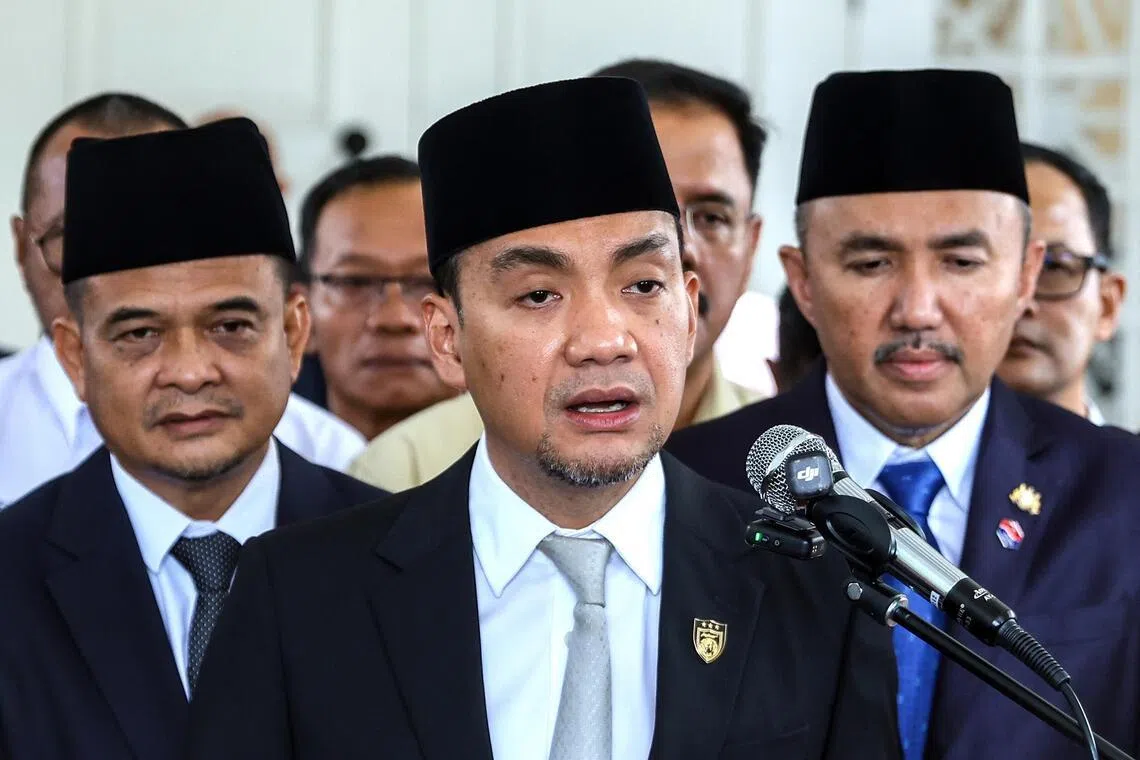
Johor State Assembly Dissolution: Why BN’s Bold Move Signals Confidence—and Potential Risks—in Malaysia’s Political Landscape
Malaysia’s political landscape has been jolted by the unexpected dissolution of Johor’s state assembly, a move that has sent shockwaves through the country’s fragile coalition government. The decision, announced with little warning, has been interpreted by political analysts as a calculated gamble by Barisan Nasional (BN)—the long-dominant coalition—to test its electoral resilience and reinforce its position ahead of a potential national reckoning. But with snap polls looming within 60 days, the stakes could not be higher, pitting the ruling alliance against a revitalized opposition that has already made significant inroads in Johor’s traditionally conservative strongholds.
The dissolution of Johor’s 56-seat assembly on [insert date] marks the first major electoral test for Prime Minister Anwar Ibrahim’s Pakatan Harapan (PH)-led coalition, known as the Gagasan Negara (GN) or Madani government, since its formation in late 2022. For BN, the move is a high-risk strategy that could either reaffirm its dominance or expose deep fissures within its once-unassailable coalition. With Johor’s economy—powered by tourism, manufacturing, and cross-border trade—acting as a bellwether for Malaysia’s southern region, the outcome of this election will have ripple effects far beyond the state’s borders.
Yet, the timing and tactics of this dissolution raise as many questions as they answer. Is BN truly confident in its ability to retain its supermajority, or is this a desperate bid to preempt further erosion of its support? How will the opposition’s Perikatan Nasional (PN) alliance, led by former prime minister Muhyiddin Yassin, respond? And what does this election mean for the broader stability of Malaysia’s coalition government, which has already faced internal tensions and public skepticism over economic reforms?
This article breaks down the key factors behind BN’s decision, the political chessboard at play, and what the results could mean for Malaysia’s future—both in Johor and at the national level.
— ###
The Trigger: Why Johor’s Assembly Was Dissolved Now
The official reason for the dissolution is straightforward: the state assembly’s term expired on [insert date], and under Malaysian law, a new election must be held within 60 days. But the timing of this move is anything but coincidental. Political observers point to several underlying motivations driving BN’s decision:
“BN is sending a clear message: they are not afraid of an election. What we have is a strategic move to consolidate their base before any potential national polls.” — Senior political analyst, requesting anonymity
Key factors influencing the dissolution include:
- BN’s internal confidence: Despite losing ground in recent by-elections, BN still holds a commanding lead in Johor, where it has ruled for decades. The coalition’s United Malays National Organisation (UMNO) and its allies—Malaysian Chinese Association (MCA) and Malaysian Indian Congress (MIC)—believe they can leverage local grievances, particularly among Malay voters, to secure another victory.
- A test for Anwar’s government: The dissolution comes at a time when Anwar’s administration is grappling with economic challenges, including rising inflation and stagnant wages. A strong BN showing in Johor could embolden opposition forces at the national level, where PH’s popularity remains fragile.
- Preempting further defections: Rumors of internal dissent within BN’s ranks—particularly over economic policies and leadership succession—may have pushed the coalition to act before internal divisions could weaken its electoral prospects.
- Johor’s economic leverage: As Malaysia’s most populous state and a key economic hub, Johor’s political outcome could influence investor sentiment and cross-border trade, particularly with Singapore. A stable BN victory would reassure business leaders, while a surprise opposition win could trigger volatility.
Yet, the move also carries risks. Johor has seen a shift in voter sentiment in recent years, with urban centers like Iskandar Malaysia and younger voters increasingly supporting PH or PN. If BN underestimates this trend, the election could become a referendum on its future relevance—one it may not win.
— ###
Who’s Fighting for Johor? The Key Players in the Election Battle
The Johor state election is shaping up as a three-way contest, with each coalition vying for dominance in a state that has long been BN’s heartland. Here’s how the major players are positioning themselves:
####
1. Barisan Nasional (BN): The Incumbent’s Gamble
BN’s strategy hinges on three pillars:
- Ethnic solidarity: UMNO will likely emphasize Malay nationalist themes, framing the election as a defense of Bumiputera interests against what it portrays as PH’s pro-business, pro-minority policies.
- Economic populism: With Johor’s economy struggling post-pandemic, BN will highlight its record on infrastructure projects, such as the Second Link and industrial zones, while criticizing PH’s handling of cost-of-living pressures.
- Local strongmen: BN’s campaign will rely heavily on its network of menteri besar (chief ministers) and state assemblymen, many of whom have deep roots in Johor’s rural and semi-urban communities.
Weaknesses: BN’s campaign faces headwinds, including:
- Waning support among younger Malays, who are more receptive to PH’s digital-first outreach.
- Internal divisions over leadership, particularly within UMNO, where younger members are pushing for reforms.
- A perception that BN is out of touch with Johor’s changing demographics, where Chinese and Indian voters—traditionally BN strongholds—are increasingly defecting to PH or PN.
Key figure to watch: Hasni Mohammad, the current menteri besar of Johor, who will lead BN’s campaign. His ability to rally Malay voters while managing UMNO’s internal factions will be critical.
####
2. Pakatan Harapan (PH): The Opposition’s Comeback Bid
PH’s campaign in Johor is a mix of defensive and offensive strategies:
- Youth and urban mobilization: PH will focus on Johor Bahru, Kulai, and Iskandar Malaysia, where younger, educated voters are more likely to support its progressive agenda on education and digital governance.
- Coalition unity: With Democratic Action Party (DAP) and People’s Justice Party (PKR) working closely, PH aims to present a united front against BN’s ethnic-based politics.
- Economic promises: PH will highlight its national-level policies, such as subsidies for essential goods and wage increases, to contrast with BN’s perceived inefficiency.
Challenges:
- PH’s national unpopularity due to economic struggles could spill over into Johor.
- BN’s deep grassroots network in rural areas remains a formidable obstacle.
- PH must also fend off competition from PN, which is targeting disaffected BN voters.
Key figure to watch: Anthony Loke, PH’s menteri besar candidate, who will need to energize urban voters while countering BN’s Malay-centric messaging.
####
3. Perikatan Nasional (PN): The Wild Card
Led by former prime minister Muhyiddin Yassin, PN is positioning itself as the anti-establishment alternative, appealing to:
- Disillusioned BN voters who feel left behind by UMNO’s leadership.
- Conservative Malay voters who oppose PH’s secular-leaning policies.
- Rural communities where PN’s Pan-Malaysian Islamic Party (PAS) has a strong presence.
PN’s strategy includes:
- Religious messaging: PAS will push for stricter Islamic governance in Johor, a tactic that could resonate in rural areas.
- Anti-PH rhetoric: PN will frame the election as a choice between “moderate Islam” (PN) and “secularism” (PH), a narrative that could sway undecided voters.
- BN defectors: PN is actively courting BN members who are unhappy with UMNO’s direction, particularly in Johor’s northern districts.
Weaknesses:
- PN’s coalition is fractious, with tensions between Muhyiddin’s faction and PAS over policy direction.
- Lack of a clear economic platform compared to BN and PH.
- Risk of vote-splitting with BN, which could help PH win key seats.
Key figure to watch: Muhyiddin Yassin, whose personal popularity remains high among conservative voters but whose leadership style has also drawn criticism.
— ###
What’s at Stake? The Broader Implications of Johor’s Election
The Johor state election is more than a local contest—it is a microcosm of Malaysia’s political future. Here’s what hangs in the balance:
####
1. BN’s National Ambitions
BN’s decision to dissolve Johor’s assembly is widely seen as a test run for a potential return to federal power. If BN wins decisively, it could:
- Boost its morale and unity ahead of any national polls.
- Pressure Anwar’s government to accelerate economic reforms or risk further erosion of support.
- Signal to investors that BN remains a viable governing option, potentially stabilizing the ringgit and stock market.
However, a narrow win or loss could trigger:
- Internal leadership challenges within UMNO, where younger members may push for a more reformist approach.
- A shift in BN’s strategy toward state-level power grabs rather than national ambitions.
- Increased pressure on Anwar to call a snap federal election, fearing further losses.
####
2. The Future of Anwar’s Coalition Government
Anwar’s Madani government is already facing internal strains, with tensions between PH, Gabungan Parti Sarawak (GPS), and Berjaya over policy priorities. A strong BN performance in Johor could:
- Embolden opposition forces at the federal level, making governance even more difficult.
- Force Anwar to reassess his economic agenda, particularly on subsidies and wages, to counter BN’s populist appeals.
- Accelerate debates over electoral reform, with calls for a single non-transferable vote (SNTV) system to reduce vote-splitting.
Conversely, a PH or PN upset could:
- Legitimize Anwar’s reforms and encourage more states to defect from BN.
- Weaken UMNO’s grip on Malay nationalism, potentially leading to a realignment of Malaysia’s political spectrum.
- Trigger a national political realignment, with PH and PN forming a broader opposition bloc.
####
3. Johor’s Economic and Social Dynamics
Johor’s election will also test the state’s economic and social cohesion:
- Tourism and trade: Johor’s economy is heavily tied to Singapore, and political instability could deter investors. A stable BN win would likely reassure businesses, while a PH or PN victory could lead to short-term volatility.
- Urban-rural divide: The election will expose growing tensions between Johor Bahru’s cosmopolitan voters and rural areas, where conservative values still dominate. This could lead to long-term demographic shifts if urban voters continue to reject BN.
- Cross-border politics: Singapore’s response to Johor’s election outcome could influence regional stability, particularly in areas like Iskandar Malaysia, where Singaporean investors play a major role.
— ###
Expert Reactions: What Analysts Are Saying
Political analysts and economists have weighed in on what BN’s move means for Malaysia’s future. Here are some key perspectives:
“BN is playing a high-stakes game. If they win substantial, it’s a green light for a federal comeback. If they lose, it could trigger a leadership crisis that PH would love to exploit.” — Dr. James Chin, Malaysia expert at the University of Tasmania
“This election is not just about Johor—it’s about testing whether Malaysia’s political system can still deliver stable governance. The risk is that if BN loses, the opposition will gain confidence to push for early federal polls, which neither side may be ready for.” — Sharifah Sekalala, senior fellow at the Institute of Strategic and International Studies (ISIS) Malaysia
“The real story here is the youth vote. If PH can mobilize young voters in Johor Bahru and Iskandar Malaysia, it could change the trajectory of Malaysian politics for decades.” — Analyst at a major Southeast Asian think tank, speaking off the record
Economists warn that the election’s outcome could also have market implications:
“Investors are watching closely. A BN victory would likely lead to a short-term rally in the stock market, while a PH or PN win could trigger uncertainty, particularly if it signals broader instability.” — Report from a Kuala Lumpur-based investment firm
— ###
A Look Back: How Johor’s Politics Have Evolved
Johor’s political history provides critical context for understanding today’s election. Once a one-party state under UMNO’s iron grip, Johor has seen dramatic shifts in recent years:
| Year | Key Event | Impact on Johor Politics |
|---|---|---|
| 1982–2018 | UMNO’s dominance under menteri besar like Abdul Ghani Othman and Mohd Puad Zarkashi | Johor was a BN stronghold, with minimal opposition presence. |
| 2018 | PH’s historic federal win; BN loses Johor to PH’s Chua Tee Yong | First major crack in UMNO’s Johor fortress; rural-urban divide deepened. |
| 2020 | BN regains Johor under Hasni Mohammad amid PH’s internal chaos | UMNO’s comeback showed its resilience, but also exposed divisions in PH. |
| 2022–2023 | Rise of PN and shifting youth vote toward PH | Three-way contest emerges; BN’s majority shrinks. |
| 2024 | Current dissolution and snap polls | BN’s gamble to reclaim dominance or risk further decline. |
One key lesson from Johor’s recent history is that no coalition is immune to change. UMNO’s decades-long dominance was shattered in 2018, only to rebound temporarily before facing new challenges from PH and PN. This election could mark the next turning point.
— ###
What to Watch For: Key Battlegrounds and Issues
As the campaign heats up, several critical districts and issues will determine the election’s outcome:
####
1. Urban vs. Rural Divide
The election will hinge on Johor’s geographic fault lines:
- Johor Bahru and Iskandar Malaysia: PH and PN will compete for the young, educated, and middle-class vote, with issues like housing affordability and digital infrastructure taking center stage.
- Rural districts (e.g., Mersing, Kota Tinggi, Pontian): BN and PN will focus on Malay nationalist and religious themes, with promises of rural development and Islamic governance.
- Chinese and Indian strongholds (e.g., Kulai, Batu Pahat): PH’s DAP will push for minority rights and economic policies, while BN will try to retain support through targeted outreach.
####
2. Economic Anxiety vs. Reform Fatigue
Voters are grappling with two competing narratives:
- BN’s message: “We delivered stability and infrastructure—don’t risk change now.”
- PH/PN’s message: “The economy is stagnant; we need new leadership.”
Key economic issues include:
- Rising cost of living, particularly for essentials like fuel and food.
- Job security in manufacturing and tourism, sectors hit hard by global economic slowdowns.
- Infrastructure projects, such as the Johor-Singapore Rapid Transit System (RTS), which could sway voters in border areas.
####
3. The Role of Defections and Alliances
Johor’s election will be shaped by:
- BN’s internal unity: Will UMNO’s younger members support the party, or will some defect to PN?
- PH’s ability to hold its coalition together: Tensions between DAP and PKR could weaken its campaign.
- PN’s ability to consolidate support: If Muhyiddin and PAS cannot agree on a unified message, they risk splitting the opposition vote.
— ###
Common Misconceptions About Johor’s Election
As the campaign unfolds, several myths and oversimplifications could cloud public understanding. Here’s what to keep in mind:

- “BN will win easily because Johor is a Malay state.”
Reality: While Malay voters dominate, Johor’s urban centers—home to Chinese, Indian, and younger Malay voters—are increasingly shifting toward PH or PN. BN’s majority has already shrunk in recent years.
- “This election is just about ethnicity.”
Reality: Economic issues, youth mobilization, and urban-rural divides are just as critical. The 2018 and 2020 elections proved that economic anxiety can override ethnic loyalties.
- “A BN win means UMNO is back in power.”
Reality: UMNO’s influence is waning, and its allies (MCA, MIC) may not have the same level of support. A BN victory could actually weaken UMNO’s dominance by forcing it to share power more equitably.
- “PH is too weak to win.”
Reality: PH’s strength lies in its ability to mobilize youth and urban voters. If it can turn out its base in Johor Bahru and Iskandar Malaysia, it could pull off an upset.
- “PN is irrelevant in Johor.”
Reality: PN’s support comes from disaffected BN voters and conservative rural areas. In a three-way contest, PN could play spoiler—but it could also take enough seats to force a hung assembly.
— ###
What Happens Next? The Road Ahead for Johor and Malaysia
The next 60 days will be intense, with campaigns ramping up, last-minute defections possible, and voters facing a deluge of promises. But regardless of the outcome, Johor’s election will have lasting consequences:
- If BN wins decisively:
- UMNO may regain confidence for a federal comeback.
- Anwar’s government could face increased pressure to deliver faster economic results.
- Investor sentiment may improve, but social tensions could rise if BN’s policies alienate minorities.
- If PH wins or forms a coalition:
- It could embolden PH’s national ambitions and weaken BN’s grip on Malay nationalism.
- Anwar may accelerate reforms, but economic challenges could persist.
- Singapore may respond cautiously, monitoring PH’s policies on cross-border issues.
- If PN emerges as a major force:
- It could force BN and PH into a realignment, with UMNO losing its central role.
- Religious and conservative policies may gain traction, reshaping Malaysia’s political discourse.
- Economic policies could become more fragmented, complicating governance.
One thing is certain: Johor’s election will not be the last. With Malaysia’s political landscape in flux, the next 12–18 months could bring unprecedented volatility, from potential federal elections to coalition reshuffles. For now, all eyes are on Johor—as its voters decide not just the state’s future, but Malaysia’s.
— ###
Key Questions and Answers
Q: Why did BN choose to dissolve Johor’s assembly now instead of waiting?
A: BN likely acted to preempt further losses and test its electoral strength before any potential national polls. Delaying could have allowed opposition parties more time to consolidate support, especially among younger voters. The timing also reflects BN’s confidence in its ability to mobilize Malay voters ahead of a possible federal election.
Q: Could this election lead to a federal snap poll?
A: It’s possible. If BN performs poorly, internal pressure on UMNO could grow, potentially leading to a leadership challenge that forces Anwar’s hand. Conversely, a strong BN win could embolden opposition forces to demand early elections, fearing further erosion of support. However, neither side currently has the constitutional power to call a snap poll without the king’s approval.
Q: How will Singapore react to Johor’s election outcome?
A: Singapore will monitor the results closely, particularly for cross-border stability. A BN victory would likely reassure Singaporean officials about economic continuity, while a PH or PN win could lead to cautious engagement, with Singapore focusing on bilateral trade and security rather than political alignment. Singapore’s response may also depend on how the winning coalition approaches issues like the RTS link and labor mobility.
Q: What are the biggest risks if BN loses?
A: A BN loss could trigger:
- Leadership crisis in UMNO, with younger members pushing for reforms or a breakaway faction.
- Accelerated defections to PH or PN, further weakening BN’s federal prospects.
- Market uncertainty, as investors reassess Malaysia’s political stability.
- Increased pressure on Anwar to call a federal election, which could backfire if PH’s national support remains weak.
Q: How could this election affect Malaysia’s economic policies?
A: The outcome will influence:
- Subsidy reforms: If BN wins, it may resist further cuts to fuel and food subsidies. If PH wins, it could push for targeted subsidies to reduce waste.
- Wage policies: PH’s focus on minimum wage increases may gain traction if it wins, while BN could prioritize business-friendly policies to attract investment.
- Investor confidence: A stable BN victory would likely boost the ringgit and stock market, while an opposition win could lead to short-term volatility.
Q: What role will social media and youth voters play?
A: Social media will be critical in mobilizing Johor’s young voters, particularly in urban areas. PH has a strong digital presence, while BN and PN are playing catch-up. Issues like climate change, digital rights, and youth unemployment will dominate online debates, with memes, viral challenges, and influencer endorsements shaping perceptions. Early data suggests youth turnout could be higher than in past elections, making digital campaigning a decisive factor.
—
