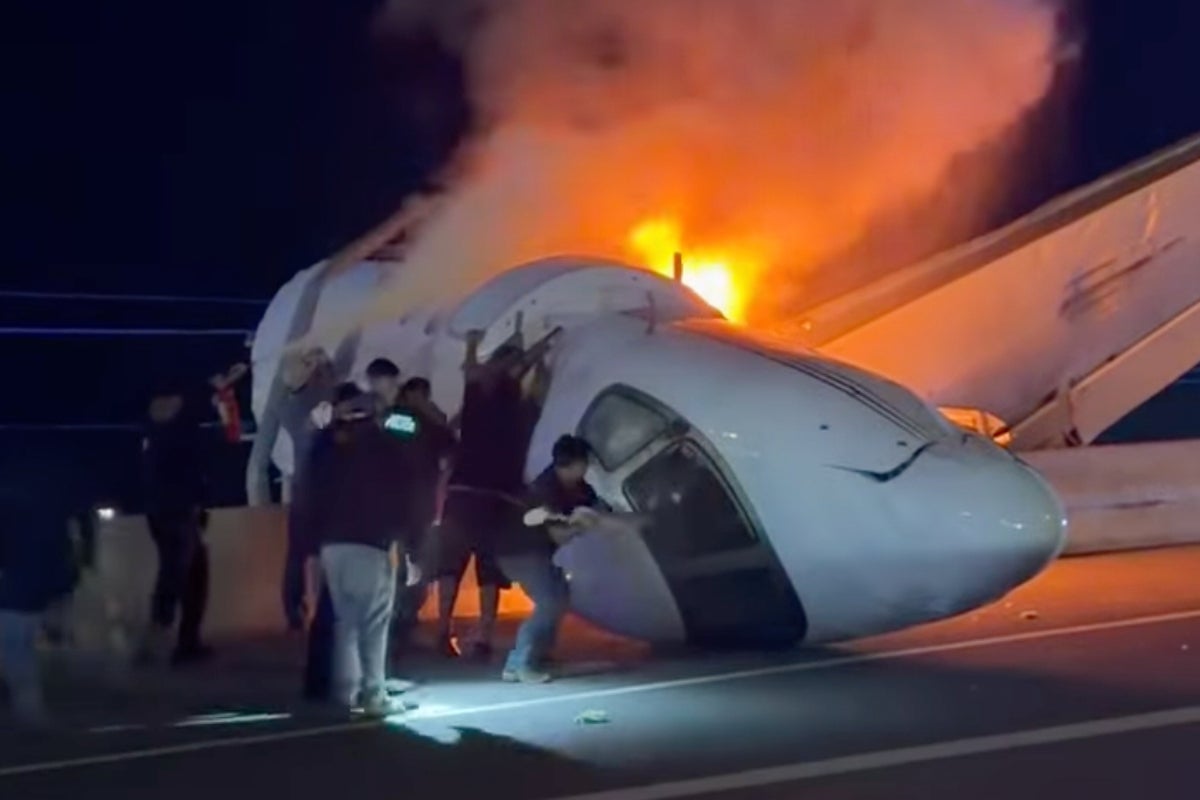
Fatal Private Jet Crash Wreaks Fiery Havoc on Texas Highway
One person died and five others were injured when a NetJets private aircraft crashed on a Texas highway and burst into flames, according to reports from The Guardian and Sky News. Motorists and bystanders intervened to rescue survivors from the burning wreckage before emergency responders arrived on the scene, as detailed by CNN and The Telegraph.
What Happened During the Texas Private Jet Crash?
A small private jet operated by NetJets crashed directly onto a Texas highway, triggering a massive fire that blocked traffic and created a hazardous scene for both passengers and motorists. According to reports from The Independent, the impact resulted in “fiery havoc,” with the aircraft becoming engulfed in flames shortly after hitting the pavement.
The crash occurred in a populated area where highway traffic was active. The aircraft’s descent ended abruptly on the roadway, leading to an immediate emergency response. Local authorities and fire crews worked to extinguish the blaze, but the intensity of the fire made the initial moments critical for those trapped inside the fuselage.
Key details of the incident include:
- Aircraft Operator: NetJets, a prominent provider of fractional aircraft ownership.
- Location: A public highway in Texas.
- Outcome: One confirmed fatality and five injuries.
- Immediate Effect: Total closure of the affected highway stretch and a large-scale fire response.
Who Was Involved and What Was the Human Toll?
The human cost of the crash is confirmed at one death and five injuries, according to The Guardian. While the identities of the passengers and crew have not been widely released in initial reports, the scale of the injuries suggests a high-impact event followed by significant thermal exposure due to the ensuing fire.
The rescue operation was characterized by the rapid response of civilians. CNN reports that bystanders rushed toward the burning aircraft to assist those inside. These motorists, who happened to be traveling on the highway at the time of the crash, acted as first responders, pulling survivors from the wreckage while the plane was still on fire.
“Drivers rush to rescue survivors from burning plane after crashing on Texas highway,” reported Sky News, highlighting the role of civilian intervention in preventing further loss of life.
The five survivors were transported to nearby medical facilities for treatment. The severity of their injuries has not been specifically categorized, though the nature of a “fiery” crash typically involves a combination of blunt force trauma and smoke inhalation or burns.
How Did Bystanders Influence the Outcome?
In the immediate aftermath of the impact, the time between the crash and the arrival of professional fire and rescue services is known as the “golden hour” or, more accurately in this case, the “golden minutes.” The Telegraph reports that bystanders were instrumental in the rescue, as they reached the aircraft before official emergency crews could establish a perimeter and deploy equipment.
The intervention of these drivers was critical for several reasons:
- Immediate Extraction: The fire spread quickly, meaning passengers who could not exit on their own faced imminent danger.
- Triage: Civilians provided the first layer of assistance, moving victims away from the heat source.
- Situational Awareness: Motorists on the scene were able to provide immediate reports to dispatchers regarding the number of survivors and the location of the fire.
This event underscores a recurring theme in aviation accidents occurring in urban or highway settings: the proximity of the public often leads to unplanned but life-saving civilian intervention.
Understanding NetJets and the Private Aviation Sector
The aircraft involved in the crash was operated by NetJets. To understand the implications of this crash, it is necessary to examine the business model of the operator. NetJets does not operate as a traditional charter service but as a fractional ownership company. This means clients buy a share of a specific aircraft and are guaranteed a certain number of flight hours per year.
Because NetJets manages a massive fleet of aircraft and employs a large number of pilots, they are often viewed as a benchmark for safety and standardization in the private aviation sector. A crash involving a NetJets aircraft typically triggers significant scrutiny from aviation regulators due to the company’s high profile and the perceived rigor of its training programs.
| Feature | Fractional Ownership (e.g., NetJets) | Private Charter |
|---|---|---|
| Ownership | Client owns a share of the plane | Client rents the plane for a trip |
| Maintenance | Managed centrally by the company | Managed by the individual owner/operator |
| Pilot Training | Standardized corporate training | Varies by operator |
The incident raises questions about the flight path and the circumstances that led a private jet to descend onto a major highway. For more information on aviation safety standards, see a related explainer on FAA safety regulations.
Why Do Private Jets Crash on Highways?
While the official cause of this specific Texas crash is pending an investigation by the National Transportation Safety Board (NTSB) or relevant authorities, aviation experts point to several common factors that lead to aircraft ending up on roadways.
Emergency Forced Landings
When a pilot experiences total engine failure or a critical mechanical malfunction near an airport or urban center, they must find the most “survivable” piece of flat land. Highways, while dangerous due to traffic, provide a long, flat, and paved surface that is often preferable to crashing into buildings, forests, or residential neighborhoods.
Controlled Flight Into Terrain (CFIT)
CFIT occurs when an airworthy aircraft is flown unintentionally into the ground. This can be caused by pilot disorientation, poor visibility, or incorrect altimeter settings. If a plane is flying low during an approach or departure, a CFIT event can easily result in a highway strike.

Mechanical Failure during Departure or Approach
Most private jet accidents occur during the takeoff or landing phases. If a plane loses power shortly after takeoff, the pilot has very little altitude to work with, often forcing a descent into the nearest open space—which, in Texas, is frequently a highway.
Comparing Media Coverage of the Incident
An analysis of how different news outlets reported the “fatal private jet crash wreaks fiery havoc on Texas highway” reveals different editorial priorities. While the facts remain consistent—one dead, five injured, NetJets aircraft—the framing varies.
- The Guardian and The Independent: These outlets focused heavily on the “fiery havoc” and the casualty count, framing the story as a tragic accident with a focus on the aftermath.
- CNN and The Telegraph: These reports placed a stronger emphasis on the “heroism” of the bystanders. Their narratives centered on the motorists who risked their lives to pull passengers from the flames.
- Sky News: This outlet provided a more direct, breaking-news style report, prioritizing the immediate sequence of events: the crash, the fire, and the rescue.
This contrast shows a divide between “outcome-based reporting” (casualties) and “action-based reporting” (the rescue). Both perspectives are necessary to provide a full picture of the event.
The Implications for Aviation Safety in Urban Areas
The Texas crash highlights the inherent risk of “urban encroachment,” where cities and highways expand into areas that were previously clear of residential or commercial infrastructure. When airports are surrounded by highways, any emergency descent becomes a high-stakes interaction between aviation and ground transport.
Industry analysts suggest that this incident may lead to renewed discussions on several fronts:
- Flight Path Review: Evaluating whether certain approach and departure paths over high-traffic highways can be modified to reduce risk.
- Emergency Response Coordination: Improving the communication between aviation authorities and highway patrol to clear roads faster during an aviation emergency.
- Bystander Training: While civilians saved lives in this instance, the risk of explosions in aircraft crashes is high. There is often a debate about whether civilians should approach burning aircraft before fire crews arrive.
For further context on how these risks are managed, readers may find a related explainer on urban airport zoning useful.
Common Misconceptions About Private Jet Crashes
Following reports of a “fatal private jet crash wreaks fiery havoc on Texas highway,” several misconceptions often arise in public discourse. It is important to clarify these based on aviation standards.
Misconception 1: Private jets are less safe than commercial airliners.
While commercial airliners have more redundant systems (e.g., multiple flight crews and advanced autopilot), high-end fractional operators like NetJets maintain safety standards that often mirror or exceed those of commercial airlines. The risk is often higher in “General Aviation” (small, privately owned planes) than in “Corporate Aviation” (managed fleets).
Misconception 2: A fire always means the plane exploded on impact.
In most aviation crashes, the fire is caused by the rupture of fuel tanks during the impact, which then ignites due to sparks or heat. The “fiery havoc” described in the Texas crash is typically a post-impact fuel fire rather than an in-flight explosion.
Misconception 3: Pilots always have time to steer away from highways.
In a “loss of control” or “engine out” scenario, a pilot may have only seconds to react. If the aircraft is at a low altitude, the highway may be the only viable option to avoid a more catastrophic collision with a structure.
Frequently Asked Questions
Which company operated the plane in the Texas highway crash?
The aircraft was operated by NetJets, a company specializing in fractional aircraft ownership.
How many people were killed or injured in the crash?
According to reports from The Guardian and other sources, one person was killed and five others were injured.
Who rescued the survivors from the burning jet?
Bystanders and motorists who were on the highway at the time of the crash rushed to the aircraft to pull survivors from the flames before emergency services arrived.
What caused the private jet to crash on the highway?
The official cause has not yet been determined. Investigations by aviation authorities are typically required to analyze flight data recorders and wreckage to find the root cause.
Where exactly in Texas did the crash occur?
The reports specify that the crash happened on a Texas highway, though the specific highway number and city were not highlighted in the primary headlines of the cited reports.
The investigation into the NetJets crash continues, with a focus on the mechanical state of the aircraft and the sequence of events leading to the descent. As the NTSB or local authorities release more data, the focus will likely shift from the immediate rescue efforts to the systemic failures that led to the aircraft hitting a public roadway.
