The American Flags Planted by Apollo Astronauts Have Likely Bleached Pure White After 50 Years of Unfiltered Solar Radiation
The American flags planted by Apollo astronauts have likely bleached pure white after 50 years of unfiltered solar radiation, leaving the most famous banners in history standing as blank cloth, according to reporting by Space Daily. The absence of a protective atmosphere on the lunar surface exposed the nylon fabric to intense ultraviolet (UV) radiation, which breaks down the chemical bonds of the red and blue dyes.
Why did the Apollo moon flags lose their color?
The degradation of the Apollo flags is a result of prolonged exposure to the harsh lunar environment. On Earth, the atmosphere and ozone layer filter out the most damaging wavelengths of ultraviolet radiation from the sun. The moon lacks an atmosphere, meaning the flags have been subjected to the full spectrum of solar UV radiation since they were first deployed between 1969 and 1972. This process, known as photodegradation, occurs when high-energy photons strike the dye molecules in the fabric, breaking the chemical bonds that reflect specific colors of light.
According to Space Daily, this relentless exposure has likely stripped the flags of their iconic red and blue hues. Once the pigment molecules are destroyed, the fabric no longer reflects those colors, leaving the nylon as a bleached, white remnant. This is a common occurrence with synthetic materials left in high-UV environments, though the effect is accelerated on the moon due to the total lack of atmospheric shielding.
Key factors contributing to the bleaching include:
- Unfiltered UV-C Radiation: The most energetic form of UV light, which is completely blocked by Earth’s ozone layer but hits the lunar surface directly.
- Extreme Temperature Fluctuations: Lunar surface temperatures swing from roughly 250 degrees Fahrenheit in the sun to minus 208 degrees Fahrenheit in the shade, stressing the physical integrity of the fabric.
- Vacuum Exposure: The lunar vacuum can cause some materials to outgas, potentially altering the chemical stability of the dyes.
What role does solar radiation play in the bleaching process?
Solar radiation consists of various wavelengths, including infrared, visible light, and ultraviolet radiation. UV radiation is particularly destructive because its photons carry enough energy to disrupt molecular bonds. In the case of the Apollo flags, the dyes used in the nylon fabric were not designed for multi-decade exposure to raw solar wind and UV rays.

When UV photons hit the dye molecules, they trigger a chemical reaction that alters the molecule’s structure. Once the structure changes, the molecule can no longer absorb and reflect the specific wavelengths of light that we perceive as red or blue. Over five decades, this process continues until almost all the pigment is gone. Space Daily notes that the result is a transition from the stars and stripes to a blank, white cloth.
This process is not limited to the flags. Other materials left on the moon, such as the lunar module descent stages and scientific instruments, have also faced degradation. However, metals and specialized coatings like Kapton foil are far more resistant to UV bleaching than the organic dyes used in textile fabrics.
| Material | Reaction to Solar Radiation | Expected Outcome |
|---|---|---|
| Nylon Fabric (Dye) | High Photodegradation | Complete bleaching to white |
| Aluminum Poles | Low Chemical Reaction | Surface oxidation/pitting |
| Kapton Foil (Gold) | High UV Resistance | Retention of reflective properties |
| Lunar Soil (Regolith) | Space Weathering | Gradual darkening/chemical shift |
How were the Apollo flags designed to withstand the lunar environment?
NASA engineers knew the moon presented a challenge, but the primary concern during the Apollo missions was not long-term color preservation. The immediate goal was to ensure the flags remained visible and “flying” in a vacuum where there is no wind. To achieve this, the flags were equipped with a horizontal telescopic crossbar that extended from the top of the flagpole. This bar held the fabric outward, creating the illusion of a waving flag in the photographs.
The fabric itself was a standard nylon. While nylon is durable, it is susceptible to UV degradation over long periods. The flags were not treated with advanced UV-resistant coatings because they were intended as symbolic markers of achievement rather than permanent architectural installations. The focus was on the deployment mechanism—ensuring the astronauts could plant the pole in the regolith and extend the arm without the fabric collapsing.
According to historical mission records, some astronauts struggled with the horizontal bars. For example, on Apollo 11, the bar did not fully extend, which left the fabric with a rippled appearance. This ripple, combined with the lack of wind, created the famous “waving” look that later became a point of contention for conspiracy theorists, despite being a result of mechanical failure and physics.
Can the Lunar Reconnaissance Orbiter (LRO) confirm the flags’ condition?
The Lunar Reconnaissance Orbiter (LRO), launched by NASA in 2009, has provided the most detailed imagery of the Apollo landing sites to date. While the LRO can identify the location of the descent stages and the astronaut footpaths, its resolution is not high enough to see the color of the flags. The flags are too small to be resolved as distinct colored objects from an orbiting satellite.
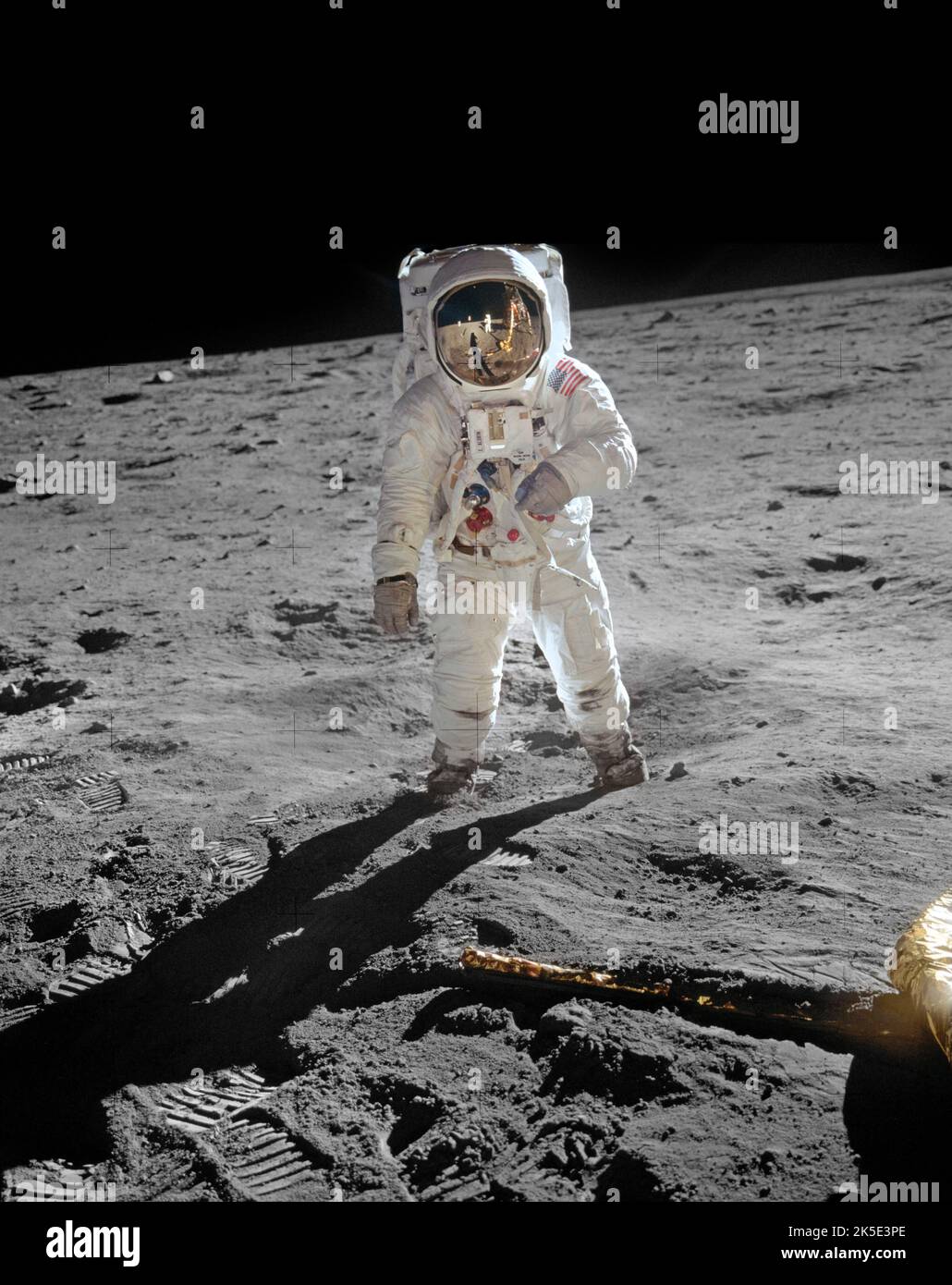
However, LRO data has provided indirect evidence regarding the flags’ existence. In several missions, the LRO detected shadows cast by the flags. By analyzing the length and direction of these shadows, NASA scientists have concluded that most of the flags are still standing, though some may have been knocked over by the exhaust of the ascent stages during liftoff. While the LRO cannot “see” that they are white, the scientific consensus on UV degradation makes the bleaching reported by Space Daily a near-certainty.
For those interested in the visual history of these sites, a related explainer on LRO imaging capabilities provides more detail on how NASA maps the lunar surface.
What does this mean for the preservation of lunar heritage?
The likely bleaching of the Apollo flags raises questions about the preservation of human history in space. The Apollo landing sites are considered “heritage sites,” containing artifacts that document the first time humans stepped onto another celestial body. The loss of the flags’ color is a physical manifestation of the “space weathering” that affects everything on the lunar surface.
Some space historians argue that the bleached state of the flags adds a new layer of meaning. Rather than being pristine symbols, the blank white cloths serve as a testament to the passage of time and the extreme hostility of the environment the astronauts braved. The flags are no longer just markers of a nation, but markers of the endurance of human materials against the vacuum of space.
There are ongoing discussions within international space agencies about the creation of “Protected Lunar Heritage Sites.” These would prevent future commercial or government missions from landing too close to the Apollo sites, which could kick up regolith and bury the flags or damage the descent stages. If the flags are already bleached white, the risk of them being physically destroyed by lunar dust becomes an even more pressing concern for preservationists.
Timeline of Apollo Flag Deployments
- July 1969 (Apollo 11): First flag planted by Neil Armstrong and Buzz Aldrin at the Sea of Tranquility.
- November 1969 (Apollo 12): Second flag planted in the Ocean of Storms.
- February 1971 (Apollo 14): Third flag planted in the Fra Mauro highlands.
- July 1971 (Apollo 15): Fourth flag planted at the Hadley-Apennine region.
- April 1972 (Apollo 16): Fifth flag planted in the Descartes Highlands.
- December 1972 (Apollo 17): Sixth and final flag planted at Taurus-Littrow.
Common misconceptions about the Apollo flags
The state of the flags often leads to misunderstandings about the nature of the missions. One common myth is that the flags “waved” because there was wind on the moon. In reality, the flags moved only when the astronauts were physically manipulating the pole. Once released, the nylon fabric continued to vibrate briefly due to inertia, but since there is no air resistance to slow the movement, the vibration lasted longer than it would on Earth.
Another misconception is that the flags would have disintegrated completely. While the dyes have likely bleached white, the nylon polymer itself is more resistant to UV radiation than the pigment. While the fabric may become brittle over centuries, it is unlikely to vanish entirely in 50 years. The flags are likely still there, just colorless.
Finally, some suggest that the flags were “painted” or “fake” because they look the same in different photos. This is simply because the horizontal bar kept them in a fixed, outstretched position, creating a consistent silhouette across different images taken during the same mission.
The broader impact of UV degradation in space exploration
The bleaching of the Apollo flags is more than a historical curiosity; it is a lesson in materials science for future missions. As NASA prepares for the Artemis missions, which aim to return humans to the lunar surface and establish a long-term presence, the degradation of the Apollo flags informs how new equipment is built.
Modern spacecraft use advanced polymers and metallic coatings that are specifically engineered to resist UV radiation and atomic oxygen. For example, the materials used in the International Space Station (ISS) are constantly monitored for degradation. The “blank cloth” result of the Apollo flags demonstrates why “off-the-shelf” materials from the 1960s are insufficient for permanent lunar bases.
Future lunar markers or flags will likely use materials like titanium-dioxide-based pigments or inorganic ceramics that do not break down under UV exposure. This ensures that the symbols of exploration remain visible for centuries rather than decades.
| Era | Primary Material Focus | Durability Strategy |
|---|---|---|
| Apollo (1960s/70s) | Nylon/Aluminum | Short-term deployment, symbolic focus |
| ISS (1990s-Present) | Kevlar/Multi-Layer Insulation (MLI) | Active maintenance, UV-shielding layers |
| Artemis (Future) | Advanced Composites/Regolith-based 3D printing | Permanent sustainability, radiation-hardened materials |
FAQs About the Apollo Moon Flags
Are the Apollo flags still standing on the moon?
According to data from the Lunar Reconnaissance Orbiter (LRO), most of the flags are believed to still be standing, although some may have been knocked over by the exhaust of the Lunar Module ascent stages during departure.
Why aren’t the flags just gone?
While the dyes in the fabric bleach white due to UV radiation, the nylon structure of the cloth is more resilient. It takes much longer for the actual polymer chains of the nylon to break down completely than it does for the pigment molecules to be destroyed.

Will the flags ever be recovered?
There are currently no official NASA plans to recover the Apollo flags. They are generally viewed as historical monuments. Recovering them would require a high-precision landing and could potentially damage the surrounding lunar environment.
Could the flags have been destroyed by micrometeorites?
While micrometeorites hit the lunar surface constantly, the probability of a direct hit on a small piece of fabric is low. However, over thousands of years, it is likely that the flags will be shredded by these tiny, high-velocity impacts.
Do other colors bleach faster than others?
Generally, red pigments are among the most susceptible to UV degradation because they often rely on chemical bonds that are easily broken by high-energy photons. Blue and green dyes also fade, but red often disappears first, which is why the American flags would transition toward white.
For more information on how NASA is planning for future lunar habitats, see a related explainer on Artemis mission goals.
