Researchers Achieve Chirality Switch in Semiconductors via Electrochemistry
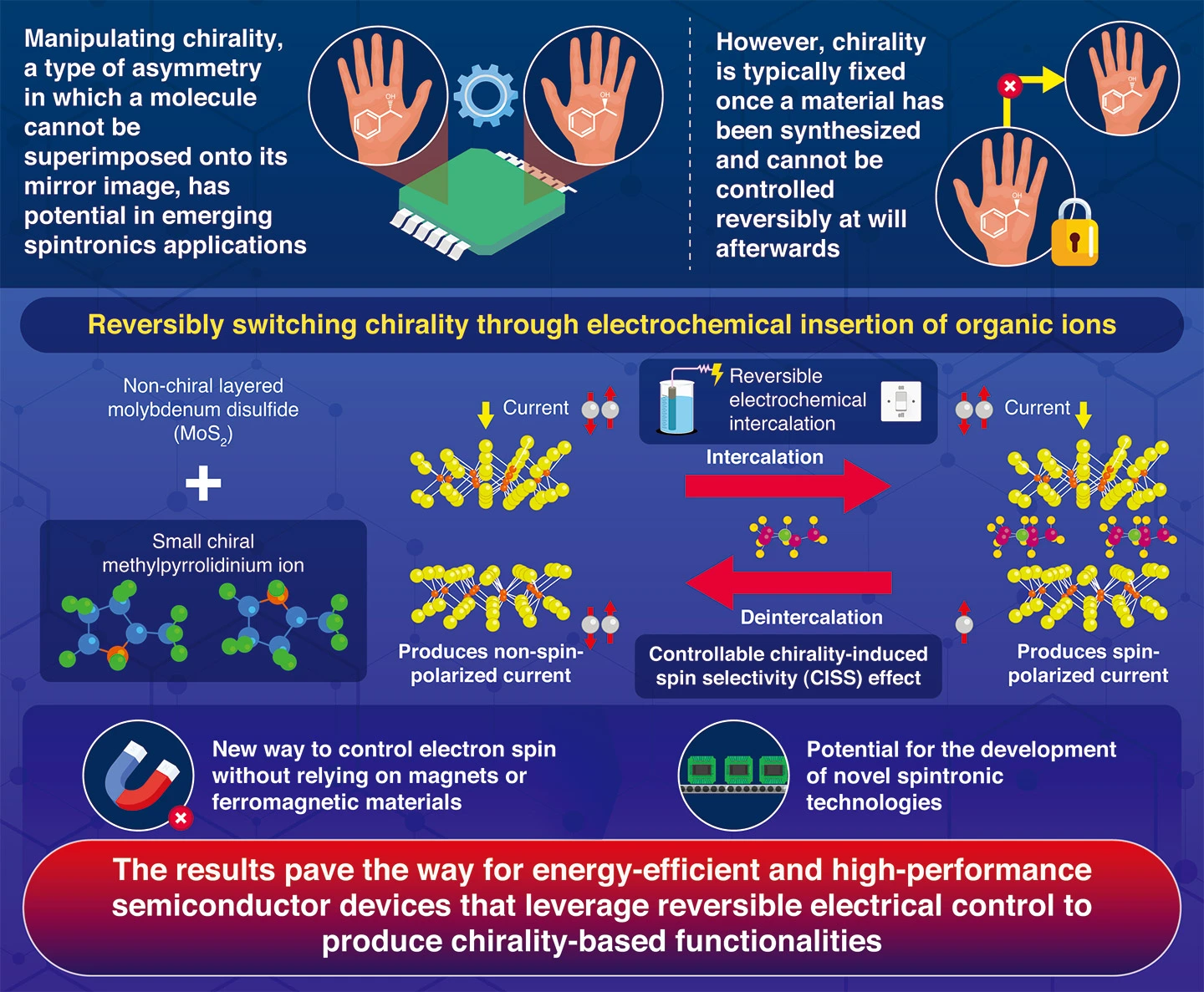
Scientists have developed a method to trigger a chirality switch in semiconductors using electrochemical processes, enabling the reversible control of a material’s structural “handedness.” According to research reports, this technique allows for the manipulation of electronic and optical properties without changing the material’s chemical composition, providing a new mechanism for developing spintronic and valleytronic devices.
How does the chirality switch in semiconductors via electrochemistry work?
A chirality switch occurs when a material’s structural symmetry is altered so that it becomes a non-superimposable mirror image of its previous state. In the context of semiconductors, researchers use electrochemistry to drive ions—such as lithium or protons—into the crystal lattice of a semiconductor. This process, known as intercalation, creates internal strain and shifts the positions of atoms within the lattice.
According to materials science principles, this structural distortion breaks the original symmetry of the semiconductor. By applying a specific voltage, the ions can be pushed into or pulled out of the material, effectively “flipping” the chirality of the system. This transition changes how electrons move through the material and how the material interacts with polarized light.
The process relies on three primary components:
- The Semiconductor Host: Typically a two-dimensional (2D) material, such as a transition metal dichalcogenide (TMD), which possesses a naturally layered structure.
- The Electrolyte: A medium that allows ions to move from the electrode into the semiconductor.
- The External Voltage: The trigger that controls the direction and density of ion flow, determining whether the chirality is switched or restored.
The ability to reverse this switch using only an electrical signal means these materials can function as non-volatile switches, retaining their chiral state even after the power is turned off.
Why is chirality significant for semiconductor technology?
Traditional semiconductors rely on the movement of electrical charge (electrons) to process information. However, chirality introduces a new degree of freedom: the “handedness” of the electron’s state or the crystal’s structure. This is the foundation of two emerging fields: spintronics and valleytronics.
The role of spintronics
Spintronics uses the intrinsic spin of an electron—up or down—rather than just its charge. A chiral semiconductor can act as a filter, allowing electrons of one spin to pass while blocking others. By switching the chirality via electrochemistry, engineers can change the spin-filtering properties of a device in real-time, which is essential for creating high-speed, low-power memory storage.
The emergence of valleytronics
Valleytronics is a more recent development that utilizes the “valley” index of electrons in the energy band structure of a semiconductor. In certain 2D semiconductors, electrons occupy two distinct energy minima, or valleys. Chirality switching allows researchers to control which valley the electrons occupy. According to technical analysis, this could lead to a new generation of “valley-bits” that process information faster than current binary transistors.
| Feature | Traditional Semiconductors | Chiral Semiconductors (Electrochemical) |
|---|---|---|
| Information Carrier | Electron Charge | Electron Spin / Valley Index |
| Control Mechanism | Voltage Gate (Field Effect) | Ion Intercalation (Electrochemical) |
| Energy Consumption | Higher (due to leakage) | Potentially Lower (non-volatile) |
| Switching Speed | Extremely Fast | Moderate (limited by ion diffusion) |
The electrochemical process vs. traditional doping
For decades, the semiconductor industry has relied on doping—the intentional introduction of impurities into a silicon crystal—to change its electrical properties. Doping is a permanent chemical change; once a wafer is doped, its properties are fixed.
The chirality switch in semiconductors via electrochemistry represents a fundamental shift because it is dynamic and reversible. Instead of permanently altering the crystal, electrochemistry uses ions as “temporary guests.” When the voltage is reversed, the ions leave the lattice, and the material returns to its original state.
Key distinctions include:
- Reversibility: Doping is static; electrochemical switching is toggleable.
- Precision: Electrochemistry allows for the tuning of the chiral state by adjusting the concentration of intercalated ions.
- Material Integrity: Because the process does not involve high-heat implantation, the crystal structure remains intact over multiple cycles.
This capability makes the technology a candidate for related explainer on memristors, which are components that “remember” the amount of charge that has passed through them, mimicking the synapses of a human brain.
What are the primary challenges to commercialization?
Despite the potential for high-efficiency computing, several hurdles remain before chirality-switching semiconductors enter mass production. The most significant issue is the speed of the switch. While electronic charge moves at near-light speed, the movement of ions (electrochemistry) is significantly slower.
Ion diffusion rates
The time it takes for ions to migrate from the electrolyte into the semiconductor lattice creates a latency period. For this technology to compete with silicon-based RAM, researchers must find ways to accelerate ion transport or use thinner materials to reduce the distance ions must travel.
Long-term stability
Repeatedly shoving ions into and out of a crystal lattice can cause mechanical stress. Over thousands of cycles, this stress can lead to “lattice fatigue,” where the semiconductor develops micro-cracks or permanent deformations, eventually destroying the device. Ensuring the structural longevity of these materials is a primary focus of current durability testing.
Integration with existing CMOS
The current global semiconductor infrastructure is built on Complementary Metal-Oxide-Semiconductor (CMOS) technology. Integrating an electrochemical cell—which requires an electrolyte—onto a standard silicon chip is a complex engineering challenge. Most current prototypes are laboratory-scale; translating them to a fab-ready process requires new methods of encapsulation to prevent the electrolyte from leaking or evaporating.
Comparison of chirality-switching methods
Electrochemistry is not the only way to induce a chirality switch. Researchers have explored mechanical strain and optical pumping as alternatives. However, each method has distinct trade-offs in terms of energy and control.
Mechanical Strain: Using a piezoelectric substrate to physically stretch the semiconductor can flip its chirality. While fast, this requires bulky hardware and is difficult to implement at the nanometer scale.
Optical Pumping: Using circularly polarized lasers can induce a chiral state in electrons. This is incredibly fast but requires an external laser source, making it impractical for portable consumer electronics.
Electrochemical Switching: This method provides the best balance of low energy consumption and stability. Because it is non-volatile, it does not require a constant power source to maintain the switched state, unlike optical or mechanical methods.
Impact on the future of quantum and neuromorphic computing
The ability to control chirality has direct implications for the architecture of future computers. Neuromorphic computing aims to create hardware that mimics the neural networks of the brain, where “weights” (the strength of connections) change over time.
An electrochemical chirality switch can act as a tunable synapse. By controlling the degree of ion intercalation, the material can exist in a spectrum of states between “left-handed” and “right-handed,” rather than a simple on/off binary. This allows for analog computing, which is far more efficient for AI workloads and pattern recognition than digital computing.
In quantum computing, chirality is linked to the protection of quantum states. Certain chiral structures can host “topological” states that are resistant to noise and decoherence. If chirality can be switched electrically, it may be possible to “route” quantum information across a chip by changing the chirality of the paths the qubits travel.
Current milestones in this research include:
- Demonstration of reversible switching: Proving that the material can flip back and forth without degrading.
- Optical verification: Using spectroscopy to confirm that the handedness of the material has actually changed.
- Device prototyping: Creating the first basic transistors that utilize the chiral switch for logic operations.
Frequently Asked Questions
What is the difference between chirality and symmetry in semiconductors?
Symmetry refers to the general regularity of a crystal lattice. Chirality is a specific type of asymmetry where an object cannot be superimposed on its mirror image. While a material can be symmetric, a chiral material is inherently asymmetric in a way that creates “left” and “right” versions of the same structure.
Can this technology replace silicon chips?
It is unlikely to replace silicon entirely in the near term. Instead, it will likely serve as a complementary technology. Chiral semiconductors may be used for specialized tasks—like AI processing or high-density memory—while silicon continues to handle general-purpose logic.
How does the “switch” actually change the electronic properties?
When the chirality flips, it changes the “spin-orbit coupling” of the electrons. This means the electrons’ movement becomes linked to their spin in a different way, changing the electrical resistance and the way the material absorbs or emits light.
Is this process energy-efficient?
Yes, because the switch is non-volatile. Once the ions are moved into place to change the chirality, they stay there. This eliminates the “leakage current” that plagues traditional transistors, which must be constantly powered to maintain their state.
What materials are most commonly used for this research?
Researchers primarily use 2D materials like Molybdenum Disulfide (MoS2) or Tungsten Diselenide (WSe2). These materials are ideal because their atomic thickness allows ions to enter and exit the lattice with minimal resistance.
The shift toward electrochemical control of chirality marks a transition from viewing semiconductors as static components to viewing them as dynamic, tunable systems. As the industry seeks alternatives to the shrinking limits of Moore’s Law, the ability to encode information in the structural handedness of a material offers a viable path toward lower-power, higher-density computing.
