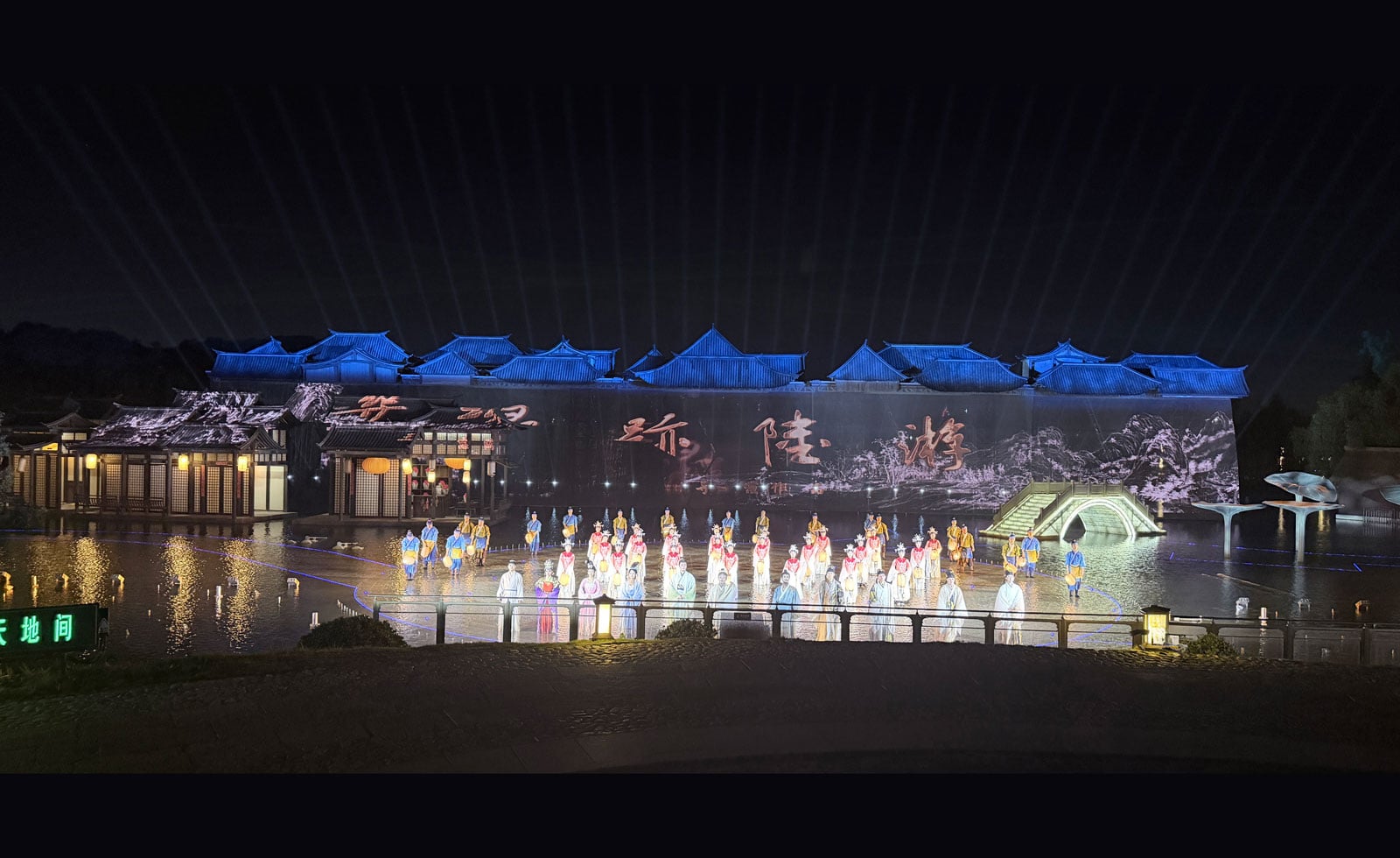
Christie Laser Projectors Light Song Dynasty Poet Lu You Spectacle – LSi Online
A sophisticated fusion of ancient Chinese literature and cutting-edge visual technology has come to life through a massive water show dedicated to the legendary Song Dynasty poet Lu You. By deploying high-performance Christie laser projectors, the production transforms a water-based stage into a dynamic canvas, translating Lu You’s evocative poetry into immersive visual narratives. This integration of laser projection technology allows for unprecedented brightness and color precision, ensuring that the delicate nuances of Song Dynasty aesthetics are preserved even on a grand, outdoor scale.
How Christie Laser Projectors Transform Poetry Into Visual Art
The core of this spectacle lies in the ability to project high-definition imagery onto a non-traditional surface: water. Projecting on water is notoriously difficult due to the reflective and refractive nature of the medium. To overcome these challenges, the production utilized Christie’s advanced laser projection ecosystem, which provides the lumen output necessary to punch through ambient light and maintain image contrast on a fluid surface.
Unlike traditional lamp-based projectors, the laser technology used in the Lu You spectacle offers a more consistent light source. This is critical for a show that relies on the “ink-wash” aesthetic common in Song Dynasty art. The deep blacks and subtle grey gradients required to mimic traditional Chinese calligraphy and painting are only achievable with the high contrast ratios provided by modern laser phosphors or RGB pure laser systems.
The technical execution involves several key components:
- High Lumen Output: Ensuring the visuals remain vivid despite the light absorption of the water.
- Precise Color Calibration: Matching the specific palette of historical Song Dynasty artifacts.
- Seamless Blending: Using multiple projectors to create a single, massive image without visible seams or overlaps.
- Environmental Durability: Housing the equipment in climate-controlled enclosures to protect the electronics from the humidity of the water show environment.
The transition from text to light allows the audience to experience the emotional weight of Lu You’s work not just as a literary exercise, but as a visceral, sensory event.
The Legacy of Lu You: Why This Poet Matters
To understand the scale of this production, one must understand the significance of Lu You (1125–1210). A titan of the Southern Song Dynasty, Lu You is revered as one of China’s most prolific and patriotic poets. His work often blended a deep love for the natural world with a poignant, sometimes heartbreaking, longing for national reunification and social justice.
Translating these themes into a visual spectacle requires more than just bright lights; it requires an understanding of mood. The production designers used the Christie projectors to evoke the specific atmospheres found in Lu You’s verses—misty mountains, flowing rivers, and the quiet solitude of a scholar’s study. By using digital projection, the show can shift instantly from a serene landscape to a dramatic, sweeping vista, mirroring the emotional shifts in the poetry.
The use of technology here serves a dual purpose: it preserves cultural heritage while making it accessible to a modern audience that may find traditional poetry daunting. By turning a poem into a “spectacle,” the organizers have created a bridge between the 12th and 21st centuries.
Technical Challenges of Water-Based Projection
Projecting onto water is fundamentally different from projecting onto a white screen. Water acts as both a mirror and a lens, which can cause “hot spots” or distorted images if the angle of projection is not perfectly calculated. The team behind the Lu You show had to employ sophisticated mapping software to ensure the images aligned with the movement of the water.
One of the primary hurdles was managing the specular reflection. When light hits water, much of it bounces away from the viewer. To combat this, the production likely utilized a combination of specific projection angles and potentially a projection screen made of water mist or a specialized thin-film layer on the water’s surface to “catch” the light more effectively.
| Challenge | Technical Solution | Impact on Viewer |
|---|---|---|
| Light Scattering | Ultra-high lumen laser sources | Crisp, vivid images despite water movement |
| Surface Distortion | Real-time warping and mapping | Stable imagery that feels “anchored” to the stage |
| Color Washout | Wide color gamut laser technology | Deep, saturated tones mimicking ink paintings |
| Environmental Humidity | Industrial-grade weatherized housings | Consistent performance without hardware failure |
Furthermore, the synchronization of the visuals with the water fountains adds a layer of complexity. The projectors must be timed to the millisecond with the water jets, creating a 3D effect where the light appears to be sculpted by the water itself. This requires a centralized control system that manages the media servers, the projectors, and the hydraulic pumps of the water show simultaneously.
The Shift from Lamp to Laser in Large-Scale Installations
The choice of Christie laser projectors over traditional xenon lamp projectors was not merely a preference but a technical necessity. For a permanent or semi-permanent installation of this magnitude, the operational costs and maintenance of lamps are prohibitive.
Longevity and Maintenance: Laser projectors typically offer 20,000 hours or more of operation before requiring a light source replacement. In contrast, traditional lamps require frequent changes and suffer from “brightness decay,” where the image dims over time. For a nightly spectacle, the reliability of laser is indispensable.
Color Precision: Laser light is monochromatic and highly coherent. This allows for a much wider color gamut, meaning the production can produce colors that are physically impossible for lamp-based systems to replicate. In the context of the Lu You show, this means the “imperial gold” and “jade green” of the Song Dynasty are rendered with absolute fidelity.
Instant On/Off: Laser systems do not require a “warm-up” or “cool-down” period. This allows the production team to trigger scenes instantly, facilitating the sharp, rhythmic cuts required for a modern theatrical performance.
For those interested in how this fits into broader trends, a related explainer on immersive digital art discusses the rise of “projection mapping” in global tourism.
Cultural Impact and the Future of “Digital Heritage”
The “Christie laser projectors light Song Dynasty poet Lu You spectacle – LSi Online” story is a prime example of a growing trend known as “Digital Heritage.” This involves using high-tech tools to breathe new life into historical sites and figures. By moving poetry out of the textbook and into a multi-sensory environment, the production increases the “emotional resonance” of the history.
This approach has several implications for the future of cultural tourism:
- Increased Engagement: Younger generations are more likely to engage with history when it is presented through an immersive, “Instagrammable” medium.
- Dynamic Storytelling: Unlike a static museum exhibit, a projection show can be updated. New poems can be added, or the visual style can be changed for different seasons.
- Economic Revitalization: These spectacles often become anchor attractions for cities, drawing tourists who then spend money at local businesses and museums.
However, some critics argue that the “spectacle” can overshadow the “substance.” The risk is that the audience remembers the bright lights more than the poignant words of Lu You. To mitigate this, the production integrates the poetry into the visuals, ensuring that the text remains a focal point of the experience rather than just a background for the light show.
Comparing Modern Projection Spectacles
When comparing the Lu You spectacle to other global installations, such as those found in Las Vegas or at the Louvre in Paris, the primary difference is the thematic intent. While many shows focus on sheer technical prowess or abstract art, the Lu You production is an exercise in narrative storytelling. It uses technology as a servant to the literature.
In many Western installations, the goal is often “disruption”—creating a surreal environment. In this Chinese production, the goal is “harmony”—using the light to enhance the natural beauty of the water and the timelessness of the poetry. This reflects a fundamental difference in aesthetic philosophy: one seeks to challenge the senses, while the other seeks to elevate the spirit through traditional values.
The scale of the Christie installation also sets a benchmark for future regional projects. By proving that laser projection can handle the volatility of a water surface at this scale, it opens the door for more ambitious “water-screen” projects across Asia.
Common Misconceptions About Laser Projection
There are several common misunderstandings regarding the technology used in this spectacle. First, many believe that “laser projection” is the same as a “laser light show” (the beams of light that dance in the sky). In reality, these are very different. A laser light show uses coherent beams to create lines and shapes; a laser projector uses a laser as the light source to push a high-resolution image through a lens, much like a traditional projector but with far more power and precision.
Second, there is a misconception that these systems are too expensive for cultural projects. While the initial capital expenditure is higher than lamp-based systems, the total cost of ownership (TCO) is lower due to the lack of lamp replacements and reduced energy consumption. For a government-funded or high-traffic tourist attraction, the ROI is found in the reduced maintenance downtime and the increased ticket sales driven by the superior visual quality.
Finally, some assume that projecting on water is a “trick” of the light. In fact, it is a complex calculation of physics. The “screen” is often a carefully controlled curtain of water droplets or a thin layer of mist, which provides the necessary surface area for the light to reflect back to the audience’s eyes.
The Synergy of Art and Engineering
The success of the Lu You spectacle is not due to the hardware alone, but to the synergy between the engineers and the artists. The engineers provided the “canvas” (the light and the water), but the artists provided the “soul” (the poetry and the choreography). This collaboration is where the true innovation happens.
The production team had to map the “emotional arc” of Lu You’s life—his early ambitions, his middle-age frustrations, and his late-life reflections—and assign a visual language to each phase. For example, the use of cooler blue tones and slow-moving water visuals during his more melancholic poems, contrasting with vibrant golds and rapid-fire projections during his patriotic calls to action.
This level of detail ensures that the technology does not feel “tacked on.” Instead, the Christie projectors become the medium through which the poet’s voice is amplified. It is a digital resurrection of a man who lived nearly a thousand years ago, proving that while technology changes, the human emotions expressed in poetry remain universal.
Frequently Asked Questions
What makes Christie laser projectors better for this show than standard projectors?
Laser projectors provide significantly higher brightness (lumens), which is essential for projecting on water. They also offer better color saturation, longer lifespans without needing bulb replacements, and the ability to turn on and off instantly, making them ideal for timed theatrical performances.
How is it possible to project an image onto water?
This is achieved through a process called projection mapping. By using high-powered light sources and calculating the exact angle of reflection, images can be projected onto a thin layer of water or a “water screen” (a curtain of mist). Specialized software is used to warp the image so it looks correct from the audience’s perspective.
Who was the poet Lu You, and why is he the subject of this spectacle?
Lu You was a prominent poet of the Southern Song Dynasty known for his patriotism and his deep connection to nature. He is one of the most respected figures in Chinese literature, and this spectacle aims to bring his written works to life for a modern audience using immersive technology.
Does the use of laser technology affect the authenticity of the historical themes?
Rather than detracting from authenticity, the technology is used to recreate the feeling of the Song Dynasty. By mimicking traditional ink-wash painting styles through high-contrast laser projection, the show captures the aesthetic essence of the era in a way that static displays cannot.
Is this technology used in other cultural installations?
Yes, projection mapping and laser installations are increasingly used in museums, historical landmarks, and public art displays globally to create “immersive experiences” that blend education with entertainment.
For more information on the intersection of technology and heritage, you may find a guide to immersive museum design helpful in understanding how these installations are planned.
