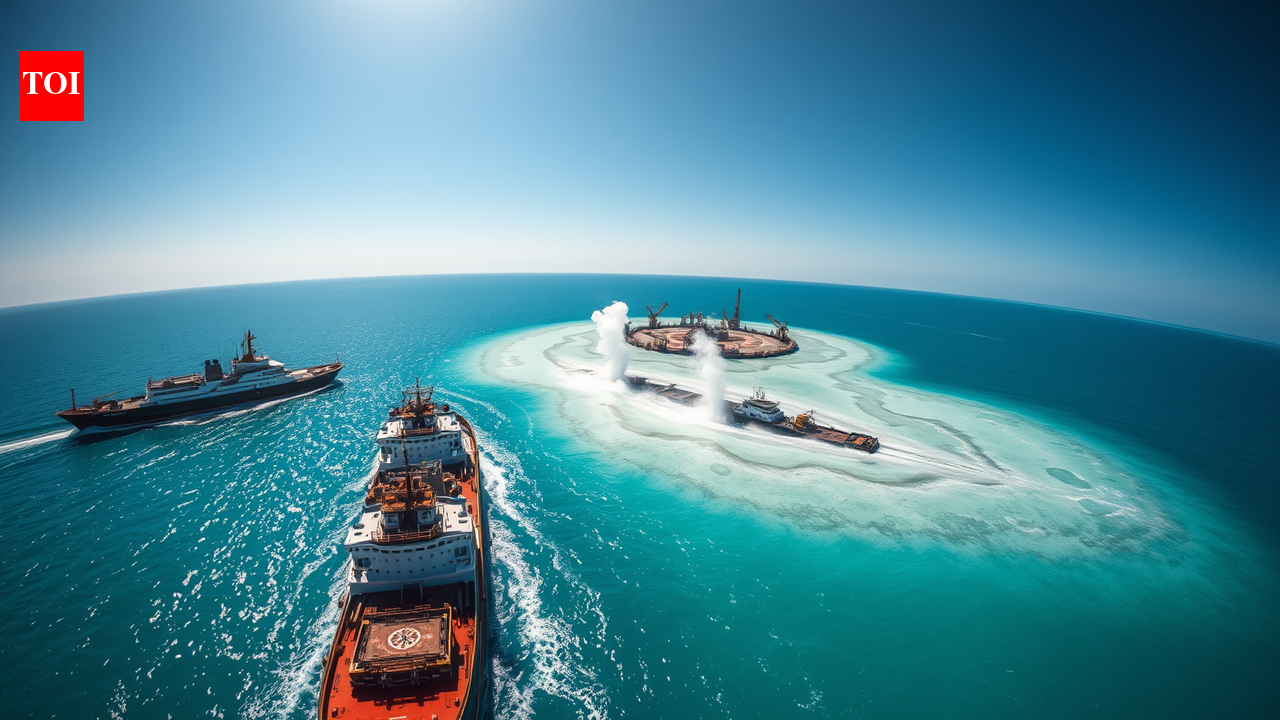
China’s biggest island-building project in years: How Antelope Reef grew to 1,490 acres in months
China has expanded Antelope Reef to approximately 1,490 acres within a few months, according to reports from The Times of India. This development represents one of the largest land-reclamation efforts in the South China Sea in recent years, occurring amid ongoing territorial disputes and conflicting sovereignty claims in the region.
How Antelope Reef expanded to 1,490 acres
The rapid growth of Antelope Reef is the result of intensive dredging and land reclamation. According to The Times of India, the feature has expanded to 1,490 acres in a matter of months, marking a significant acceleration in China’s maritime construction activities. This process typically involves the use of massive suction hopper dredgers that vacuum sand and coral from the seabed and spray it onto the reef to create stable land masses.
Reports from India Today suggest that this project was conducted with a high degree of secrecy, avoiding the immediate scrutiny that accompanied earlier island-building campaigns. The speed of the expansion indicates a streamlined engineering process and a prioritized strategic objective to establish a permanent presence on the reef.
Key technical aspects of the expansion include:
- Massive Dredging: The relocation of millions of cubic meters of sediment to raise the reef above sea level.
- Rapid Timeline: The transition from a submerged or semi-submerged feature to a 1,490-acre landmass in a short window.
- Infrastructure Readiness: The preparation of the land for potential military or administrative installations.
Why is China building a new island in the South China Sea?
The motivations behind the expansion of Antelope Reef vary depending on the source. CGTN, a Chinese state-affiliated outlet, reports that China’s activities in the South China Sea are focused on safeguarding sovereignty and maintaining peace. From this perspective, the construction serves as a defensive measure to protect national interests and ensure maritime stability.
Conversely, analysis from India Today frames the project as a strategic move to extend China’s operational reach. By creating artificial islands, China can project power further from its mainland, establishing “unsinkable aircraft carriers” that can house runways, radar installations, and missile batteries. This allows for increased surveillance and control over critical shipping lanes.
The Australian Naval Institute provides a different strategic lens, describing a “use it or lose it” approach. This doctrine suggests that by physically occupying and developing disputed features, a nation creates a fait accompli, making it diplomatically and militarily costly for other claimants to challenge the status quo.
The strategic importance of Antelope Reef
Antelope Reef is situated in a region of the South China Sea characterized by overlapping claims between China, the Philippines, Vietnam, and Malaysia. The expansion of this specific reef allows China to tighten its grip on the “Nine-Dash Line,” the controversial boundary used by Beijing to claim the vast majority of the sea.
The strategic value of a 1,490-acre island includes:
- Logistical Hubs: Providing a base for the China Coast Guard (CCG) and the People’s Liberation Army Navy (PLAN) to refuel and resupply.
- Air Superiority: The potential for airstrips that can support fighter jets and surveillance drones.
- Electronic Warfare: The installation of signal intelligence (SIGINT) equipment to monitor foreign naval movements.
By transforming Antelope Reef, China effectively moves its frontline further south, reducing the response time for its naval assets to reach disputed areas like the Spratly Islands.
Comparing narrative frames on the expansion
Different international sources characterize the Antelope Reef project through vastly different lenses. While the physical fact of the 1,490-acre expansion is reported, the intent behind it remains a point of global contention.
| Source | Primary Frame | Key Justification/Concern |
|---|---|---|
| CGTN | Sovereignty & Peace | Protecting national borders and regional stability. |
| The Times of India | Scale & Speed | Focus on the sheer size (1,490 acres) and rapid growth. |
| India Today | Secrecy & Strategy | Questioning why the project was hidden from public view. |
| Australian Naval Institute | Maritime Doctrine | The “use it or lose it” strategy to secure territorial claims. |
The “Use It or Lose It” strategy in maritime law
The Australian Naval Institute highlights a critical tension in international maritime law. Under the United Nations Convention on the Law of the Sea (UNCLOS), the status of a maritime feature—whether it is an island, a rock, or a low-tide elevation—determines the maritime zones a country can claim around it.
An “island” can generate a 200-nautical-mile Exclusive Economic Zone (EEZ), while a “rock” only generates a 12-nautical-mile territorial sea. By building up Antelope Reef to 1,490 acres, China attempts to change the physical nature of the feature. While the Permanent Court of Arbitration ruled in 2016 that artificial islands do not generate their own EEZs, the physical presence of a massive base still provides a functional advantage that legal rulings cannot easily erase.
This “use it or lose it” mentality drives the urgency of the construction. If a feature remains undeveloped, it is easier for other nations to contest or occupy. Once a paved runway and barracks are established, the cost of removal becomes prohibitive.
Impact on regional stability and neighboring nations
The expansion of Antelope Reef has direct implications for the security architectures of Southeast Asian nations. The Philippines and Vietnam, in particular, have expressed concern over the militarization of the South China Sea. The presence of a new, large-scale base allows China to enforce its claims more aggressively against fishing vessels and oil exploration ships from neighboring states.
The United States, while not a claimant, maintains a “Free and Open Indo-Pacific” policy. The U.S. Navy frequently conducts Freedom of Navigation Operations (FONOPs) to challenge what it considers excessive maritime claims. A larger base at Antelope Reef increases the complexity of these operations by providing China with better tracking and intercept capabilities.
Potential long-term consequences include:
- Increased Friction: More frequent encounters between the Chinese Coast Guard and other regional navies.
- Ecological Damage: The dredging process destroys coral reefs, which are vital for regional biodiversity and fish stocks.
- Diplomatic Deadlock: The continued construction undermines negotiations for a binding Code of Conduct (CoC) between China and ASEAN.
Historical context: A pattern of land reclamation
The growth of Antelope Reef is not an isolated event but part of a broader pattern. Over the last decade, China has transformed several features in the Spratly Islands into fortified bases. This includes the “Big Three”—Mischief Reef, Subi Reef, and Fiery Cross Reef.
In those previous projects, China followed a similar blueprint:
- Initial Occupation: Securing a small feature or low-tide elevation.
- Rapid Dredging: Using specialized ships to create a landmass.
- Infrastructure Build-out: Constructing runways, hangars, and deep-water ports.
- Militarization: Deploying surface-to-air missiles and radar systems.
The Antelope Reef project is notable because it suggests that China has not ceased its island-building efforts, despite international pressure and the 2016 arbitration ruling. Instead, it has refined the process to be faster and more discreet.
Common misconceptions about artificial islands
There is a frequent misunderstanding that building an island automatically grants legal ownership of the surrounding waters. According to international law, specifically the 2016 ruling by the Permanent Court of Arbitration, land reclamation does not change the legal status of a feature. If a reef was a “low-tide elevation” before the dredging, it remains so in the eyes of the law, regardless of how many acres of sand are piled on top of it.
Another misconception is that these islands are purely for civilian use. While China often mentions “civilian” purposes such as search and rescue or meteorological research, the scale of the infrastructure—such as the reinforced runways reported in similar projects—is designed for military-grade aircraft. The size of Antelope Reef (1,490 acres) far exceeds what would be required for basic weather stations or rescue beacons.
For more on the legal frameworks governing these waters, see a related explainer on UNCLOS and maritime boundaries.
Frequently Asked Questions
How large is the expansion at Antelope Reef?
According to reports from The Times of India, Antelope Reef has grown to approximately 1,490 acres within a few months.
What methods are used to build these islands?
China primarily uses suction hopper dredgers. These ships vacuum sand and coral from the ocean floor and pump it onto the reef to create new land.
Does building an island give China legal rights to the water?
Under international law and the 2016 Permanent Court of Arbitration ruling, artificial islands do not generate their own Exclusive Economic Zones (EEZ) or territorial seas.
Why is the project described as “secret”?
India Today reports that the project was conducted with less transparency than previous campaigns, suggesting a strategic effort to avoid immediate international condemnation.
What is the “use it or lose it” strategy?
As analyzed by the Australian Naval Institute, this is a maritime strategy where a nation physically occupies and develops a disputed area to create a permanent presence that is difficult for rivals to challenge.
Who else claims the area around Antelope Reef?
The South China Sea is subject to overlapping claims by China, Vietnam, the Philippines, Malaysia, Taiwan, and Brunei.
The rapid transformation of Antelope Reef into a 1,490-acre landmass signals a continued commitment by Beijing to alter the geography of the South China Sea. As the feature evolves from a reef into a fortified base, the regional balance of power shifts, forcing neighboring nations and global powers to recalibrate their maritime strategies. The intersection of rapid engineering and aggressive territorial claims ensures that Antelope Reef remains a focal point of geopolitical tension.
