Building in Space With Laser “Origami” – Universe Today: University of Florida Research Into Orbital Construction
Researchers at the University of Florida are developing a “laser origami” technique to construct massive space structures by using lasers to trigger the unfolding of specialized materials. This method aims to deploy large-scale orbital assets without relying on traditional mechanical motors or gears, according to University of Florida reports on the project.
How Laser Origami Solves the Rocket Fairing Problem
The primary constraint in space exploration is the size of the rocket fairing. Every satellite, telescope, or space station must fit inside the protective nose cone of a launch vehicle. Because these fairings have fixed diameters, engineers must fold complex instruments into tight packages, a process that often requires heavy mechanical actuators to unfold them once they reach orbit.
The research into building in space with laser “origami” – Universe Today reports and University of Florida data suggest—proposes a shift away from these mechanical systems. Instead of using motors that can jam or fail in the harsh vacuum of space, this method uses light to drive the structural transformation. By targeting specific “hinges” or fold lines with lasers, the material reacts and unfolds into a predetermined shape.
This approach addresses three specific engineering bottlenecks:
- Mass Reduction: Removing motors, gears, and lubricants reduces the overall weight of the payload, lowering launch costs.
- Reliability: Mechanical failures during deployment are a common cause of mission loss. Laser-induced folding removes the risk of a seized gear.
- Scale: Laser-triggered structures can potentially be folded more densely than those requiring bulky mechanical joints, allowing for larger final structures to be launched in smaller rockets.
The Mechanics of Laser-Induced Folding
The “origami” aspect of this technology refers to the mathematical precision of the fold patterns. Scientists use origami principles to determine how a flat sheet of material can be collapsed into a small volume and then expanded into a complex 3D shape. The University of Florida research focuses on the trigger mechanism that executes these folds.
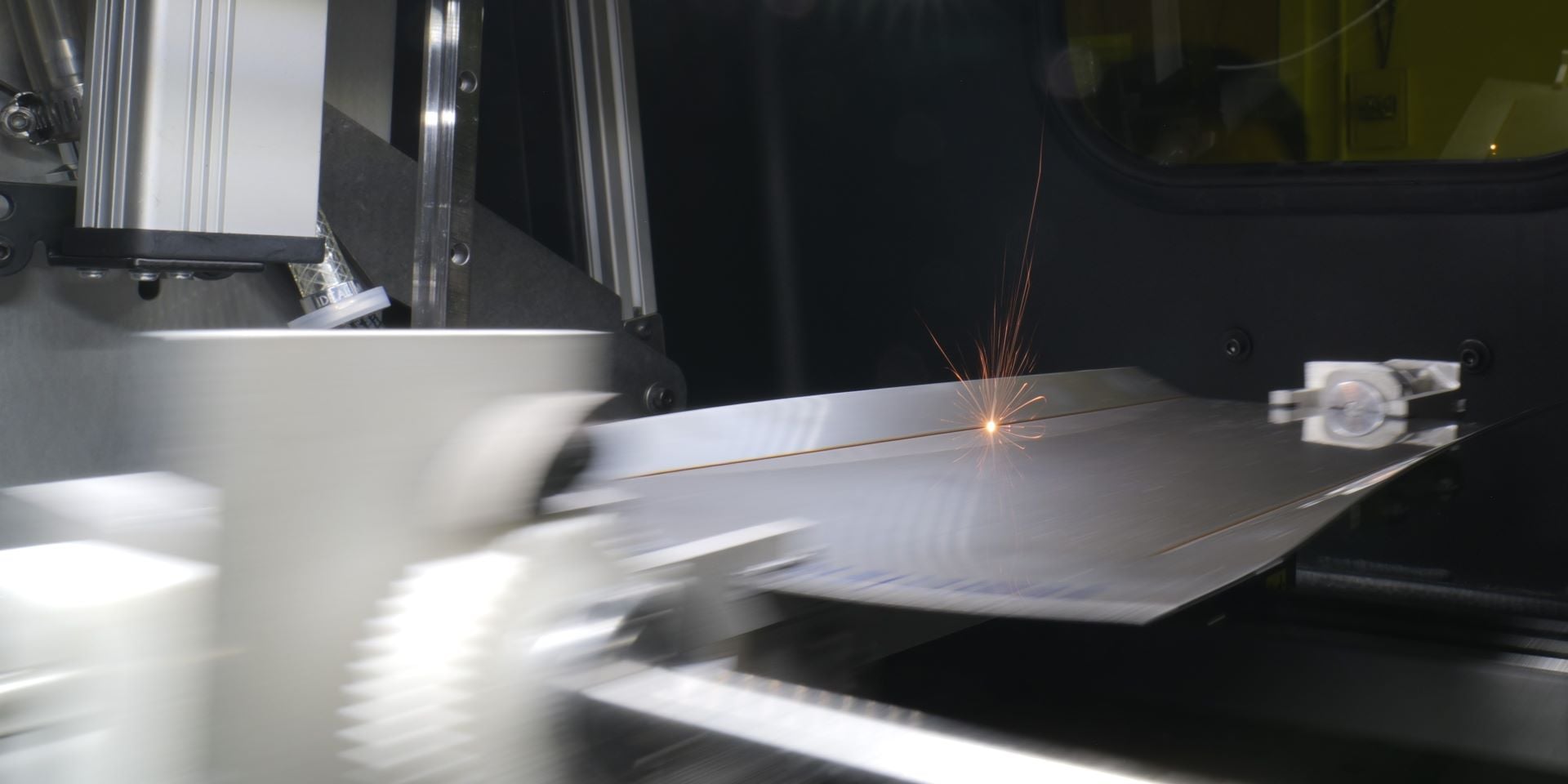
According to the research, the process involves materials that are sensitive to specific wavelengths of light. When a laser hits a designated area of the structure, it induces a physical change—such as thermal expansion or a phase transition in a polymer—that forces the material to bend. By sequencing these laser pulses, engineers can “guide” the structure as it unfolds, ensuring it reaches the correct geometry without the need for physical guidance systems.
“The goal is to create a system where the instructions for the build are embedded in the material itself, and the laser acts as the catalyst for assembly,” according to the University of Florida’s research framework.
Material Requirements for Laser Construction
Not all materials are suitable for laser origami. The project requires a combination of structural rigidity and localized flexibility. The University of Florida team investigates materials that can maintain their shape in the extreme temperature swings of space while remaining responsive to laser triggers.
Key material properties include:
- Shape-Memory Polymers: Plastics that “remember” a shape and return to it when heated by a laser.
- Composite Laminates: Layers of material that expand at different rates when exposed to heat, creating a bending motion.
- Radiation Resistance: Materials that do not degrade under intense UV and cosmic radiation before the deployment trigger is activated.
Comparing Laser Deployment to Mechanical Deployment
To understand the impact of this technology, it is necessary to contrast it with current industry standards. Most deployable structures, such as the solar arrays on the International Space Station or the mirrors of the James Webb Space Telescope, rely on a mix of springs, motors, and manual releases.
| Feature | Mechanical Deployment | Laser Origami Deployment |
|---|---|---|
| Actuation Method | Motors, springs, pyrotechnic bolts | Targeted laser pulses |
| Weight | High (due to hardware) | Low (light-based trigger) |
| Failure Points | Mechanical jams, lubricant freezing | Laser misalignment, material fatigue |
| Complexity | High hardware complexity | High material/software complexity |
| Scalability | Limited by actuator size | High (limited by laser range) |
Potential Applications for Orbital Laser Construction
The ability to build in space with laser “origami” opens the door to structures that are currently impossible to launch. When the limitation of the rocket fairing is removed, the scale of orbital infrastructure can increase by orders of magnitude.
Ultra-Large Space Telescopes
Current telescopes are limited by the size of the mirror that can be folded into a rocket. A laser-origami system could deploy a mirror or a sunshield spanning hundreds of meters. Such a telescope would provide unprecedented resolution, allowing astronomers to image the surfaces of exoplanets in distant star systems.
Massive Solar Power Arrays
Space-based solar power (SBSP) requires enormous arrays to collect enough energy to beam back to Earth. Launching these arrays in pieces and assembling them with robots is slow and expensive. Laser origami would allow a compact “seed” to be launched and then unfolded into a multi-kilometer power grid using a series of automated laser triggers.
Deep Space Habitats
For long-term missions to Mars or the Moon, humans need radiation-shielded living quarters. Laser-folded structures could provide the initial skeletal frame for a habitat, which could then be covered in lunar or Martian regolith for protection. This reduces the amount of heavy building material that must be transported from Earth.

For more on the evolution of space habitats, see our related explainer on orbital manufacturing.
Technical Challenges and Implementation Risks
Despite the potential, the University of Florida research highlights several hurdles that must be cleared before laser origami becomes a standard for space missions.
Precision and Alignment
A laser must hit a precise point on a material to trigger a fold. In the chaotic environment of orbital deployment, where structures may be vibrating or rotating, maintaining this alignment is difficult. Any deviation in the laser’s path could result in an asymmetrical fold, potentially ruining the entire structure.
Power Requirements
Generating lasers powerful enough to induce material changes requires significant energy. While a small fold might require little power, deploying a structure the size of a football field would require a substantial power source, potentially necessitating a dedicated nuclear or high-efficiency solar battery on the deployment craft.
Thermal Management
Space is a land of extremes. In direct sunlight, materials heat up; in the shade, they freeze. Since laser origami relies on thermal or chemical changes triggered by light, the ambient temperature of the environment could cause “accidental” unfolding or prevent the laser from reaching the necessary trigger temperature.
The Broader Context of In-Space Manufacturing
The concept of building in space with laser “origami” – Universe Today’s coverage emphasizes—is part of a larger trend toward In-Space Manufacturing (ISM). For decades, the strategy was “build on Earth, launch to space.” The new paradigm is “launch raw materials, build in space.”
This shift is driven by the increasing cost of lifting mass out of Earth’s gravity well. Even with the advent of reusable rockets, the “cost per kilogram” remains a limiting factor. By using laser origami, the “mass” being launched is primarily the raw material, while the “intelligence” of the build is handled by the laser system and the pre-programmed fold patterns of the material.
This complements other ISM technologies, such as 3D printing in microgravity. While 3D printing is excellent for creating solid, dense parts, laser origami is superior for creating large, thin-shell structures like antennas, shields, and frames.
Common Misconceptions About Space Origami
There are several frequent misunderstandings regarding how this technology works and what it is intended to do.
Misconception 1: The laser “welds” the parts together.
In the context of the University of Florida’s laser origami, the laser is not primarily used for welding or fusing materials. Instead, it acts as a trigger for a shape-change. It is a catalyst for unfolding, not a tool for joining separate pieces of metal.
Misconception 2: The structures are made of paper.
While the term “origami” is used, the materials are advanced polymers and composites. These materials are designed to withstand the vacuum of space and extreme radiation, unlike the paper used in traditional origami.
Misconception 3: This replaces all rockets.
Laser origami does not replace the need for rockets; it optimizes what the rocket carries. You still need a launch vehicle to get the folded material into orbit; the laser system simply changes how that material becomes a usable structure once it arrives.
Future Milestones in Laser-Triggered Assembly
The path from laboratory research at the University of Florida to an orbital deployment involves several critical milestones. Engineers must first prove the concept in “drop towers” or parabolic flights to simulate microgravity, as the way materials unfold in 1G (Earth gravity) is vastly different from how they behave in 0G.
Following ground tests, the next step involves “CubeSat” missions—small, inexpensive satellites used to test specific technologies. A CubeSat equipped with a small laser and a sample of origami material would provide the first real-world data on how laser-induced folding performs in the actual environment of Low Earth Orbit (LEO).
If these tests succeed, the industry may see a transition toward “hybrid” structures: assets that use traditional mechanical systems for critical primary deployments and laser origami for secondary, large-scale expansions.
For a deeper look at how these materials are tested, read our related guide to microgravity simulation.
Frequently Asked Questions
What exactly is “laser origami” in space construction?
Laser origami is a method of deploying large space structures by using lasers to trigger the unfolding of specialized, pre-folded materials. Instead of using heavy motors or gears, the laser provides the energy necessary to make the material change shape and expand into its final form.

Why is the University of Florida researching this instead of using robots?
While robots can assemble structures, they are heavy, complex, and prone to mechanical failure. Laser origami reduces the need for robotic arms and actuators, allowing for a lighter payload and a more reliable deployment process that is triggered by light rather than physical movement.
Can laser origami be used to build space stations?
It is more likely to be used for the “skin” or “skeleton” of a station—such as large antennas, solar arrays, or radiation shields. The heavy, pressurized modules where humans live would still likely require traditional manufacturing, but the supporting infrastructure could be deployed via laser origami.
How does a laser make a material fold?
The laser targets specific areas of the material that are designed to react to heat or light. This can cause a “shape-memory polymer” to return to its original form or cause different layers of a composite material to expand at different rates, creating a bending motion that unfolds the structure.
What are the main risks of this technology?
The primary risks include laser misalignment, where the beam misses the trigger point, and thermal interference, where the extreme temperatures of space either trigger the fold prematurely or prevent the laser from working effectively.
