Belfast stabbing suspect in court after night of protests
A suspect appeared in a Belfast court following a stabbing attack that triggered a wave of violent protests across Northern Ireland. The legal proceedings occurred after a night of unrest involving arson and targeted demonstrations at hotels, as far-right elements leveraged the incident to incite further disorder, according to reports from DW and other international news agencies.
What happened during the Belfast stabbing suspect’s court appearance?
A suspect detained in connection with a stabbing in Belfast appeared before a judge as the city grappled with the aftermath of overnight volatility. The court proceedings followed a period of intense police activity aimed at stabilizing the region after the initial attack sparked immediate reactions on the street. According to DW, the suspect’s appearance in court serves as a formal step in the judicial process, though the proceedings took place against a backdrop of heightened security and public tension.
The stabbing incident itself acted as a catalyst for broader civil unrest. While the court focused on the individual accused of the crime, the police force remained on high alert to prevent the legal proceedings from becoming a focal point for further demonstrations. Security measures were tightened around the courthouse to ensure the safety of the judiciary, the defendant, and the public.
Key details regarding the legal status of the case include:
- Charges: The suspect is facing charges related to the stabbing attack.
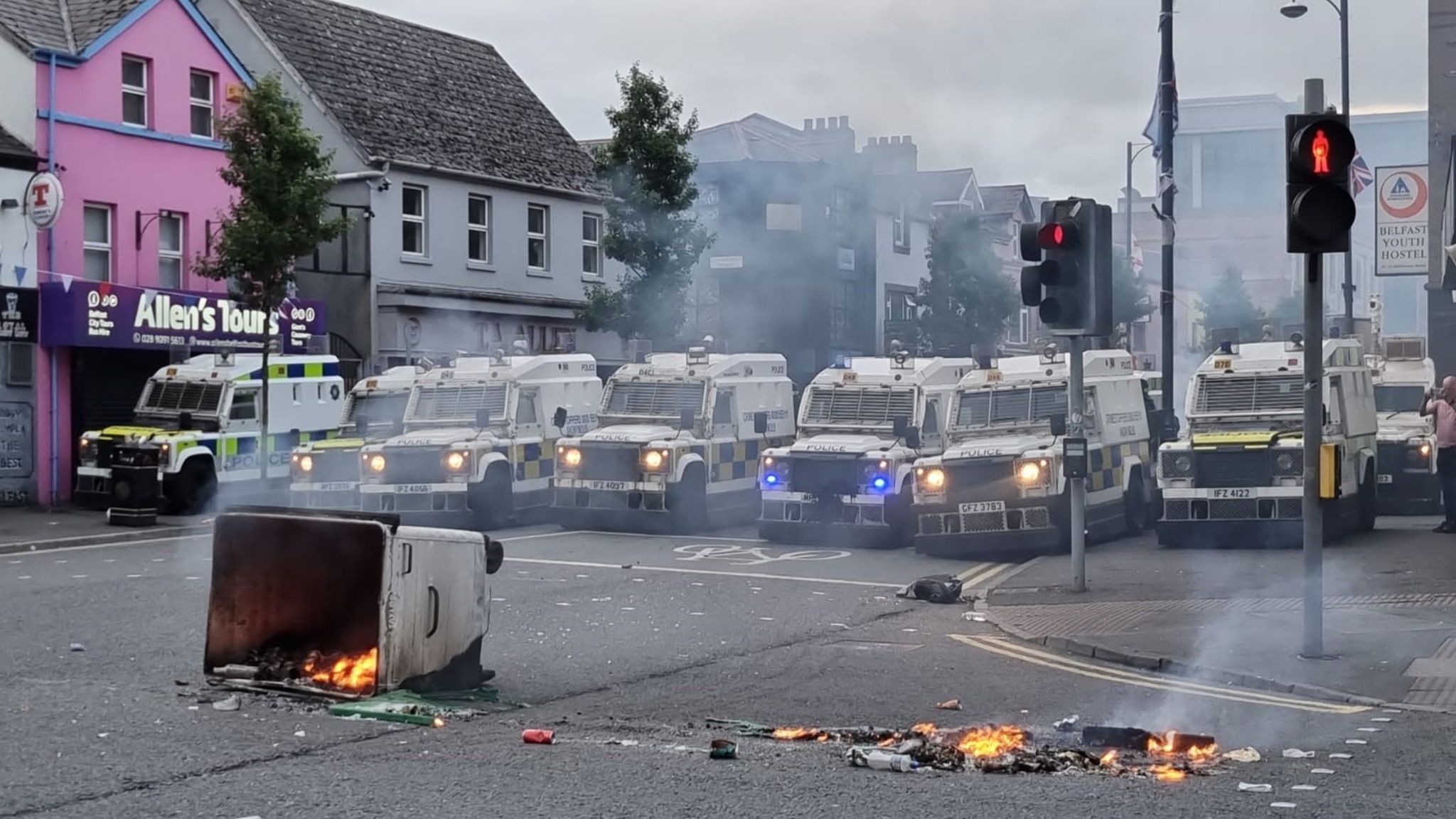
- Security: Increased police presence was deployed to manage crowds and prevent clashes.
- Judicial Process: The court is currently determining the next steps for the suspect’s detention and trial timeline.
Why did the stabbing lead to a night of protests in Northern Ireland?
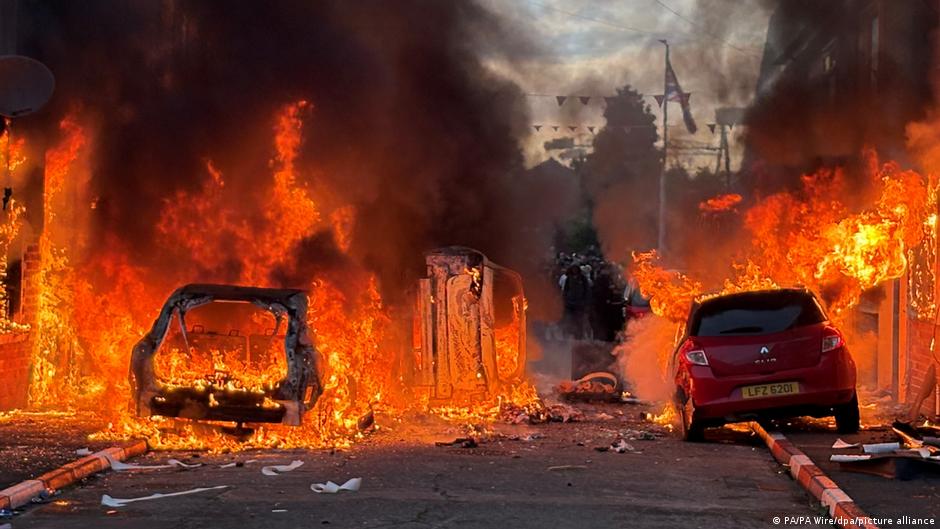
The transition from a criminal act to widespread civil unrest occurred rapidly, driven by a combination of local tensions and digital amplification. According to the Belfast Telegraph, the unrest manifested in violent clashes and targeted attacks, most notably in County Antrim. In one instance, a lorry was set on fire as a crowd attempted to target a hotel, which reports indicate was being used to house asylum seekers.
The violence was not spontaneous but followed a pattern of coordinated agitation. Reports from the Belfast Telegraph highlight the existence of online “hit lists” used to target specific locations and individuals. These lists were branded “unacceptable” by officials and community leaders, as they served to direct mobs toward specific sites, turning a local tragedy into a campaign of targeted harassment and arson.
The unrest followed a specific trajectory:
- The Incident: A stabbing occurred in Belfast, creating an immediate emotional vacuum.
- Digital Spread: Misinformation and calls to action spread via social media platforms.
- Physical Mobilization: Groups gathered at strategic points, including hotels in Co Antrim.
- Escalation: Protests turned into riots, resulting in property damage and the burning of vehicles.
How is the far right exploiting the Belfast attack?
The Australian Broadcasting Corporation (ABC) reports that the stabbing attack was quickly co-opted by far-right groups to advance a specific political agenda. Rather than treating the event as a criminal matter, these groups framed the attack as a symptom of systemic failure regarding immigration and border control. By doing so, they utilized a human tragedy to justify xenophobic violence and recruit individuals into anti-migrant movements.
This strategy involves a “rapid response” cycle where a violent event is recorded, stripped of context, and redistributed with a narrative that blames “outsiders.” The ABC notes that this tactic is designed to create a sense of imminent threat among the local population, thereby making violent “defense” of the community seem necessary to those being radicalized online.
“The attack played into the hands of Britain’s far right,” according to analysis by the Australian Broadcasting Corporation, suggesting that the event was an opportunity for agitators to test the resilience of local security and the volatility of the public.
The exploitation of the event typically follows three stages:
| Stage | Action | Goal |
|---|---|---|
| Narrative Framing | Linking the crime to immigration status. | Create a “them vs. us” mentality. |
| Targeting | Publishing lists of hotels or centers. | Direct physical violence toward migrants. |
| Political Gain | Using riots to demand policy changes. | Normalize far-right rhetoric in mainstream discourse. |
What has the victim’s family said about the violence?
In a direct appeal for peace, the family of the stabbing victim has urged the public to decouple their personal tragedy from the political violence currently gripping the streets. According to The Guardian, the family stated clearly that their loss should not be used as fuel for further hatred or violence.

The family’s statement highlights a critical tension in the aftermath of the attack: the gap between the actual victims of the crime and the political actors who claim to be acting in their name. By speaking out, the family attempted to strip the far-right movements of their perceived moral authority to “avenge” the victim through riots and arson.
The Guardian reports that the family’s plea focused on several core points:
- Rejection of Violence: A demand that no further blood be spilled in the name of the victim.
- Call for Unity: An appeal for the community to support one another rather than dividing along ethnic or national lines.
- Focus on Justice: A request that the public allow the legal system to handle the suspect in court rather than taking the law into their own hands.
How did Northern Ireland become a breeding ground for these riots?
The Financial Times provides a systemic analysis of why Northern Ireland remains susceptible to this type of volatility. The region’s history of sectarian conflict has left a legacy of segregated communities and a deep-seated familiarity with street violence as a form of political expression. According to the Financial Times, this historical infrastructure makes it easier for modern agitators to mobilize crowds.
The analysis suggests that the “breeding ground” is not just historical but socio-economic. Stagnant wages, lack of opportunity in certain urban areas, and a feeling of political abandonment create a population that is more susceptible to the simplistic narratives offered by far-right groups. When a catalyst—such as the Belfast stabbing—occurs, these underlying frustrations are channeled into targeted violence.
The Financial Times contrasts the current unrest with past conflicts, noting that while the targets have shifted from religious or political factions to migrants and asylum seekers, the methods of mobilization (barricades, arson, and community-led riots) remain strikingly similar to the “Troubles” era.
Comparison of Riot Drivers:
- Historical Drivers: Religious identity, territorial disputes, and national sovereignty.
- Modern Drivers: Anti-migrant sentiment, online misinformation, and economic alienation.
- Consistent Element: A cultural precedent for using public disorder to signal grievance.
What are the broader implications for UK security and policy?
The events following the stabbing suspect’s court appearance indicate a growing challenge for UK law enforcement: the speed of digitally coordinated unrest. The use of “hit lists” and real-time coordination via encrypted apps means that police are often reacting to events rather than preventing them. This shift requires a change in policing strategy, moving toward more proactive digital monitoring and rapid-response deployment.
Furthermore, the targeting of hotels housing asylum seekers suggests a vulnerability in the UK’s current housing strategy for migrants. The concentration of asylum seekers in specific, often isolated hotels creates “soft targets” that are easily identified and attacked by mobs. This may lead to a policy review regarding how and where asylum seekers are accommodated to ensure their safety and the security of the surrounding neighborhoods.
There is also a legal implication regarding the prosecution of those who incite violence online. The “unacceptable” nature of the online lists mentioned by the Belfast Telegraph suggests that authorities may seek to apply stricter hate speech and incitement laws to those who coordinate these attacks from behind a screen, even if they are not physically present at the riot.
Common Misconceptions Regarding the Unrest
One common misconception is that the riots are a direct reaction to the stabbing itself. However, the analysis from the Financial Times and ABC suggests the stabbing was a trigger, not the cause. The cause is a pre-existing environment of socio-economic instability and organized far-right agitation. The stabbing provided the necessary emotional spark to activate a machine that was already in place.
Another misconception is that the violence is localized only to Belfast. The reports of lorry fires and hotel protests in County Antrim demonstrate that the unrest is regional, spreading across Northern Ireland as digital calls to action reach different communities.
Timeline of Events
| Event Phase | Key Action | Impact |
|---|---|---|
| Initial Incident | Stabbing attack in Belfast. | Immediate police response; victim injured. |
| Digital Escalation | Far-right groups share incident; “hit lists” created. | Rapid mobilization of anti-migrant crowds. |
| Night of Unrest | Protests in Belfast and Co Antrim; lorry burned. | Property damage; threats to asylum seeker hotels. |
| Legal Action | Suspect appears in court. | Formal judicial process begins amid high security. |
| Community Response | Victim’s family issues plea for peace. | Public pushback against the use of tragedy for violence. |
For those seeking a deeper understanding of the regional tensions, a related explainer on Northern Ireland’s political history may provide necessary context on why certain areas remain volatile.
Frequently Asked Questions
Who is the suspect in the Belfast stabbing case?
The suspect’s specific identity is handled according to court guidelines, but they appeared in a Belfast court following their arrest for the stabbing attack. The legal process is ongoing to determine their guilt or innocence.
Why were hotels in County Antrim targeted?
According to reports from the Belfast Telegraph, some of these hotels were being used to house asylum seekers. Far-right groups used the Belfast stabbing as a pretext to target these locations, claiming they were protecting the community from migrants.
What was the reaction of the victim’s family?
The family has pleaded with the public not to use their tragedy to justify or fuel further violence. As reported by The Guardian, they want the focus to remain on justice through the courts rather than street riots.
How did social media contribute to the riots?
Social media was used to spread misinformation and coordinate attacks. Specifically, “hit lists” were circulated online to direct protesters toward hotels and other targets, accelerating the transition from a protest to a riot.
Is this part of a larger trend in the UK?
Yes. Analysis from the ABC and Financial Times suggests that far-right groups across the UK are increasingly using local violent incidents to trigger wider anti-migrant unrest, leveraging existing economic and social grievances.
The situation remains fluid as the court continues to process the suspect and police work to prevent further outbreaks of violence. The intersection of criminal justice, digital misinformation, and deep-seated social division continues to make Northern Ireland a focal point for these tensions.
