Belfast Riots: Knife Suspect Granted Asylum Under Fast-Track Scheme; ‘Much Calmer’ in Northern Ireland on Thursday Night
The Police Service of Northern Ireland (PSNI) reported a “calmer” Thursday night across the region following a period of intense public disorder sparked by a knife attack. According to the Irish Independent, the suspect involved in the knife attack had been granted asylum under a fast-track scheme, a detail that surfaced amid the unrest. While the Belfast Telegraph noted there were no significant incidents of public disorder on Thursday night, the BBC reported that previous disorder led to 19 arrests and the targeting of a house in an arson attack.
What triggered the unrest in Belfast?
The current wave of instability in Belfast was precipitated by a knife attack, which served as the catalyst for subsequent public disorder. The situation escalated when reports emerged regarding the legal status of the perpetrator. The Irish Independent reports that the suspect had been granted asylum through a fast-track scheme, a fact that appears to have fueled public anger and led to street protests.
This intersection of violent crime and immigration policy created a volatile environment. In Northern Ireland, where social and political tensions are often closely linked to identity and governance, the revelation that a suspect in a violent crime had accessed the asylum system via an accelerated process became a focal point for demonstrators.
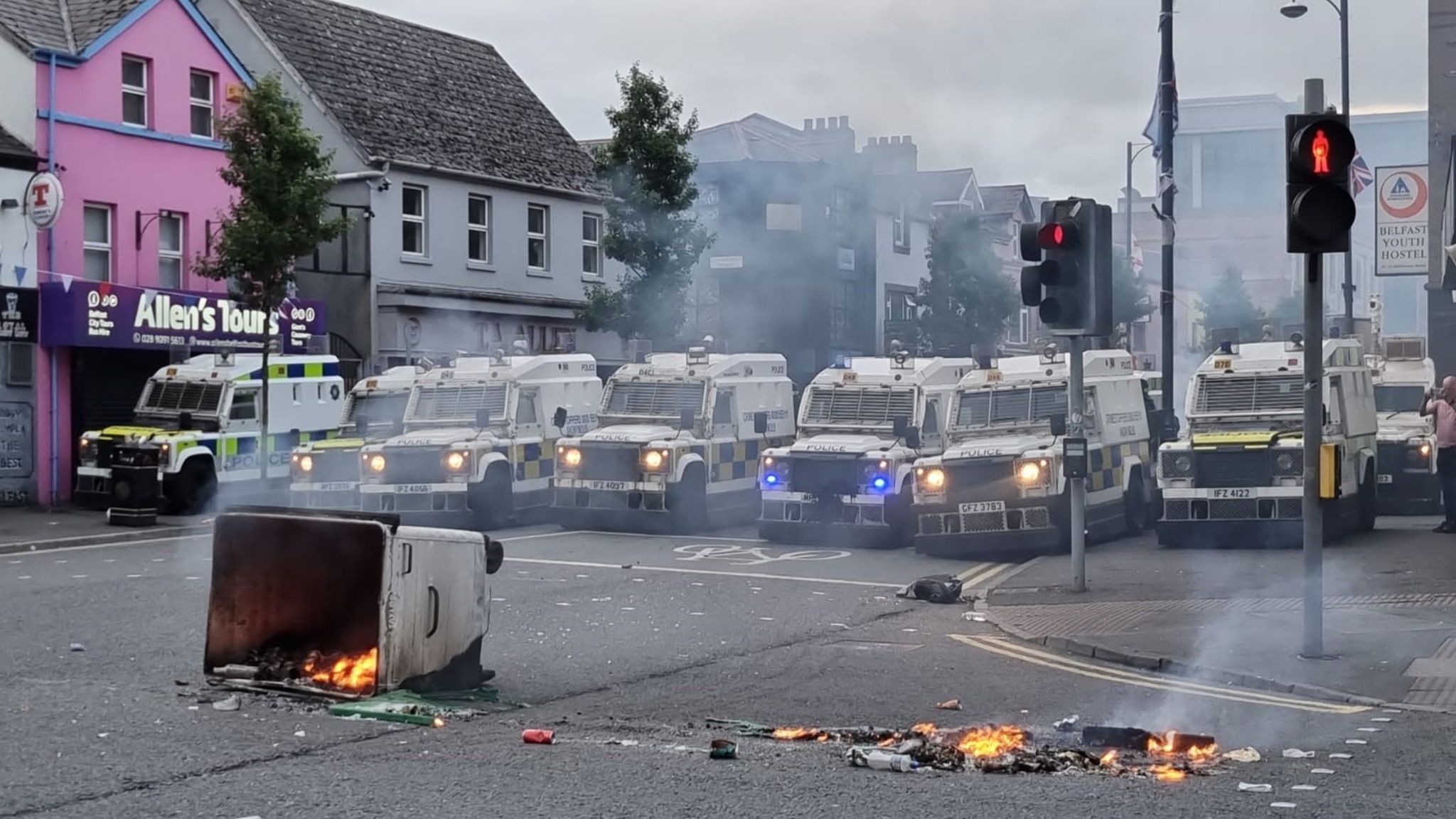
The disorder manifested in several ways, ranging from spontaneous gatherings to organized protests. According to reports from the BBC, the unrest was not limited to peaceful protest; it escalated into criminal activity, including an incident where a residential property was targeted in an arson attack. This shift from political expression to targeted violence marked a significant escalation in the local security environment.
How many arrests were made during the disorder?
Law enforcement figures vary depending on the specific timeframe of the reporting, reflecting the evolving nature of the unrest. The BBC reports a total of 19 arrests made in connection with the general disorder following the knife attack. These arrests encompass a range of offenses, likely including violent disorder, criminal damage, and breach of the peace.
In contrast, the Belfast Telegraph focused on the immediate aftermath of Thursday night, reporting that three individuals were arrested. This lower number aligns with the PSNI’s assessment that the night was “much calmer” compared to the preceding days of volatility.
| Reporting Source | Reported Arrests | Context of Figure |
|---|---|---|
| BBC | 19 | Total arrests over the period of disorder |
| Belfast Telegraph | 3 | Arrests specifically on Thursday night |
The disparity between these two figures highlights the transition from a peak of widespread disorder to a period of relative stability. The 19 arrests reported by the BBC represent the broader law enforcement response to the riots, while the three arrests noted by the Belfast Telegraph indicate that while the situation has improved, police presence and activity remain necessary to prevent a resurgence of violence.
Why is the “fast-track” asylum scheme a point of contention?
The Irish Independent highlighted that the knife suspect had been granted asylum under a “fast-track scheme.” This specific detail has become a central grievance for those involved in the unrest. Fast-track schemes are generally designed to expedite the processing of asylum claims for specific groups or nationalities to reduce backlogs and provide quicker certainty for refugees.
However, when an individual who has benefited from such a scheme is accused of a violent crime, the policy itself often comes under scrutiny. Critics argue that accelerated processing may overlook critical security screenings or character assessments. In the context of Belfast, this perceived failure of the state to vet individuals properly is often framed as a failure of public safety.
The controversy is compounded by the existing political climate in Northern Ireland. Public disorder in the region frequently mirrors broader debates regarding national identity, borders, and the efficacy of government administration. The use of a fast-track scheme, in this instance, served as a symbol for wider frustrations regarding immigration controls and the perceived prioritization of asylum seekers over local security.
What were the political reactions to the violence?
The unrest has drawn condemnation from political figures who view the violence as an unacceptable response to the underlying issues. According to RTE.ie, Benn described the unrest in Northern Ireland as “completely unacceptable.” This statement reflects a broader political consensus that regardless of the grievances regarding asylum policies or criminal acts, the use of arson and street riots is an illegitimate means of protest.
The reaction from political leadership typically focuses on three primary areas:
- The Rule of Law: Emphasizing that the judicial system, not street violence, is the appropriate venue for addressing crimes and policy failures.
- Public Safety: Condemning attacks on residential properties, such as the arson attack reported by the BBC, which put innocent civilians at risk.
- Social Cohesion: Warning against the potential for immigration-related tensions to destabilize the fragile peace in Northern Ireland.
By labeling the unrest “completely unacceptable,” political figures aim to decouple the legitimate debate over asylum fast-tracking from the criminal acts of rioting. This framing is essential for maintaining public order and preventing the unrest from evolving into a more sustained sectarian or ideological conflict.
How is the security situation evolving in Northern Ireland?
Current reports indicate a downward trend in violence, though the PSNI remains vigilant. The Irish Times reports that the PSNI described the night as “calmer,” a sentiment echoed by the Belfast Telegraph, which noted the absence of “significant incidents of public disorder” on Thursday night.
The “calmer” status is a result of several factors. First, the immediate shock and anger following the knife attack and the revelation of the suspect’s asylum status may have peaked. Second, the arrest of 19 individuals, as reported by the BBC, likely acted as a deterrent to others considering participating in the riots.
Despite the current lull, security analysts often point out that “calm” in Northern Ireland can be deceptive. The underlying triggers—specifically the intersection of crime and immigration policy—remain unresolved. The PSNI’s operational focus has shifted from active riot control to monitoring potential flashpoints and ensuring that the arson attack reported by the BBC does not inspire copycat incidents.
“The transition from widespread disorder to a ‘calmer’ night suggests a temporary stabilization, but the focus on the suspect’s asylum status indicates a persistent social tension.”
Comparing media framing of the unrest
An analysis of the reports from different outlets reveals a slight variation in how the story is framed, which provides a more complete picture of the events.
The Irish Independent focuses heavily on the causal link, emphasizing the fast-track asylum scheme as the primary driver of the anger. This framing positions the story as a critique of immigration policy and government oversight. In contrast, the BBC emphasizes the criminality of the response, foregrounding the 19 arrests and the arson attack. This framing prioritizes the breakdown of law and order over the political motivations of the rioters.
Meanwhile, the Belfast Telegraph and The Irish Times prioritize the current state of stability. By reporting on the “calmer” night and the lack of significant disorder, these outlets provide a “cooling” narrative, signaling to the public that the immediate crisis has passed. RTE.ie provides the political lens, focusing on the condemnation of the violence by officials, which frames the events as a matter of civic duty and political acceptability.
These differing perspectives show a story that is simultaneously about a violent crime, a controversial government policy, a failure of public order, and a political struggle for stability.
Common misconceptions about the Belfast unrest
In the wake of such events, several oversimplifications often emerge in public discourse. It is important to distinguish between reported facts and common narratives.
Misconception: The riots were solely about immigration
While the Irish Independent notes that the suspect’s asylum status was a major trigger, the unrest in Belfast rarely has a single cause. The violence is often an outlet for deeper, pre-existing social tensions and a general distrust of institutional governance. The asylum status acted as a catalyst, but the volatility of the environment was already present.

Misconception: The situation has returned to normal
Reports of a “calmer” night from The Irish Times and the Belfast Telegraph do not necessarily mean the underlying tension has vanished. In security terms, a lack of “significant incidents” on a single night is a tactical success for the PSNI, but it does not resolve the political and social grievances that led to 19 arrests and an arson attack.
Misconception: Fast-track asylum is the only way suspects enter the country
The focus on the “fast-track scheme” in the Irish Independent report highlights a specific administrative path. It is a misconception to assume this is the only or even the most common route for asylum seekers. Fast-track schemes are specific tools used for certain demographics; however, the fact that it was used in this specific case became the focal point for the protesters.
What to monitor moving forward
The trajectory of the situation in Northern Ireland will likely depend on several key developments. First, the legal proceedings against the knife suspect will be closely watched. Any updates on the trial or the suspect’s legal status could reignite public interest and potentially lead to further protests.
Second, the government’s response to the “fast-track” controversy will be critical. If there are calls for a review of how these schemes are administered or how security vetting is conducted, it may address some of the grievances that fueled the riots. Conversely, a lack of communication on this front could leave the door open for further unrest.
Finally, the PSNI’s ability to maintain the “calmer” state reported on Thursday night will be the primary measure of success. The transition from 19 arrests and arson to a night with only three arrests suggests that law enforcement has regained control, but the long-term stability of the region depends on the resolution of the social tensions that triggered the events.
For those following the legal aspects of this case, a related explainer on asylum processing may provide further context on how these schemes operate. Additionally, monitoring reports on Northern Ireland public order laws will be essential for understanding how the PSNI manages future protests.
Frequently Asked Questions
Who was the suspect in the Belfast knife attack?
While specific personal identities are often withheld during active legal proceedings, the Irish Independent reports that the suspect is an individual who was granted asylum in the region via a fast-track scheme.
How many people were arrested during the Belfast riots?
According to the BBC, 19 arrests were made in total over the period of disorder. The Belfast Telegraph specifically reported three arrests on Thursday night, which was described as a calmer period.
What is a fast-track asylum scheme?
As referenced in reports by the Irish Independent, fast-track schemes are administrative processes designed to accelerate the decision-making process for asylum seekers from specific categories or countries to reduce processing times.
Was there any property damage during the unrest?
Yes. The BBC reported that at least one house was targeted in an arson attack during the period of public disorder following the knife attack.
What was the official reaction to the unrest?
Political figures, including Benn as reported by RTE.ie, have described the unrest as “completely unacceptable,” emphasizing that violence is an inappropriate response to policy grievances.
Is Northern Ireland currently safe?
The PSNI, as reported by The Irish Times and the Belfast Telegraph, indicated that Thursday night was “much calmer” with no significant incidents of public disorder, suggesting a reduction in immediate risk, although police presence remains active.
