Universe Expansion Still Accelerating Say Astronomers – Mirage News: Dark Energy Claims Debunked
Astronomers have confirmed that the expansion of the universe continues to accelerate, effectively debunking a recent study that suggested dark energy does not exist, according to reports from BBC Sky at Night Magazine and Mirage News. This finding resolves a potential crisis in cosmology by reaffirming that a mysterious force is pushing galaxies apart at an increasing rate.
Why astronomers say the universe expansion is still accelerating
The consensus among the scientific community remains that the cosmos is not merely growing, but doing so at an ever-increasing speed. According to reports via Mirage News, this confirmation follows a period of uncertainty triggered by a study claiming that the acceleration of the universe might be an illusion or a result of flawed data. However, subsequent analysis has dismissed those claims, reinforcing the standard model of cosmology.
This acceleration is attributed to dark energy, an invisible influence that permeates all of space. While matter—both visible and dark—exerts a gravitational pull that attempts to draw the universe inward, dark energy acts as a repulsive force. According to BBC Sky at Night Magazine, the “crisis” regarding the existence of this force has been averted, ensuring that current physics models remain intact.
The verification of continued acceleration relies on the observation of distant Type Ia supernovae. These “standard candles” allow astronomers to measure precisely how far away a galaxy is and how fast it is receding. When these measurements are plotted over time, the data indicates that the recession speed is increasing, rather than slowing down under the influence of gravity.
- Verified Fact: The universe’s expansion rate is increasing.
- Key Driver: Dark energy is the primary mechanism behind this acceleration.
- Outcome: Recent studies attempting to disprove dark energy have been debunked.
What is dark energy and why does it drive cosmic expansion?
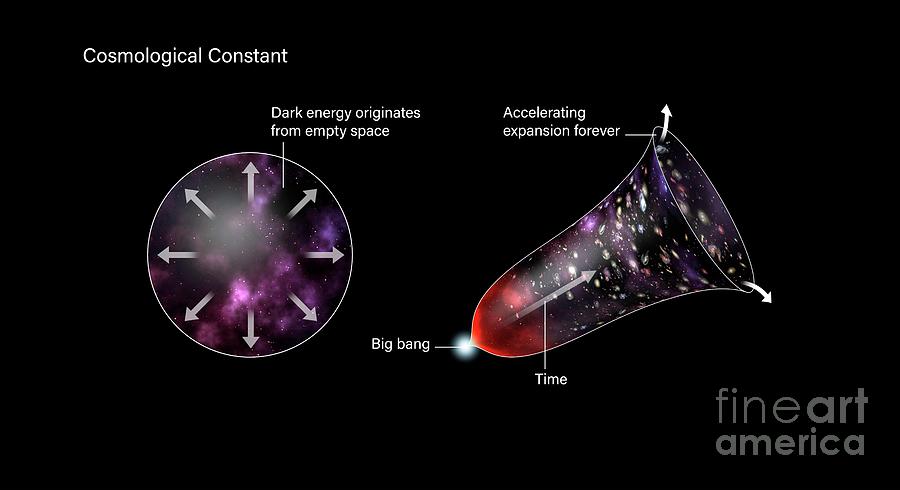
Dark energy is not “energy” in the traditional sense of a light bulb or a battery; rather, it is a property of space itself. According to cosmological models cited by BBC Sky at Night Magazine, as the universe expands, more space is created. Because dark energy is a constant density tied to space, the total amount of dark energy in the universe increases as the volume of the universe grows.
This creates a feedback loop: more space leads to more dark energy, which in turn drives faster expansion, creating even more space. This repulsive pressure overcomes the gravitational attraction of the galaxies, pushing them away from one another at speeds that eventually exceed the speed of light relative to an observer on Earth.
The Cosmological Constant
In mathematical terms, dark energy is often represented by the Greek letter Lambda (Λ), known as the cosmological constant. Originally proposed by Albert Einstein to keep the universe static, it was later repurposed to explain why the universe is accelerating. Astronomers now view this constant as the energy density of the vacuum, meaning that “empty” space is not actually empty but possesses an inherent energy that pushes outward.
Dark Energy vs. Dark Matter
It is common to confuse dark energy with dark matter, but they perform opposite functions. While dark energy pushes the universe apart, dark matter acts as a cosmic glue. According to astrophysical data, dark matter provides the extra gravity needed to hold galaxies together, preventing stars from flying off into the void. Together, these two invisible components make up roughly 95% of the total mass-energy content of the universe, leaving ordinary matter—the stuff that makes up planets and people—at a mere 5%.
related explainer on [the nature of dark matter]
How the “dark energy crisis” was averted
The recent tension in the scientific community arose from a study that questioned the validity of the acceleration. The researchers in that study suggested that the perceived acceleration was an artifact of how we observe the universe or a result of local anomalies in the distribution of matter. If true, this would have meant that dark energy—the cornerstone of modern cosmology—was a fiction.
According to Mirage News, this created a perceived “crisis” because the removal of dark energy would require a complete rewrite of the laws of physics. It would mean that our understanding of General Relativity is fundamentally flawed on a cosmic scale. However, astronomers have since debunked these claims by applying more rigorous data filters and utilizing a wider array of observational tools.
The debunking process involved comparing the disputed data with independent sets of observations, including the Cosmic Microwave Background (CMB)—the afterglow of the Big Bang. The CMB provides a snapshot of the early universe, and when extrapolated forward using the laws of physics, it aligns with a universe dominated by dark energy. The contradiction found in the “no dark energy” study was found to be an outlier rather than a new rule of physics.
“Crisis averted” – The Universe is still expanding. Scientists say they’ve debunked a study that claims dark energy doesn’t exist.
What this means for the ultimate fate of the cosmos
The confirmation that the universe expansion is still accelerating has profound implications for how the universe will end. If the acceleration continues indefinitely, the most likely scenario is the “Big Freeze,” also known as the Heat Death of the universe.
In a Big Freeze scenario, galaxies will move so far apart that they will eventually disappear from each other’s view. Stars will exhaust their nuclear fuel and burn out, leaving behind black holes and cold remnants. Because the expansion prevents new gas clouds from collapsing into new stars, the universe will gradually grow colder and darker until it reaches a state of maximum entropy, where no more energy can be exchanged.
Alternative Scenarios
Before the acceleration was confirmed, astronomers considered the “Big Crunch.” This theory suggested that gravity would eventually halt the expansion and pull everything back together into a single point. However, the data reported by BBC Sky at Night Magazine makes this scenario highly unlikely, as there is not enough matter in the universe to overcome the repulsive force of dark energy.

A more violent possibility is the “Big Rip.” This would occur if dark energy becomes stronger over time. Instead of just pushing galaxies apart, the force would eventually become so powerful that it would tear apart galaxies, then solar systems, then stars, and finally atoms themselves. Current data suggests the cosmological constant is stable, making the Big Freeze more probable than the Big Rip.
| Scenario | Driving Force | Final Outcome | Likelihood (Current Data) |
|---|---|---|---|
| Big Freeze | Constant Dark Energy | Cold, dark, empty void | High |
| Big Rip | Increasing Dark Energy | Matter torn apart | Low/Theoretical |
| Big Crunch | Gravity (Matter) | Collapse into singularity | Very Low |
Measuring the expansion: The Hubble Tension
While astronomers agree the universe is accelerating, they are currently embroiled in a different debate known as the “Hubble Tension.” This involves the Hubble Constant (H0), which is the unit of measurement used to describe the rate of expansion.
According to data from the Planck satellite, which measures the CMB, the expansion rate is roughly 67 kilometers per second per megaparsec. However, when astronomers measure the expansion using “local” methods—such as observing Cepheid variable stars and supernovae—they get a higher number, around 73 kilometers per second per megaparsec.
This discrepancy is not a sign that dark energy is missing, but rather a sign that our measurements are slightly off or that there is something about the early universe we do not yet understand. As reported in the context of the Universe Expansion Still Accelerating Say Astronomers – Mirage News story, the fact that both measurements show acceleration is what matters most; the exact number is a matter of ongoing refinement.
Key Milestones in Expansion Discovery
- 1929: Edwin Hubble discovers that galaxies are moving away from us, proving the universe is expanding.
- 1998: Two independent teams discover that this expansion is actually accelerating, leading to the proposal of dark energy.
- Present: New studies attempt to challenge dark energy, but are debunked, reaffirming the accelerated expansion.
Common misconceptions about the expanding universe
The concept of an accelerating universe often leads to several common misunderstandings. Clarifying these is essential for understanding the news regarding the Universe Expansion Still Accelerating Say Astronomers – Mirage News report.
Misconception 1: Galaxies are moving “through” space
Many believe galaxies are flying through a void like shrapnel from an explosion. In reality, the space between the galaxies is stretching. The galaxies themselves are largely staying put in their local neighborhoods, but the fabric of the universe is expanding. This is why galaxies within our own Local Group (like Andromeda and the Milky Way) are actually moving toward each other—gravity is strong enough to overcome dark energy on a small scale.
Misconception 2: There is a “center” to the expansion
Because we see everything moving away from us, it is tempting to think Earth is the center of the universe. However, the expansion is happening everywhere simultaneously. No matter which galaxy you stand in, all other distant galaxies will appear to be moving away from you. It is similar to dots on a balloon: as you blow it up, every dot moves away from every other dot.
Misconception 3: The expansion is limited by the speed of light
Einstein’s theory states that nothing can travel through space faster than light. However, there is no such limit on the expansion of space itself. Consequently, distant galaxies can recede from us at speeds that appear to exceed the speed of light because the space between us is growing so rapidly.
related explainer on [Einstein’s Theory of Relativity]
Frequently Asked Questions about Universe Expansion Still Accelerating Say Astronomers – Mirage News
Is the universe still expanding?
Yes. According to reports from BBC Sky at Night Magazine and Mirage News, the universe is not only expanding but is doing so at an accelerating rate.
What happened to the study that said dark energy doesn’t exist?
The study has been debunked by other astronomers. While it suggested that acceleration might be an illusion, further analysis of cosmic data confirmed that dark energy is real and the acceleration is continuing.

What is the difference between dark energy and dark matter?
Dark matter acts as an attractive force (gravity) that helps hold galaxies together. Dark energy acts as a repulsive force that pushes galaxies apart and accelerates the expansion of the universe.
Will the Earth be affected by this expansion?
Not in the short term. Gravity holds our solar system and our local cluster of galaxies together. The expansion only occurs over vast distances between galaxy clusters. We will not be “stretched” or torn apart by dark energy on a human or planetary scale.
What is the “Big Freeze”?
The Big Freeze is a theoretical end-of-the-universe scenario where the acceleration of expansion pushes galaxies so far apart that the universe becomes cold, dark, and devoid of usable energy, eventually reaching a state of total stillness.
How do we know the expansion is accelerating?
Astronomers use Type Ia supernovae as “standard candles.” By measuring the brightness and redshift of these stars, they can determine that distant galaxies are moving away from us faster now than they were in the past.
