New AI Tool Boosts Pancreatic Cancer Detection: Machine Learning Identifies Tumors Years Before Diagnosis
Artificial intelligence is now capable of detecting pancreatic cancer years before a clinical diagnosis by analyzing patterns in existing CT scan data. According to reports from Asian Scientist Magazine and OkDiario, these tools can identify subtle markers in both contrast and non-contrast imaging that often escape human detection, potentially shifting the window for life-saving surgical intervention.
How does the new AI tool boost pancreatic cancer detection?
The integration of artificial intelligence into radiology is transforming the identification of pancreatic ductal adenocarcinoma (PDAC), a malignancy known for its aggressive nature and late-stage discovery. According to Asian Scientist Magazine, new AI tools are boosting pancreatic cancer detection by recognizing morphological changes in the pancreas that are too slight for the human eye to perceive. These tools do not replace radiologists but act as a high-sensitivity secondary screen.
Pancreatic tumors often blend into the surrounding tissue during the early stages. AI algorithms, trained on massive datasets of both healthy and cancerous scans, identify “texture” changes and subtle density shifts. This capability allows the software to flag suspicious regions for human review long before a mass becomes visible on a standard clinical report.
Key capabilities of these AI systems include:
- Automated Segmentation: The AI can isolate the pancreas from other abdominal organs, reducing the time a radiologist spends searching the image.
- Pattern Recognition: Detection of indirect signs, such as the dilation of the pancreatic duct, which may precede the appearance of a visible tumor.
- Quantitative Analysis: Measuring exact changes in tissue density over time by comparing a current scan with historical data.
Can AI enhance both non-contrast and contrast-enhanced CT detection?
A critical technical hurdle in pancreatic imaging is the reliance on contrast agents—dyes injected into the bloodstream to make tumors stand out. However, according to diagnosticimaging.com, AI is now enhancing detection across both non-contrast and contrast-enhanced Computed Tomography (CT) scans.

Contrast-enhanced CTs remain the gold standard because they highlight the difference in blood flow between a tumor and healthy tissue. Yet, not every patient can receive contrast due to kidney failure or allergic reactions. AI tools are filling this gap by extracting high-value data from non-contrast scans, which were previously considered less reliable for early detection. By analyzing the raw Hounsfield units (density measurements) of the pixels, AI can spot anomalies that a human radiologist might dismiss as noise or anatomical variation.
The following table compares the traditional human approach to the AI-enhanced approach in CT imaging:
| Imaging Type | Traditional Human Detection | AI-Enhanced Detection |
|---|---|---|
| Contrast-Enhanced CT | Relies on visible contrast differences; may miss small, iso-attenuating tumors. | Identifies subtle texture anomalies and blood-flow patterns invisible to the eye. |
| Non-Contrast CT | Often viewed as insufficient for early-stage cancer screening. | Detects density shifts and structural irregularities in “plain” scans. |
| Historical Data | Manual comparison of old and new scans; time-consuming. | Automated longitudinal analysis to spot growth trends over several years. |
How can AI spot pancreatic cancer years before a formal diagnosis?
One of the most significant claims regarding these tools is the ability to predict cancer years in advance. According to OkDiario, AI can spot pancreatic cancer hiding in data that doctors have already collected. This process involves “retrospective analysis,” where AI scans medical archives for patients who were eventually diagnosed with cancer to find the earliest possible sign of the disease in their previous, unrelated scans.
Many patients undergo abdominal CT scans for unrelated issues—such as kidney stones, gallbladder problems, or general abdominal pain—years before they develop symptoms of pancreatic cancer. In these “incidental” scans, the cancer may have been present in a nascent form. While a radiologist at the time would have reported the scan as “normal” because no obvious mass existed, the AI identifies the precursors.
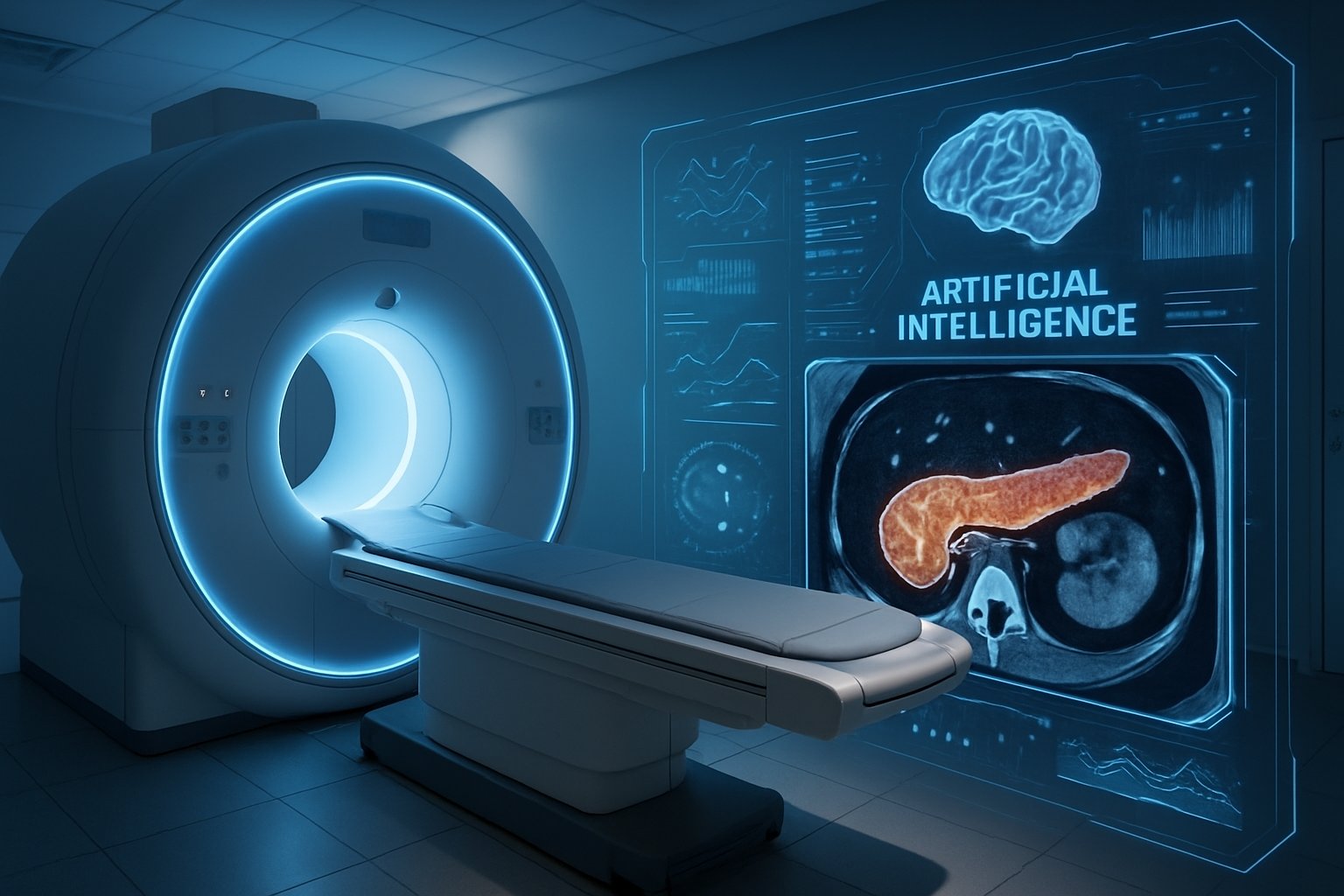
This predictive capability relies on three primary data drivers:
- Vascular Changes: AI can detect minute changes in how blood vessels wrap around the pancreas, a common early sign of malignancy.
- Parenchymal Atrophy: The AI notices when a specific part of the pancreas begins to shrink or lose volume, which often happens before a tumor is large enough to be seen.
- Ductal Distension: Subtle widening of the pancreatic duct is often a “smoke signal” for a tumor located further down the line.
“The AI isn’t just looking for a lump; it’s looking for the systemic changes the body makes in response to a developing tumor,” according to analysis of the technology’s application in early detection.
Why is early detection so critical for pancreatic cancer survival?
The urgency behind the development of these AI tools stems from the devastating statistics associated with pancreatic cancer. Because the pancreas is located deep in the abdominal cavity, tumors are rarely felt during a physical exam, and early symptoms are often vague—such as indigestion or back pain.
By the time a patient presents with jaundice or significant weight loss, the cancer has often metastasized or involved major blood vessels, making it “unresectable.” According to medical data referenced in Asian Scientist Magazine, the survival rate for pancreatic cancer increases dramatically if the tumor is caught while it is still localized and can be surgically removed.
The implications of AI detection include:
- Increased Surgical Eligibility: Moving a patient from Stage IV to Stage I or II allows for a Whipple procedure or other surgical interventions.
- Targeted Surveillance: Patients flagged by AI as “high risk” based on previous scans can be put on a strict monitoring schedule, catching the tumor the moment it becomes actionable.
- Reduced Diagnostic Delay: AI reduces the “diagnostic odyssey” where patients visit multiple doctors for vague symptoms before a CT scan is finally ordered.
For more information on how technology is changing oncology, see our related explainer on AI in medical imaging.
What are the limitations and risks of AI-driven detection?
Despite the promise, the transition from research to clinical practice involves significant risks. A primary concern is the “false positive” rate. If an AI is too sensitive, it may flag benign cysts or inflammation (pancreatitis) as cancerous. According to diagnosticimaging.com, this could lead to unnecessary, invasive biopsies or high-risk surgeries on patients who do not actually have cancer.
There is also the issue of “over-diagnosis.” Some slow-growing lesions might never have caused the patient harm in their lifetime, but AI detection forces a clinical intervention. Radiologists must balance the AI’s sensitivity with clinical judgment to avoid causing undue patient anxiety and medical waste.
Other hurdles include:
- Data Privacy: Analyzing years of historical patient data requires strict adherence to HIPAA and other global privacy standards.
- Algorithmic Bias: If an AI is trained primarily on one demographic, it may be less accurate for patients of different ethnicities or ages.
- Integration: Many hospitals use legacy software that cannot easily integrate real-time AI overlays onto their existing imaging workstations.
Comparing AI detection to traditional screening methods
Unlike breast cancer (mammography) or colon cancer (colonoscopy), there is currently no widely accepted screening test for the general population for pancreatic cancer. The risks of invasive screening outweigh the benefits for the average person. This is why the AI approach described by OkDiario is so vital—it uses existing data rather than requiring new, invasive tests.
While traditional screening focuses on high-risk groups (those with specific genetic mutations like BRCA2), AI expands the net to “opportunistic screening.” This means any patient who happens to get a CT scan for any reason is automatically screened for pancreatic precursors. This shifts the paradigm from seeking out the cancer to letting the AI find the cancer during routine care.
How will this impact the future of radiology and patient care?
The shift toward AI-assisted detection is likely to redefine the role of the radiologist. Rather than spending hours searching for a needle in a haystack, the radiologist will act as a validator, reviewing the “heat maps” generated by the AI to confirm the presence of a lesion. This increases efficiency and reduces human fatigue, which is a leading cause of missed diagnoses in high-volume hospitals.

In the long term, this technology could lead to the creation of “digital twins,” where a patient’s imaging history is continuously monitored by an AI. Any deviation from the patient’s personal baseline would trigger an alert, regardless of whether the change meets the general population’s threshold for “abnormal.”
The integration of these tools into the healthcare system will likely follow a phased approach: first as a research tool, then as a secondary “second-read” system, and eventually as a primary triage tool that prioritizes urgent scans for the radiologist’s immediate attention.
Common Questions About AI Pancreatic Cancer Detection
Can AI replace my doctor in detecting cancer?
No. According to reports from Asian Scientist Magazine and diagnosticimaging.com, AI is designed as a decision-support tool. It flags areas of concern, but a qualified radiologist or oncologist must make the final diagnosis and determine the treatment plan.
Do I need a special kind of CT scan for AI to work?
No. One of the primary advantages of these tools is their ability to work with standard CT scans, including both contrast-enhanced and non-contrast images. In many cases, AI analyzes scans that have already been taken and stored in medical records.
How early can AI actually detect these tumors?
While exact timelines vary by patient, OkDiario reports that AI can identify markers years before the cancer becomes symptomatic or visible to human radiologists. This “pre-diagnostic” window is the primary goal of the technology.
Is AI detection available in all hospitals?
Not yet. Most of these tools are currently in the clinical trial or early adoption phase. Availability depends on the hospital’s technology infrastructure and the regulatory approval of the specific AI software in that region.
Are there side effects to using AI for detection?
The AI software itself has no side effects. However, the risk lies in the clinical response to a “false positive,” which could lead to unnecessary follow-up tests or biopsies. This is why human oversight remains mandatory.
For those interested in the broader application of machine learning in healthcare, a related explainer on AI diagnostics provides further context on how these systems are being deployed across various medical specialties.
