
Biggest KiwiSaver Managers Lagging in Returns: Analysis of the Performance Gap in New Zealand’s Retirement Savings
Recent data and market analysis have highlighted a concerning trend for millions of New Zealanders: the biggest KiwiSaver managers lagging in returns compared to their smaller, more agile counterparts. For many investors, the natural inclination is to trust the “too big to fail” institutions—the household names with the largest assets under management (AUM). However, current performance metrics suggest that size may actually be a hindrance, leading to lower growth for members who prioritize stability and brand recognition over aggressive performance.
This disparity raises critical questions about how KiwiSaver funds are managed, the impact of institutional inertia, and whether the fees paid to the largest providers are delivering commensurate value. As New Zealanders face a rising cost of living and an uncertain economic future, the gap between a high-performing boutique fund and a lagging giant can translate into tens of thousands of dollars in lost retirement wealth over a working lifetime.
The Performance Divide: Big vs. Minor Managers
In the world of investment, there is a recurring tension between scale and agility. The report that the biggest KiwiSaver managers lagging in returns is not an isolated incident but rather a reflection of a systemic challenge within the financial services industry. Large-scale managers often oversee billions of dollars, which provides them with significant resources and infrastructure. However, this same scale can create a “drag” on performance.
Smaller managers, often referred to as “boutique” funds, are frequently able to move more quickly into emerging markets, niche asset classes, or high-growth stocks that are too small for a multi-billion dollar fund to enter without significantly moving the market price. When a giant fund attempts to buy a mid-cap stock, their sheer volume of buying can drive the price up, eroding the potential return. A smaller fund can enter and exit these positions with far less friction.
Why Scale Can Hinder Returns
- Market Impact: Large funds cannot invest in smaller, high-growth companies because the investment would represent too small a percentage of their total portfolio to move the needle, or too large a percentage of the company’s shares, creating liquidity issues.
- Institutional Inertia: Larger organizations often have more rigid governance structures and slower decision-making processes, making them less responsive to rapid market shifts.
- Diversification Overload: To manage massive amounts of capital, big managers often over-diversify, which can lead to “closet indexing”—where the fund performs almost exactly like a low-cost index fund but charges active management fees.
For the average KiwiSaver member, this means that by choosing a manager based on their size or popularity, they may be inadvertently opting for a “middle-of-the-road” performance strategy that fails to capture the upside of more dynamic investment approaches.
The Hidden Cost of Management Fees
When discussing why the biggest KiwiSaver managers lagging in returns is such a vital issue, one cannot ignore the role of fees. In many cases, the largest providers have legacy fee structures that are higher than those of newer, digitally-native, or low-cost providers. While a difference of 0.5% in annual fees might seem negligible in the short term, the effect of compounding over 30 or 40 years is staggering.
Many large managers operate with high overheads—expensive office spaces, large marketing budgets, and extensive administrative staff. These costs are ultimately passed down to the member. When these higher fees are combined with lagging returns, the “net return” to the member is squeezed from both ends.
| Feature | Large-Scale Institutional Managers | Boutique/Agile Managers |
|---|---|---|
| Investment Agility | Low – Limited by fund size | High – Can pivot quickly |
| Asset Access | Primarily Large-Cap/Blue Chip | Mix of Large, Mid, and Small-Cap |
| Fee Structure | Often higher due to overheads | Often leaner or performance-based |
| Risk Profile | Tend toward conservative/benchmark | Can be more aggressive or specialized |
“The danger for the KiwiSaver member is the assumption that a larger fund is a safer fund. Safety in terms of institutional longevity is different from safety in terms of ensuring your money grows fast enough to beat inflation.”
Analyzing the Impact of Asset Allocation
A significant factor in the performance gap is how different managers approach asset allocation. The biggest managers often stick closely to traditional benchmarks. While this prevents them from significantly underperforming the market, it also prevents them from significantly outperforming it. This “benchmark hugging” is a common trait among the largest funds, as managers are often more afraid of being at the bottom of the rankings than they are motivated to be at the top.
Growth vs. Conservative Strategies
It is key to distinguish between the type of fund and the manager’s performance. A conservative fund will always have lower returns than a growth fund in a bull market. However, the current issue is that even when comparing “Growth” funds across the board, the larger managers are often failing to keep pace with the smaller ones. This suggests that the issue isn’t the risk profile, but the execution of the investment strategy.
Smaller managers often employ more active strategies, taking concentrated bets on sectors they believe will outperform. While this carries more risk, it is the primary driver of the superior returns seen in some of the smaller KiwiSaver providers. For those with a long time-horizon before retirement, this active approach can be far more beneficial than the passive, broad-brush approach of the giants.
For a deeper dive into how to choose your risk level, see our related explainer on KiwiSaver fund types.
The Psychological Trap: Brand Trust vs. Financial Reality
Why do so many New Zealanders remain with lagging large managers? The answer lies in psychology. There is a perceived security in brand recognition. When a bank or a major insurance company manages a fund, members feel their money is “safe.” This is a conflation of solvency (the company not going bankrupt) with performance (the money actually growing).
In reality, KiwiSaver funds are held in trust, meaning the assets are separate from the provider’s own balance sheet. If a provider goes bust, the money in the fund still belongs to the members. The “security” of a big brand provides remarkably little actual protection compared to the tangible loss of returns caused by poor management.
Common Misconceptions About Big Funds
- “They have more experts”: While they may have more staff, more people does not equal better returns. Often, too many “cooks in the kitchen” lead to cautious, mediocre decisions.
- “They have better access to deals”: While they can access large-scale institutional deals, they lack the ability to enter the high-growth “seed” or “early-stage” opportunities that drive massive returns.
- “They are more stable”: Stability is good for a savings account, but for a retirement fund, “stability” that doesn’t beat inflation is effectively a loss of purchasing power.
Economic Pressures and the Current Market Climate
The trend of the biggest KiwiSaver managers lagging in returns has been exacerbated by recent global economic volatility. The shift from a low-interest-rate environment to a high-inflation, high-rate environment has punished many of the traditional “safe” assets that large funds heavily favor.
Large funds often have significant holdings in government bonds and large-cap equities. When interest rates rose sharply, the value of existing bonds dropped, and many large-cap stocks saw their valuations compressed. Smaller, more agile managers were often quicker to rotate their portfolios into inflation-hedging assets or alternative investments, allowing them to weather the storm more effectively.
The Role of Global Diversification
Another area where smaller managers have excelled is in true global diversification. Some of the largest NZ managers have historically had a “home bias,” over-investing in the New Zealand market. While the NZX is stable, it lacks the explosive growth sectors (like Big Tech or AI) found in the US and Asian markets. Smaller managers, less tethered to local institutional expectations, have often been more aggressive in their global allocations.
How to Evaluate Your Own KiwiSaver Performance
If you are concerned that your provider is one of the biggest KiwiSaver managers lagging in returns, there are concrete steps you can take to assess your situation. Consider not make decisions based on a single month of data, but rather on long-term trends.
Step 1: Check the Net Return
Look at your annual statement, but don’t just look at the percentage gain. Subtract the fees. If your fund grew by 5% but charged 1.2% in fees, your actual return is 3.8%. Compare this “net return” against the average for your specific fund type (e.g., Growth, Balanced, or Conservative).
Step 2: Compare Against a Benchmark
Most funds compare themselves to a “benchmark” index. If your manager is consistently performing below the benchmark for three to five years, it is a sign of systemic underperformance rather than a temporary market dip.
Step 3: Analyze the Fee-to-Performance Ratio
Ask yourself: Am I paying a premium for active management but getting index-like returns? If you are paying high fees for a “managed” fund that is lagging behind a low-cost passive fund, you are effectively paying for underperformance.
For those unsure how to transition, we recommend reading our guide to switching KiwiSaver providers to avoid common pitfalls.
The Long-Term Implications for New Zealand Retirees
The systemic issue of large managers lagging in returns has profound implications for the national economy. If a significant portion of the population is underperforming in their retirement savings, the burden on the state to provide support for elderly citizens will increase. Retirement “poverty” is often not the result of not saving, but of saving in the wrong vehicles.
The compounding effect of a 1% or 2% difference in annual returns can be the difference between a comfortable retirement and one defined by financial constraint. For a 25-year-old starting their career, the choice of manager today will dictate their quality of life in 40 years. The current trend suggests that the “safe” choice of a big-name manager may actually be the riskiest long-term strategy.
Frequently Asked Questions
Why are the largest KiwiSaver managers often underperforming?
Large managers often face “diseconomies of scale.” Their massive fund size makes them less agile, preventing them from investing in smaller, high-growth opportunities. High corporate overheads can lead to higher fees, and a cautious, benchmark-hugging culture often prevents them from achieving superior returns.
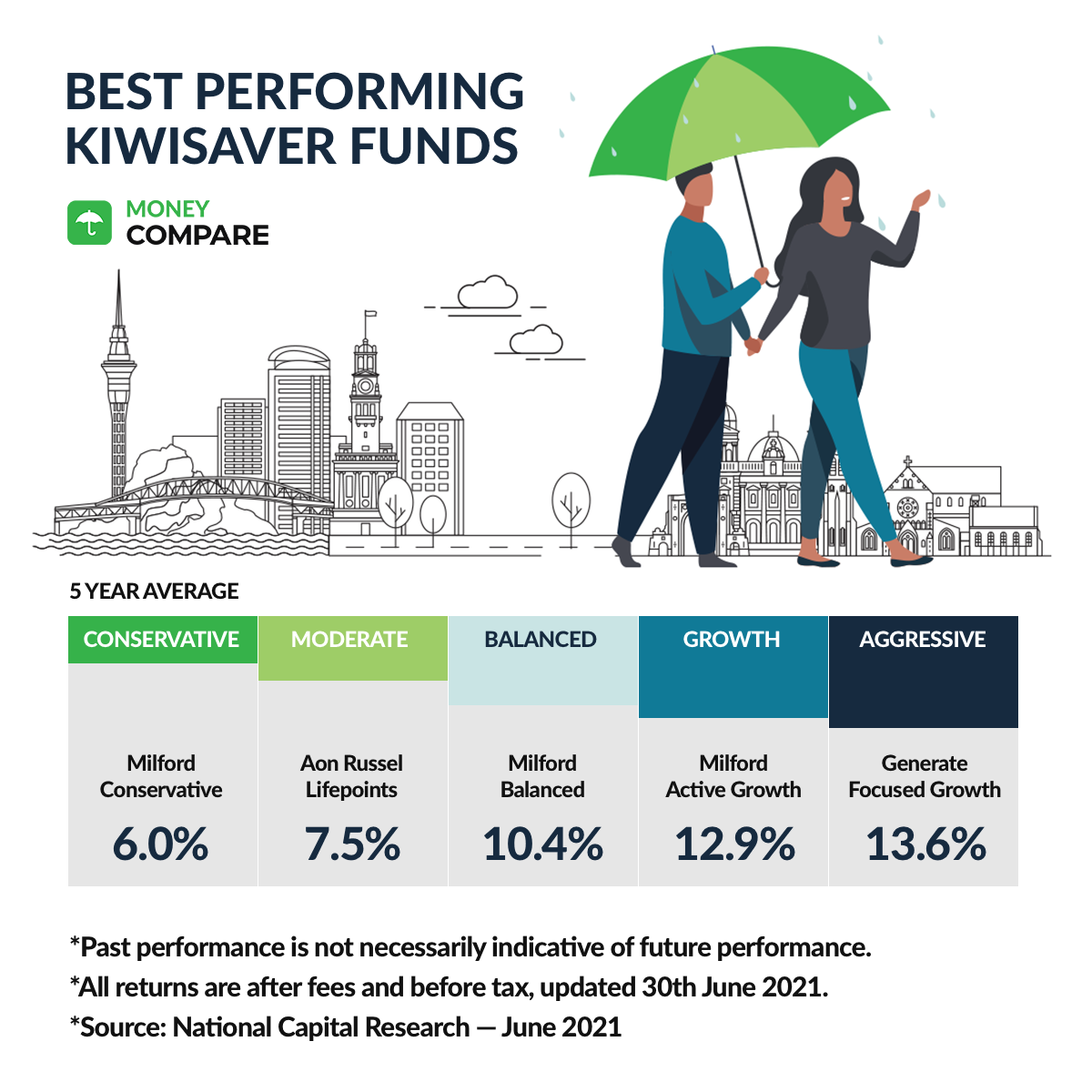
Is it risky to move my money from a big manager to a smaller one?
In terms of the safety of your capital, no. KiwiSaver funds are held in trust, meaning your money is separate from the provider’s company assets. The primary risk is investment risk (the possibility that any fund’s value may go down), which is based on the fund type (Growth vs. Conservative) rather than the size of the manager.
How often should I review my KiwiSaver manager’s performance?
It is generally recommended to review your fund every 12 to 24 months. Checking too frequently can lead to “emotional trading,” where investors move their money after a short-term dip, often selling low and buying high. Look for long-term trends (3–5 years) rather than short-term fluctuations.
Do lower fees always mean better returns?
Not necessarily, but they provide a head start. A fund with higher fees must outperform a low-fee fund by at least the amount of those fees just to break even. While some high-fee managers do deliver exceptional returns that justify the cost, many of the largest managers are lagging in returns while still charging premium fees.
What is “benchmark hugging” in KiwiSaver funds?
Benchmark hugging occurs when a fund manager keeps the portfolio very close to a standard market index (like the S&P 500) to avoid the risk of significantly underperforming. While this protects the manager from looking bad, it also makes it nearly impossible for the member to achieve “alpha,” or returns that beat the market average.
The reality of the current financial landscape is that the prestige of a provider’s name is not a proxy for the growth of your balance. As the evidence grows that the biggest KiwiSaver managers lagging in returns is a persistent trend, the responsibility shifts to the investor to be proactive, critical, and diligent in managing their retirement future.
