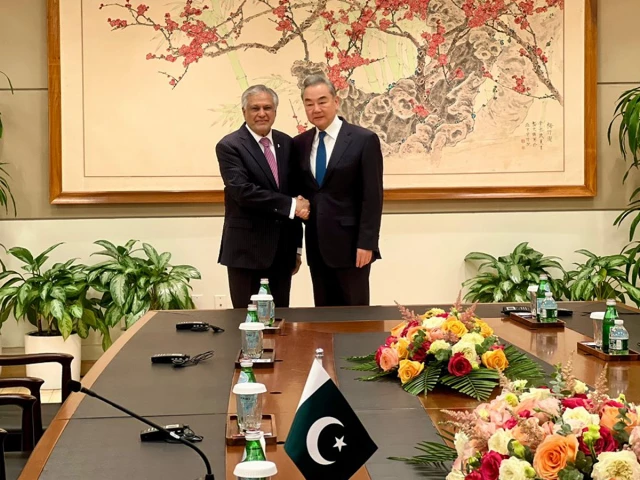
China’s FM Wang Yi Reiterates Appreciation for Pakistan’s Constructive Role Amid US-Iran Talks in Meeting with Dar
In a high-stakes diplomatic encounter that underscores the shifting sands of global geopolitics, China’s Foreign Minister Wang Yi has formally expressed his appreciation for Pakistan’s strategic and constructive contributions to the ongoing efforts to stabilize relations between the United States and Iran. The meeting, held with Pakistan’s Finance Minister Ishaq Dar, served as more than a routine diplomatic exchange; it highlighted the critical role Islamabad plays as a bridge between competing superpowers and volatile regional actors.
The dialogue between Wang Yi and Ishaq Dar comes at a juncture where the Middle East and South Asia are navigating a complex web of nuclear negotiations, economic sanctions and security concerns. By acknowledging Pakistan’s “constructive role,” Beijing is not only validating Islamabad’s diplomatic maneuvers but also signaling its own interest in a stable, multipolar regional order where China can expand its economic footprint through the Belt and Road Initiative (BRI) without the disruption of a major conflict in the Persian Gulf.
The Core of the Meeting: Diplomacy and Economic Synergy
The discussions between Foreign Minister Wang Yi and Finance Minister Ishaq Dar were characterized by a dual focus: the immediate need for regional diplomatic mediation and the long-term sustainability of the China-Pakistan Economic Corridor (CPEC). While the meeting was hosted within a framework of bilateral cooperation, the overarching theme was the intersection of economic stability and geopolitical peace.
Wang Yi’s praise for Pakistan’s role in the US-Iran dialogue is particularly significant given the delicate nature of these talks. For years, the United States and Iran have been locked in a cycle of sanctions and brinkmanship over Iran’s nuclear program. Pakistan, maintaining functional relationships with both Tehran and Washington, has often found itself in a unique position to facilitate back-channel communications or provide the diplomatic “breathing room” necessary for negotiations to proceed.
Key Pillars of the Discussion
- Diplomatic Facilitation: Recognition of Pakistan’s efforts to lower tensions between Washington and Tehran.
- Economic Cooperation: Discussions on the acceleration of CPEC projects and financial stability in Pakistan.
- Regional Security: Shared concerns over the stability of Afghanistan and its ripple effects on neighboring states.
- Multilateralism: A joint commitment to opposing unilateral sanctions and promoting a rules-based international order.
“The synergy between China and Pakistan extends beyond infrastructure; it is a strategic partnership that contributes to the peace and stability of the wider Asian region, particularly in mediating complex international disputes.”
Analyzing Pakistan’s “Constructive Role” in US-Iran Relations
To understand why China’s FM Wang Yi reiterates appreciation for Pakistan’s constructive role amid US-Iran talks in meeting with Dar, one must analyze the specific geopolitical leverage Pakistan holds. Pakistan shares a border with Iran and has historically maintained a pragmatic relationship with the Islamic Republic. Simultaneously, Pakistan remains a key security partner for the United States in South Asia, despite the fluctuations in their bilateral ties.
This “middle-man” status allows Islamabad to act as a conduit for messaging that cannot be delivered through official, public channels. When the US seeks to signal intent to Iran without appearing weak, or when Iran seeks to test the waters of American diplomacy, neutral or semi-neutral ground is required. Pakistan’s willingness to facilitate these interactions is a value-add that Beijing views as essential for regional equilibrium.
Why Pakistan is an Effective Mediator
Pakistan’s effectiveness in this role stems from several factors:
- Geographic Proximity: Being a direct neighbor to Iran allows for rapid, secure communication.
- Ideological Balance: Pakistan manages a complex relationship with various Islamic schools of thought, allowing it to engage with Tehran’s leadership effectively.
- Strategic Necessity: Both the US and Iran recognize that a stable Pakistan is beneficial to their respective interests, making Islamabad a trusted, if cautious, intermediary.
| Stakeholder | Primary Interest in US-Iran Talks | Role of Pakistan |
|---|---|---|
| China | Energy security and BRI stability | Support for Pakistan’s mediation to avoid regional war |
| United States | Nuclear non-proliferation and regional containment | Using Pakistan as a diplomatic channel/sensor |
| Iran | Lifting of economic sanctions | Utilizing Pakistan for regional outreach and trade |
| Pakistan | Border security and economic investment | Leveraging diplomatic utility for strategic gains |
China’s Strategic Calculus: Why Beijing Values This Mediation
China’s endorsement of Pakistan’s role is not merely a gesture of friendship. It is a calculated move rooted in Beijing’s broader foreign policy goals. For China, a conflict between the US and Iran would be catastrophic for its energy imports, as a significant portion of its oil passes through the Strait of Hormuz. Instability in the Middle East would jeopardize the western extensions of the Belt and Road Initiative.
By supporting Pakistan’s mediation, China achieves several objectives:
1. Reducing US Hegemony
When Pakistan facilitates talks, it demonstrates that the US cannot solve regional problems through unilateral sanctions alone. It highlights the necessity of regional players and their allies (like China) in crafting a sustainable peace. This subtly shifts the power dynamic from a US-centric approach to a more multilateral one.
2. Strengthening the “Iron Brotherhood”
By publicly praising Pakistan’s diplomatic prowess, Wang Yi reinforces the narrative that the China-Pakistan relationship is a “comprehensive strategic partnership.” This elevates Pakistan from being seen as merely a recipient of Chinese loans to a sophisticated diplomatic partner capable of influencing global affairs.
3. Securing Energy Corridors
A peaceful relationship between the US and Iran reduces the risk of maritime warfare. This ensures that the flow of oil and gas remains uninterrupted, which is critical for China’s industrial machine. Read our related explainer on global energy security to understand the stakes involved.

The Economic Dimension: The Role of Ishaq Dar
The fact that Foreign Minister Wang Yi met with Finance Minister Ishaq Dar, rather than solely with the Foreign Minister of Pakistan, is a detail of immense importance. It signals that in the eyes of Beijing, diplomacy and finance are inextricably linked. Pakistan’s ability to play a role in US-Iran talks is, in part, tied to its economic survival and its ability to maintain stability at home.
For Minister Dar, the meeting was an opportunity to ensure that China remains committed to Pakistan’s economic recovery. The discussion likely touched upon the restructuring of loans, the infusion of new investments into CPEC Phase II, and the need for Chinese support in Pakistan’s dealings with the International Monetary Fund (IMF).
The “Diplomacy-for-Investment” Trade-off
While not explicitly stated, there is an implicit understanding in international relations that diplomatic utility can be leveraged for economic concessions. Pakistan’s role as a “constructive” force in the Middle East increases its value to China. In return, Beijing is more likely to provide the financial flexibility Pakistan needs to avoid economic volatility, as a bankrupt Pakistan would be a far less effective diplomatic tool.
Potential Obstacles and Misconceptions
Despite the optimistic tone of the meeting, several challenges persist. A common misconception is that Pakistan has total control over the US-Iran dialogue or that China is the primary architect of these talks. In reality, the primary drivers remain the internal politics of Washington and Tehran.
Common Misconceptions Corrected
- Misconception: Pakistan is acting as a proxy for China.
Correction: While aligned with China, Pakistan pursues its own national interests, specifically border security and economic stability, which often overlap with Beijing’s goals. - Misconception: The US is fully supportive of Pakistan’s mediation.
Correction: The US relationship with Pakistan is transactional and often strained. Washington utilizes Pakistan’s channels but remains wary of Islamabad’s close ties with Beijing. - Misconception: US-Iran talks are solely about nuclear weapons.
Correction: The talks encompass regional influence, missile proliferation, and the lifting of crippling economic sanctions that affect global trade.
Broader Implications for South Asian Stability
The alignment between China and Pakistan on the issue of US-Iran relations has ripple effects across South Asia. For instance, India views the growing China-Pakistan strategic depth with caution. Any increase in Pakistan’s diplomatic stature on the global stage is often viewed through the lens of regional competition.
the stability of Afghanistan is a critical variable. Both China and Pakistan are eager to see a stable Afghan government that can prevent the spillover of terrorism. By coordinating their diplomatic efforts regarding Iran and the US, Beijing and Islamabad are attempting to create a “security umbrella” that isolates extremist elements and promotes trade across the region.
The Impact on Global Multilateralism
This meeting reflects a broader trend toward “minilateralism”—where small groups of countries coordinate on specific issues rather than relying on large, often paralyzed organizations like the UN Security Council. The China-Pakistan-Iran-US nexus, though fragile, represents a pragmatic attempt to manage conflict through indirect diplomacy.
Key Takeaways from the Wang Yi-Dar Encounter
To summarize the significance of this event, it is helpful to look at the immediate and long-term outcomes:
- Immediate Outcome: A public endorsement of Pakistan’s diplomatic utility, boosting Islamabad’s international profile.
- Strategic Outcome: A reinforced commitment from China to maintain regional stability to protect its economic interests.
- Economic Outcome: A strengthened dialogue on CPEC and financial support, linking Pakistan’s diplomatic success to its economic viability.
- Geopolitical Outcome: A clear signal that China views the US-Iran tension as a critical vulnerability that requires regional mediation.
Frequently Asked Questions
Why did China’s FM Wang Yi meet with Pakistan’s Finance Minister instead of the Foreign Minister?
The meeting with Finance Minister Ishaq Dar emphasizes that diplomacy and economics are intertwined. Since Pakistan’s diplomatic role is supported by its internal stability, and since CPEC is a cornerstone of the relationship, addressing financial matters alongside geopolitical ones is a strategic priority for both nations.

How exactly does Pakistan help in US-Iran talks?
Pakistan acts as a diplomatic bridge. Because it maintains relations with both the US and Iran, it can facilitate “track II diplomacy” (unofficial talks), convey messages, and provide a neutral environment for discussions that would be politically impossible in Washington or Tehran.
What is the main goal of China in supporting these talks?
China’s primary goal is stability. Conflict in the Persian Gulf would threaten China’s energy security and disrupt the Belt and Road Initiative. By supporting mediation, China ensures that its economic interests are not compromised by a potential war between the US and Iran.
Does this mean the US and Iran are close to a deal?
Not necessarily. While the appreciation for Pakistan’s “constructive role” indicates that channels are open, the core issues—such as nuclear enrichment limits and sanctions relief—remain highly contentious. The mediation helps maintain the dialogue, but it does not guarantee a final agreement.
How does this affect CPEC?
This diplomatic alignment strengthens the political will behind CPEC. When Pakistan proves itself as a valuable strategic partner in global diplomacy, China is more likely to invest further in the corridor, viewing it not just as a trade route but as a strategic asset in a stable region.
The ongoing coordination between Beijing and Islamabad suggests a long-term strategy to reshape the geopolitical landscape of Asia. By positioning Pakistan as a key mediator in some of the world’s most volatile disputes, China is effectively expanding its influence without the need for direct military intervention. As the US and Iran continue their cautious dance of diplomacy, the role of the “constructive” intermediary will only grow in importance, making the partnership between Wang Yi and the Pakistani leadership a focal point for international observers.
