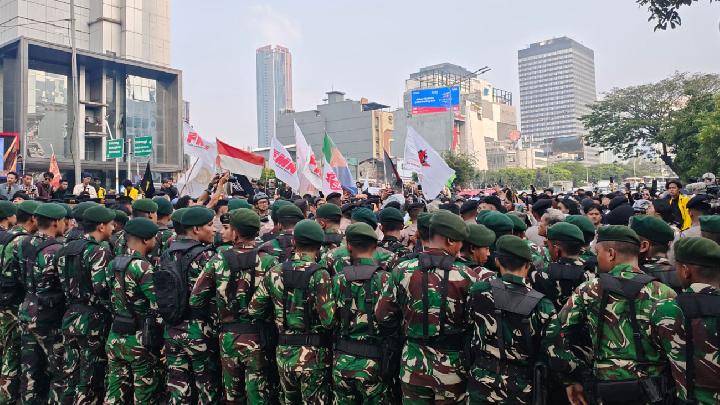
Military Deployment at Student Protest Sparks Debate in Indonesia – Tempo.co English
Military deployment during recent student demonstrations in Jakarta has triggered a national debate over security protocols and democratic rights. According to reports from Tempo.co English and other regional outlets, thousands of students occupied the streets to protest government spending and economic policies, eventually dispersing peacefully despite a heavy security presence. The use of military personnel to support police in managing civil unrest has raised questions about the boundary between maintaining public order and the restriction of assembly.
Why did students return to the streets of Jakarta?
Students returned to the streets primarily to voice opposition to what they characterize as wasteful government spending. According to The Jakarta Post, the demonstrations centered on the allocation of state funds, with protesters arguing that public resources are being mismanaged while the general population faces increasing financial hardship.
The protests were not isolated incidents of anger but represented a coordinated effort by student unions to demand greater fiscal accountability. Protesters targeted specific government policies that they claim prioritize elite interests over public welfare. These grievances are tied to a broader sense of frustration regarding how the Indonesian state manages its budget amidst a volatile global economy.
Key drivers of the unrest include:
- Budgetary Mismanagement: Allegations of wasteful spending on non-essential government projects.
- Policy Disagreement: Opposition to specific legislative moves that students believe weaken public oversight.
- Economic Instability: Rising costs of living that disproportionately affect students and low-income families.
The scale of the mobilization suggests a resurgence in student activism, a force that has historically played a significant role in Indonesian political transitions. By focusing on “wasteful spending,” the students have pivoted their rhetoric toward economic governance, signaling a shift from purely political demands to those concerning the daily survival of the citizenry.
What triggered the debate over military deployment?
The debate over the presence of the military at civil protests was highlighted by Tempo.co English, which noted that the deployment of non-police security forces in urban protest zones is a sensitive issue in Indonesia. The core of the controversy lies in the transition from the New Order era to the current democratic period, during which the military’s role in internal security was officially curtailed.
Critics argue that the visibility of military personnel during student-led rallies can be perceived as an attempt to intimidate peaceful protesters. The debate centers on whether the military’s involvement is a necessary support measure for the police or an overreach of authority. According to Tempo.co English, this deployment has sparked a wider conversation about the “normalization” of military presence in civilian spaces.
The deployment of military assets during civilian protests often invites scrutiny regarding the adherence to democratic norms and the separation of military and police functions in internal security.
Supporters of the security measures, however, maintain that the volume of protesters required a multi-layered security approach to prevent clashes and protect government infrastructure. The tension remains between the state’s mandate to ensure stability and the citizens’ right to protest without the presence of combat-trained forces.
How did security forces manage the demonstrations?
Security measures in Jakarta were extensive, involving a combination of physical barriers and a high density of personnel. ANTARA Foto documented the security landscape, showing the strategic placement of officers and the use of security checkpoints to regulate the flow of protesters toward government buildings.
The security strategy appeared to focus on containment. By creating perimeters, authorities aimed to prevent protesters from storming government offices while allowing them to voice their grievances within designated areas. This “containment” model is often used in Jakarta to mitigate the risk of escalation, though it is frequently criticized by activists as a means of neutralizing the impact of a protest.
The following table outlines the security response versus the protesters’ actions as reported across different sources:
| Security Measure (Source: ANTARA Foto / Jakarta Globe) | Student Action (Source: The Jakarta Post / Louisiana First News) |
|---|---|
| Deployment of military and police personnel | Mass mobilization and street occupation |
| Installation of physical barriers and checkpoints | Chanting and delivery of demands regarding spending |
| Monitoring and crowd control operations | Peaceful dispersal after rally objectives were met |
Despite the heavy presence of security forces, the Jakarta Globe reported that thousands of students eventually dispersed peacefully. This outcome suggests that while the security presence was intimidating, it did not necessarily lead to the violent clashes that have characterized previous Indonesian protests. The peaceful conclusion is being viewed by some as a sign of student discipline and by others as a success of the security forces’ containment strategy.
What economic pressures are driving student unrest?
While the immediate catalyst was government spending, the underlying cause of the unrest is a deepening economic crisis. Louisiana First News reported that Indonesian students are protesting government policies as economic pressures grow. This indicates that the protests are a symptom of systemic financial stress affecting the youth and the working class.
Economic pressures in Indonesia have been exacerbated by inflation and the rising cost of basic commodities. For students, this translates to higher tuition costs and a more competitive, precarious job market upon graduation. When students see “wasteful spending” by the government, it creates a sharp contrast with their own financial struggles, fueling the anger seen on the streets of Jakarta.
The economic grievances include:
- Inflation: Rising prices for fuel and food that diminish the purchasing power of average households.
- Employment Gap: A mismatch between university degrees and available high-paying jobs, leading to youth underemployment.
- Social Safety Nets: A perceived lack of adequate government support for those most affected by economic downturns.
This economic dimension transforms the protests from a simple political disagreement into a struggle for economic survival. The students are not merely protesting a policy; they are protesting a perceived indifference from the state toward the economic plight of its citizens.
How did different news outlets report the rally’s outcome?
The framing of the events varied across different media outlets, reflecting different angles of the story. While all sources agreed on the basic facts—that students protested and then left—the emphasis differed significantly.

Tempo.co English focused heavily on the political and legal implications of military deployment, framing the story as a debate over democratic boundaries. In contrast, The Jakarta Post highlighted the fiscal grievances, focusing on the “wasteful spending” aspect and the students’ demands for budgetary reform.
The Jakarta Globe and ANTARA Foto provided a more operational view. ANTARA Foto focused on the visual evidence of security measures, while the Jakarta Globe emphasized the peaceful resolution, noting that the crowds dispersed without significant violence. Finally, Louisiana First News placed the event in a global economic context, linking the local protests to broader economic pressures facing the Indonesian population.
These differing perspectives provide a comprehensive view of the event: it was a fiscally motivated protest (Jakarta Post), managed by a controversial security apparatus (Tempo.co English and ANTARA Foto), which ended without violence (Jakarta Globe), and was driven by systemic economic hardship (Louisiana First News).
For those interested in the legal framework governing these events, a related explainer on Indonesian protest laws may provide further context on what is legally permitted during public demonstrations.
The role of student movements in Indonesian democracy
To understand why this specific deployment sparked such a debate, it is necessary to look at the historical role of students in Indonesia. Student movements were the primary engine behind the 1998 Reformasi, which ended the 32-year rule of President Suharto. During that era, military deployment against students often led to tragedy, making any current military presence at a rally a trigger for historical trauma and political anxiety.
The current generation of students is operating in a different political environment, but the symbolic weight of the military remains. When Tempo.co English reports on the “debate” surrounding deployment, it is referencing this historical tension. The fear is that the return of the military to civil policing roles could signal a regression toward authoritarian tactics.
However, the peaceful dispersal reported by the Jakarta Globe suggests a new dynamic. Modern protests in Jakarta often involve a complex negotiation between student leaders and security commanders. This suggests a shift toward a more managed form of dissent, where both sides seek to avoid the chaos of the past while still allowing the political message to be delivered.
The intersection of economic pressure and political activism creates a volatile mix. As reported by Louisiana First News, the economic drivers make the protests more inclusive, drawing in students from various socioeconomic backgrounds who are all feeling the pinch of inflation and government mismanagement.
Common Misconceptions Regarding the Protests
One common misconception is that the protests were purely political maneuvers by opposition parties. However, reporting from The Jakarta Post suggests the grievances were rooted in specific fiscal issues—namely wasteful spending—that affect a broad cross-section of the public regardless of party affiliation.
Another misconception is that the military deployment led to immediate violence. On the contrary, the Jakarta Globe verified that the thousands of students dispersed peacefully. The “debate” mentioned by Tempo.co English is not about a specific act of violence, but about the principle and legality of using the military for civil crowd control.
Finally, some may assume these protests are limited to Jakarta. While the largest rallies occurred in the capital, the economic pressures cited by Louisiana First News are nationwide, suggesting that the unrest in Jakarta is a reflection of a broader national sentiment.
Potential Long-term Implications
The continued deployment of the military in civil roles could lead to a gradual shift in public perception. If such deployments become routine, the distinction between the Indonesian National Police (Polri) and the Indonesian National Armed Forces (TNI) may blur in the eyes of the public. This could have long-term effects on the democratic checks and balances established after 1998.
Economically, the protests put pressure on the government to reassess its spending priorities. If the state ignores the demands regarding “wasteful spending” while economic pressures continue to mount, the likelihood of more frequent and larger demonstrations increases. The students have established a blueprint for mobilization that can be easily replicated if their demands are not met.
The government’s response to these protests—whether it chooses to engage in fiscal reform or double down on security measures—will likely determine the stability of the urban environment in the coming months. A focus on security without addressing the underlying economic causes may only provide a temporary solution to a systemic problem.
Frequently Asked Questions
Why was the military deployed during the student protests in Jakarta?
According to reports, security forces used a multi-layered approach to manage the large volume of protesters and protect government infrastructure. The deployment was intended to support the police in maintaining order and preventing the storming of official buildings.

What are the main reasons students are protesting in Indonesia?
The protests are primarily driven by opposition to wasteful government spending and growing economic pressures. Students are demanding greater fiscal accountability and policies that address the rising cost of living and economic instability.
Did the protests in Jakarta lead to violence?
No. According to the Jakarta Globe, thousands of students dispersed peacefully after the rally. While security measures were heavy, the event did not result in the widespread violence seen in some historical protests.
Why is the use of the military in these protests controversial?
As noted by Tempo.co English, the military’s role in civil unrest is a sensitive topic due to Indonesia’s history. Critics argue that military presence in civilian protests can be intimidating and may contradict democratic norms regarding the separation of military and police duties.
How is the economic situation affecting student activism?
Louisiana First News reports that increasing economic pressures, including inflation and financial hardship, have pushed students to the streets. The contrast between these hardships and perceived government waste has fueled the urgency of their demands.
The current situation in Jakarta serves as a barometer for the national mood. The combination of fiscal frustration and the debate over security tactics suggests a population that is highly attentive to both how its money is spent and how its rights are protected. As the government navigates these economic pressures, the role of the security apparatus will remain a focal point for both domestic and international observers.
