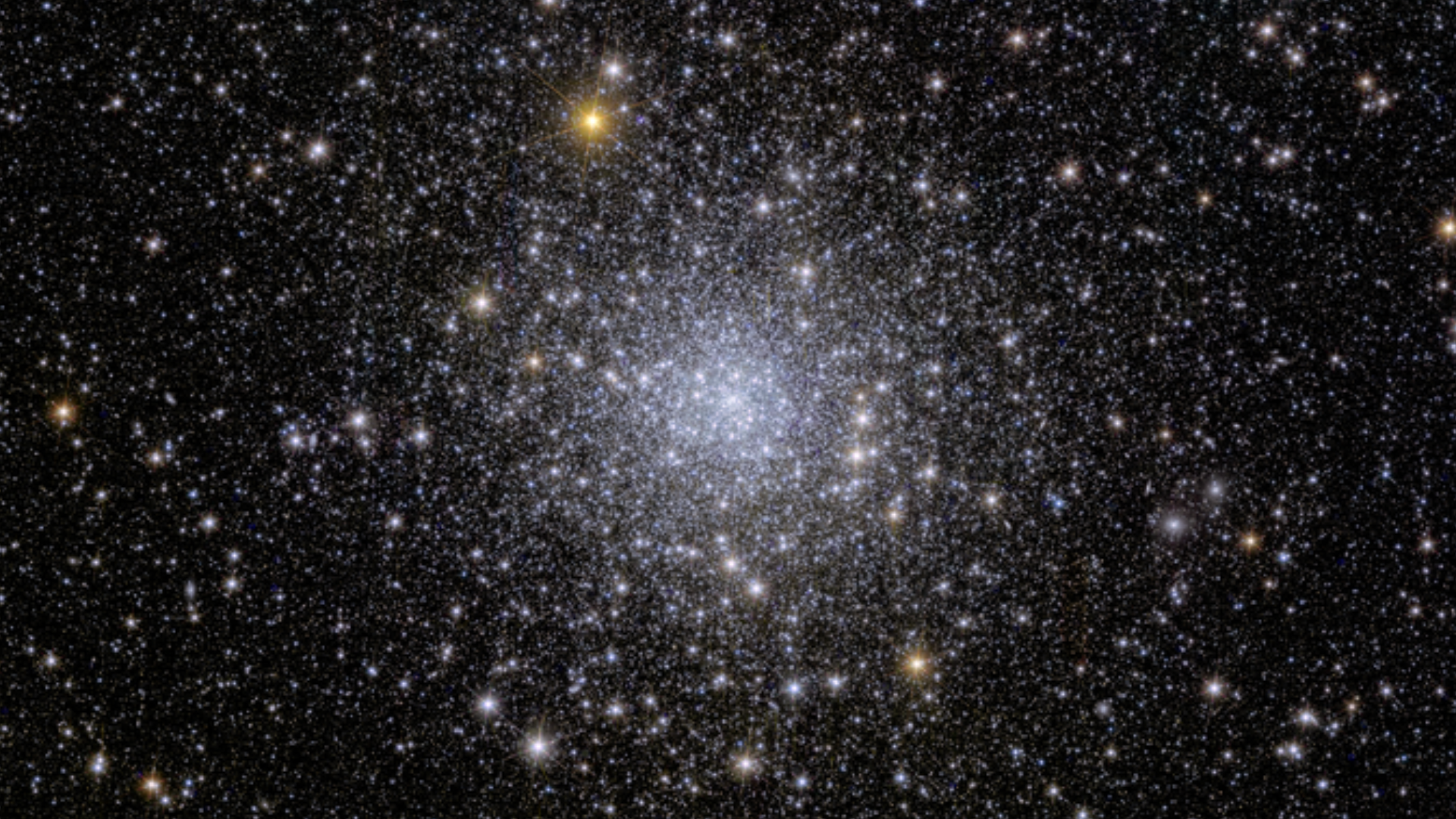
Glittering Star Cluster Image Reveals Missing Patch of Stars: ‘We Were Not Looking for the Gap, but We Found It’
In the vast, silent theater of the cosmos, some of the most profound discoveries are not the result of meticulous planning, but of sheer, unexpected serendipity. A recent analysis of a glittering star cluster image reveals a missing patch of stars—a cosmic void where stellar density should be highest. This anomaly has left astronomers questioning the stability of the cluster and the unseen forces that may be sculpting the architecture of our galaxy. As one researcher noted regarding the discovery, “We were not looking for the gap, but we found it,” highlighting a recurring theme in astrophysics: the most key data often lies in the things that aren’t there.
This discovery is more than a mere visual curiosity; This proves a forensic clue into the gravitational dynamics of star clusters. When astronomers observe a “gap” or a “missing patch” in a region typically teeming with stars, it suggests a violent or invisible influence—such as a hidden black hole, a passing rogue star, or the lingering effects of dark matter. By analyzing these voids, scientists can effectively map the “invisible” side of the universe, using the absence of light to detect the presence of mass.
The Anatomy of the Discovery: What Exactly is the ‘Gap’?
To understand why a missing patch of stars is so significant, one must first understand the nature of star clusters. Whether they are open clusters (loose groups of young stars) or globular clusters (densely packed, ancient spheres), these systems are governed by a delicate gravitational equilibrium. Stars orbit a common center of mass, and while they occasionally drift or are ejected, the overall distribution usually follows a predictable density gradient—thickest at the core and thinning toward the edges.
The image in question, however, broke this pattern. Instead of a smooth transition of stellar density, researchers identified a distinct, asymmetrical void. This “gap” is not a result of dust obscuring the view—a common occurrence in space known as interstellar extinction—but rather a genuine absence of stellar bodies. The stars are simply not there.
The Role of Serendipity in Modern Astronomy
The phrase “we were not looking for the gap” underscores a critical aspect of scientific progress. Modern astronomy relies heavily on “considerable data” from surveys like Gaia or imaging from the James Webb Space Telescope (JWST). Astronomers often set out to measure the age of a cluster or the chemical composition of its stars, only to notice a structural anomaly in the background. This specific discovery occurred during a routine mapping exercise, proving that the human eye, combined with high-resolution imaging, remains an essential tool for spotting anomalies that algorithms might overlook.
“The most exciting phrase in science is not ‘Eureka!’ but ‘That’s funny…’ This gap is a classic example of a ‘that’s funny’ moment that could rewrite our understanding of stellar interactions.”
Potential Culprits: What Could Clear a Patch of Stars?
When a section of a star cluster goes missing, physicists look for a “gravitational vacuum cleaner”—something capable of pushing stars away or pulling them in and consuming them. There are several leading theories regarding the cause of this specific missing patch.
1. The Influence of Intermediate-Mass Black Holes (IMBHs)
One of the most tantalizing possibilities is the presence of an Intermediate-Mass Black Hole. While we are familiar with stellar-mass black holes (small) and supermassive black holes (at the center of galaxies), IMBHs are the “missing link” of the cosmos. An IMBH lurking within a cluster would act as a gravitational disruptor, slingshotting nearby stars out of the cluster or absorbing them, thereby creating a localized void in the stellar population.
2. Tidal Stripping and Galactic Interaction
Star clusters do not exist in isolation; they move through the Milky Way, interacting with the galactic disk and other massive structures. If a cluster passes through a region of high gravitational shear—such as the galactic plane—the “tidal forces” can strip stars away from the cluster’s outer edges. If the cluster’s orbit is particularly erratic, these tidal forces could potentially carve “holes” or gaps into the cluster’s structure.
3. Stellar Dynamics and ‘Mass Segregation’
Over millions of years, stars within a cluster exchange kinetic energy. Heavier stars tend to sink toward the center, while lighter stars are pushed toward the periphery. In some extreme scenarios, complex gravitational “dances” between binary star systems can result in the violent ejection of other stars. While this usually happens on an individual basis, a chain reaction of ejections could theoretically leave a depleted region.
| Theory | Mechanism | Likelihood | Key Evidence Needed |
|---|---|---|---|
| IMBH | Gravitational absorption/slingshotting | Moderate | High-velocity star orbits near the gap |
| Tidal Stripping | External galactic gravitational pull | High | Stellar “tails” extending from the cluster |
| Mass Segregation | Internal kinetic energy exchange | Low (for large gaps) | Correlation between star mass and position |
Why This Discovery Matters for Galactic Archaeology
The study of these gaps falls under the umbrella of “Galactic Archaeology.” Just as an archaeologist uses fragments of pottery to reconstruct an ancient civilization, astronomers use the current positions and velocities of stars to reconstruct the history of the Milky Way.
A missing patch of stars is essentially a “scar” in the fabric of the cluster. By analyzing the shape and size of the gap, scientists can calculate the mass of the object that caused it and the timing of the event. This allows them to trace the cluster’s path backward through time, revealing where it has been and what it has collided with.
- Mapping Dark Matter: If no visible object (like a black hole) is found, the gap could be evidence of a “dark matter sub-halo” passing through the cluster.
- Understanding Cluster Life Cycles: It provides a glimpse into the “death” of clusters, showing how they gradually dissolve into the general galactic field.
- Testing General Relativity: Extreme gravitational anomalies in clusters provide a natural laboratory to test Einstein’s theories on a scale larger than a single solar system.
For those interested in how these structures evolve, a related explainer on stellar evolution can provide deeper context on how individual stars contribute to the overall health of a cluster.
The Technology Behind the Image
The discovery of the missing patch would have been impossible twenty years ago. The precision required to identify a gap in a glittering sea of thousands of stars demands two things: extreme angular resolution and precise astrometry (the measurement of star positions).

The Power of High-Resolution Imaging
Modern telescopes use adaptive optics to cancel out the “twinkling” effect caused by Earth’s atmosphere, allowing for images that are crisp and clear. When these images are processed, astronomers use “density maps”—heat maps that show where stars are most concentrated. In these maps, the gap appears as a “cold spot,” a stark contrast to the surrounding brilliance.
Astrometry and Proper Motion
Beyond a static image, astronomers use “proper motion” data. By comparing images taken years apart, they can see which way the stars are moving. If the stars around the gap are moving in a coordinated “swirl” or are being pushed away from the void, it confirms that the gap is caused by a gravitational force rather than a coincidental alignment of stars.
Common Misconceptions About ‘Space Voids’
When news of a “missing patch of stars” breaks, it often leads to several common misunderstandings. It is important to clarify what these gaps are—and what they are not.
Is it a ‘Black Hole’ in the literal sense?
Many readers assume that a “gap” means there is a black hole sitting exactly in the middle of the hole. In reality, a black hole might have passed through the region long ago, or its influence might be felt from a distance. The gap is the effect, not necessarily the location, of the object.
Is it just a cloud of dust?
This is the most common scientific hurdle. Space is filled with “dark nebulae”—clouds of cold gas and dust that block light. However, astronomers use infrared imaging to peer through the dust. If the gap remains visible in infrared, it means the stars are truly missing, not just hidden.
Is the cluster ‘disappearing’?
A single gap does not mean the entire cluster is evaporating. Most clusters lose stars slowly over billions of years. A localized gap is an event—a specific interaction—rather than a general trend of decay.
The Broader Impact on Astrophysical Theory
The realization that “we were not looking for the gap, but we found it” serves as a reminder of the limitations of hypothesis-driven research. While it is important to ask specific questions, the most transformative discoveries often come from “exploratory data analysis.”
If this gap is indeed caused by an IMBH, it solves one of the biggest mysteries in astronomy: how supermassive black holes grew so large in the early universe. If IMBHs exist and act as “seeds” within star clusters, it suggests a hierarchical growth process where small black holes merge to become giants.
this discovery pushes the development of new AI-driven detection tools. Astronomers are now training machine learning algorithms to scan thousands of other star clusters for similar “missing patches,” potentially revealing a hidden population of black holes or dark matter clumps across the galaxy.
For more on the instruments used in these discoveries, see our detailed guide to next-generation telescopes.
Frequently Asked Questions
What is a star cluster?
A star cluster is a group of stars that formed from the same giant molecular cloud and are held together by mutual gravitational attraction. They are generally divided into “open clusters,” which are young and loosely bound, and “globular clusters,” which are ancient, dense, and spherical.
Why would stars be ‘missing’ from a cluster?
Stars can be removed from a cluster through various gravitational interactions. This includes “tidal stripping” by the galaxy, ejections caused by three-body interactions (where two stars orbit each other and kick a third one out), or the influence of a massive object like a black hole.
How do astronomers know the gap isn’t just dust?
Astronomers use multi-wavelength observations. While visible light is blocked by dust, infrared light can pass through it. If the void is still present in infrared images, it confirms that there are no stars in that region, rather than just a cloud of dust blocking the view.
Is this discovery dangerous to Earth?
No. These star clusters are located thousands of light-years away. Whatever gravitational anomaly is causing the gap has no effect on our solar system or the stability of our own neighborhood in the galaxy.
What happens to the stars that were ‘kicked out’?
Stars ejected from a cluster become “field stars.” They wander the galaxy independently, though they often carry the “chemical fingerprint” of their original cluster, allowing astronomers to identify them as former members of a specific group.
The discovery of the missing patch of stars serves as a poignant reminder that the universe is often more complex than our current models suggest. By embracing the unexpected and investigating the voids, science moves closer to understanding the invisible forces that govern everything from the smallest star to the largest galaxy. As researchers continue to analyze the glittering images of the deep sky, they remain open to the possibility that the most important discoveries are the ones they weren’t even looking for.
