Scientists May Have Detected The First Signature of a Black Hole’s Event Horizon – ScienceAlert
Researchers have identified potential “fingerprints” that may represent the first direct signature of a black hole’s event horizon, according to reports from ScienceAlert. This detection suggests that scientists can now identify the precise boundary where gravity becomes so intense that not even light can escape, providing a new method to test the laws of general relativity.
How Scientists Detected the Event Horizon’s Signature
The detection relies on analyzing the “ringdown” phase of gravitational waves produced during the collision of two black holes. According to reports from ScienceAlert, when black holes merge, they create a new, larger black hole that vibrates momentarily before settling into a stable state. These vibrations emit gravitational waves that carry specific data about the object’s geometry.
Astrophysicists look for “echoes” in these signals. In a standard black hole model, the event horizon is a one-way street; anything crossing it is gone forever. However, some theoretical models suggest that if the event horizon has a specific structure—or if it isn’t a perfect vacuum—some gravitational waves might reflect off the boundary. These reflections would appear as faint, repeating pulses following the primary merger signal.
The identification of these signatures allows researchers to distinguish between a traditional black hole and other theoretical compact objects, such as “boson stars” or “gravastars.” By isolating these echoes, scientists can effectively map the “edge” of the black hole, a feat previously thought to be nearly impossible due to the nature of the event horizon.
- Primary Tool: Laser Interferometer Gravitational-Wave Observatory (LIGO) and Virgo detectors.
- Data Source: Gravitational wave signals from binary black hole mergers.
- Key Indicator: Post-merger “echoes” in the ringdown phase.
What Exactly Is a Black Hole’s Event Horizon?
The event horizon is the definitive boundary surrounding a black hole. According to general relativity, once an object or a photon of light crosses this threshold, the escape velocity required to leave exceeds the speed of light. Because nothing can travel faster than light, the event horizon marks the absolute point of no return.
For decades, the event horizon remained a mathematical prediction rather than an observed reality. While astronomers could see the effects of black holes—such as gas heating up in an accretion disk or stars orbiting an invisible mass—they could not “see” the horizon itself because it emits no light.
The significance of detecting a “signature” or “fingerprint” of this boundary is that it moves the event horizon from the realm of theoretical physics into empirical observation. If the signature is confirmed, it proves that the event horizon exists exactly as predicted by Albert Einstein’s equations, or, conversely, it reveals a flaw in those equations.
“The event horizon is the most extreme environment in the universe. Detecting its signature is akin to finding the shoreline of a dark ocean where no light ever returns.”
Comparing Visual Observations and Gravitational Signatures
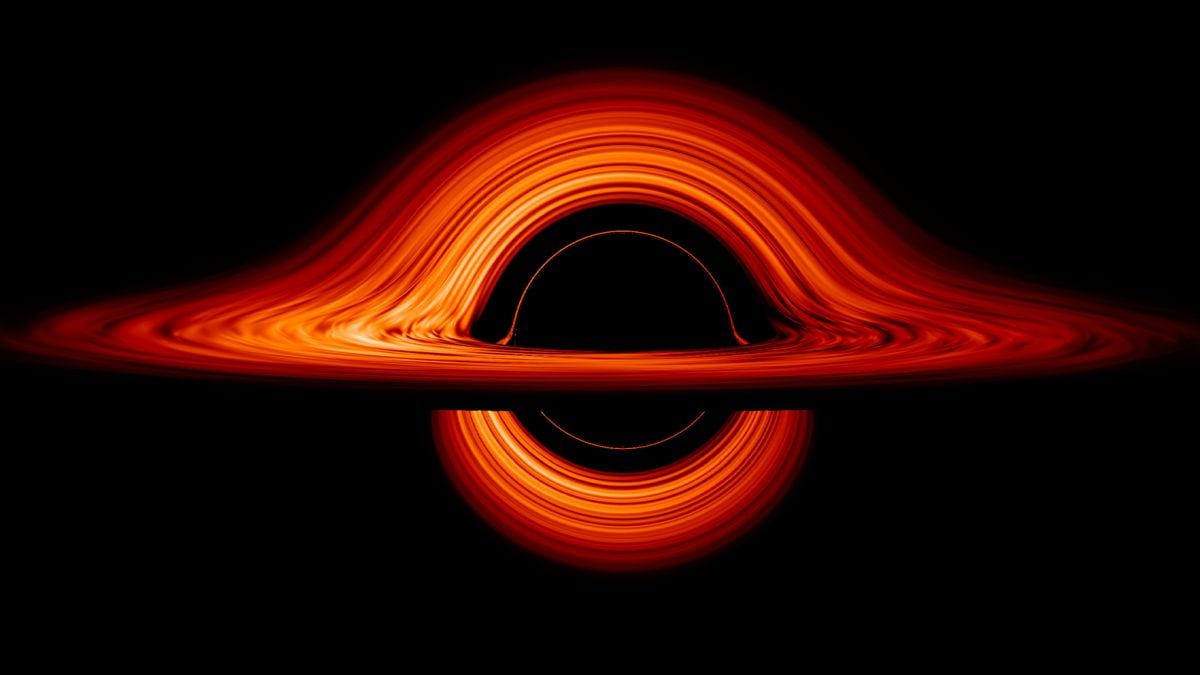
It is important to distinguish this new discovery from the famous images produced by the Event Horizon Telescope (EHT). The EHT images of M87* and Sagittarius A* showed the “shadow” of the black hole—the dark region where light is captured—surrounded by a glowing ring of plasma. While these images provided visual evidence of a black hole’s presence, they did not detect the event horizon’s physical “signature” in the way gravitational wave echoes do.
The current research focuses on the vibrational properties of the horizon. While the EHT provides a photograph, the gravitational wave data provides a “sound recording” of the black hole’s structure. This allows scientists to probe the internal physics of the horizon rather than just its external silhouette.
| Feature | EHT Visual Imaging | Gravitational Wave Signatures |
|---|---|---|
| Method | Radio Interferometry (Light) | Laser Interferometry (Spacetime Ripples) |
| What is Seen | The “Shadow” and Accretion Disk | Vibrational “Echoes” of the Horizon |
| Primary Goal | Mapping the shape and size | Testing the nature of the boundary |
| Evidence Type | Electromagnetic Radiation | Gravitational Radiation |
Why This Discovery Matters for Modern Physics
The detection of an event horizon signature addresses one of the greatest conflicts in science: the clash between general relativity and quantum mechanics. General relativity describes the universe on a massive scale (gravity, stars, galaxies), while quantum mechanics describes the very small (atoms, subatomic particles). Black holes are the only places in the universe where both theories must apply simultaneously.
The Information Paradox
According to quantum mechanics, information cannot be destroyed. However, general relativity suggests that anything falling into a black hole is lost forever once it crosses the event horizon. This is known as the Black Hole Information Paradox. If the event horizon has a “signature” or a structure that reflects waves, it suggests that information might be stored or reflected at the boundary, potentially solving the paradox.
Testing the “Firewall” Hypothesis
Some physicists propose the “Firewall” theory, which suggests that the event horizon is not a smooth transition but a high-energy barrier that incinerates anything touching it. Detecting specific fingerprints in the gravitational waves could provide evidence for or against the existence of these firewalls. If the ringdown signal deviates from Einstein’s predictions, it indicates that the horizon is not a void but a physical membrane.

Related explainer on the nature of singularities may provide further context on what exists beyond the horizon.
The Role of LIGO and Virgo in the Detection
The detection was made possible by the extreme sensitivity of the LIGO (Laser Interferometer Gravitational-Wave Observatory) and Virgo detectors. These instruments measure changes in distance smaller than the width of a proton. When two black holes merge millions of light-years away, they send ripples through the fabric of spacetime that stretch and squeeze these detectors.
To find the event horizon signature, scientists use a process called “matched filtering.” They compare the incoming signal against thousands of theoretical templates. When a signal matches a template that includes “echoes,” it suggests the presence of a boundary at the event horizon. According to ScienceAlert, the challenge lies in the signal-to-noise ratio; these echoes are incredibly faint and can be easily mistaken for background noise.
Key Milestones in Black Hole Detection
- 1916: Karl Schwarzschild provides the first mathematical solution for a black hole.
- 1971: Cygnus X-1 is identified as the first widely accepted black hole candidate.
- 2015: LIGO detects the first gravitational waves from a black hole merger.
- 2019: The Event Horizon Telescope captures the first image of a black hole’s shadow.
- Present: Potential detection of the event horizon’s specific vibrational signature.
Common Misconceptions About Event Horizons
As news of this discovery spreads, several common misunderstandings often arise regarding what an “event horizon signature” actually is.
Misconception 1: We have “seen” the event horizon.
We have not seen it in the traditional sense. The event horizon is, by definition, invisible. What scientists have detected is a signature—a mathematical pattern in gravitational waves that corresponds to the horizon’s existence. It is more like hearing a door slam and knowing a door exists, rather than seeing the door itself.
Misconception 2: The event horizon is a physical surface like a planet.
In general relativity, the event horizon is a mathematical boundary, not a solid object. However, the “fingerprints” being studied are designed to test if it behaves like a physical surface (a “membrane”) due to quantum effects. This is exactly what the researchers are trying to determine.
Misconception 3: This means we can now travel to a black hole and return.
The detection of a signature does not change the physics of the horizon. The event horizon remains a point of no return. The discovery helps us understand the boundary from a distance; it does not provide a way to bypass it.
Potential Implications for Future Astronomy
If these signatures are confirmed across multiple merger events, it will usher in an era of “Black Hole Spectroscopy.” Just as chemists use spectroscopy to determine the composition of a star by analyzing its light, astrophysicists will use gravitational wave spectroscopy to determine the “composition” and nature of black holes.
This could lead to the discovery of new particles or forces. For instance, if the echoes vary depending on the mass of the black hole, it could reveal how gravity changes at different scales. It may also provide the first empirical evidence for string theory, which predicts that black holes are actually “fuzzballs” of strings rather than singularities surrounded by a void.
Future upgrades to the LIGO and Virgo detectors, as well as the planned LISA (Laser Interferometer Space Antenna) mission in space, will allow scientists to detect lower-frequency waves. This will enable the study of supermassive black holes, providing a clearer look at the event horizons of the giants at the center of galaxies.
Frequently Asked Questions
What is the “signature” of a black hole’s event horizon?
The signature refers to specific “echoes” or repeating patterns found in the gravitational waves emitted after two black holes merge. These echoes suggest that waves are reflecting off the boundary of the event horizon, providing a detectable fingerprint of its existence.
How is this different from the 2019 black hole photo?
The 2019 photo captured the visual “shadow” created by light bending around the black hole. The new discovery involves gravitational waves, which are ripples in spacetime. While the photo shows the area of the black hole, the signature probes the physical nature of the horizon boundary.
Does this prove that Einstein was right?
Currently, the detection supports the general existence of the event horizon as predicted by Einstein. However, if the “echoes” are confirmed, they might actually suggest that Einstein’s theory is incomplete and needs to be merged with quantum mechanics to fully explain the horizon’s behavior.
Can we detect event horizons in all black holes?
Not yet. This method currently requires the violent energy of a black hole merger to create signals strong enough for our detectors to pick up. Stationary black holes do not produce these specific gravitational wave echoes, making them much harder to analyze using this method.
What happens if the signature is proven wrong?
If the echoes are found to be noise rather than signals, it reinforces the standard model of the event horizon as a perfect, non-reflective void. While less “exciting” than a new discovery, it would further validate general relativity as the definitive description of gravity.
The ongoing analysis of gravitational wave data continues to refine our understanding of these cosmic enigmas. As detectors become more sensitive, the line between theoretical physics and observed reality continues to blur, bringing the secrets of the event horizon into clearer focus.
