
‘It made no sense’: Rare Moonbow Spotted over Mackenzie Country – 1News
In a breathtaking display of atmospheric physics, a rare lunar rainbow—more commonly known as a moonbow—recently illuminated the night skies of New Zealand’s Mackenzie Country. For those witnessing the event, the experience was one of utter bewilderment and awe, leading many to describe the sight as something that simply “made no sense” given the darkness of the hour. This ethereal phenomenon, which transforms the night into a ghostly mirror of a daytime rainbow, has sparked a surge of interest in the unique meteorological conditions that allow such an event to occur in one of the world’s most pristine celestial viewing areas.
While standard rainbows are a common sight following a summer shower, the moonbow is an elusive sibling, requiring a precise alignment of lunar position, moisture levels, and an almost total absence of light pollution. The recent sighting in the Mackenzie Country serves as a vivid reminder of the natural wonders that remain hidden in plain sight, waiting for the perfect convergence of environmental factors to reveal themselves.
The Anatomy of a Lunar Phenomenon
To understand why a witness would claim the event “‘it made no sense’: rare moonbow spotted over Mackenzie Country – 1News,” one must first understand the science of optics. At its core, a moonbow is functionally identical to a daytime rainbow. Both are caused by the refraction, reflection, and dispersion of light through water droplets in the atmosphere.
When sunlight enters a raindrop, it slows down and bends (refracts), reflects off the back of the drop, and bends again as it exits. Because different wavelengths of light bend at different angles, the white light splits into the familiar spectrum of red, orange, yellow, green, blue, indigo, and violet. A moonbow follows this exact same process, but with one critical difference: the light source is the moon rather than the sun.
Because moonlight is actually reflected sunlight, it is significantly weaker. In most cases, the human eye cannot perceive the colors of a moonbow. the phenomenon often appears as a shimmering, white arc. However, under exceptionally dark conditions—such as those found in the heart of the South Island—the colors can sometimes be faintly visible to the naked eye, or they can be captured in vivid detail through long-exposure photography.
“The moonbow is a testament to the fragility of light. It requires a world that is quiet and dark enough for the moon’s reflected glow to become the dominant force in the atmosphere.”
Key Differences: Rainbows vs. Moonbows
To better visualize why these events are so distinct, the following table outlines the primary differences between the common rainbow and the rare lunar version.
| Feature | Daytime Rainbow | Lunar Rainbow (Moonbow) |
|---|---|---|
| Light Source | Direct Sunlight | Reflected Moonlight |
| Visibility | High; easily seen by all | Low; often appears white or ghostly |
| Required Conditions | Sun behind observer, rain in front | Bright moon behind observer, rain/mist in front |
| Frequency | Common | Extremely Rare |
| Visual Impact | Vibrant, saturated colors | Pale, ethereal, or monochromatic |
Why Mackenzie Country? The Role of the Dark Sky Reserve
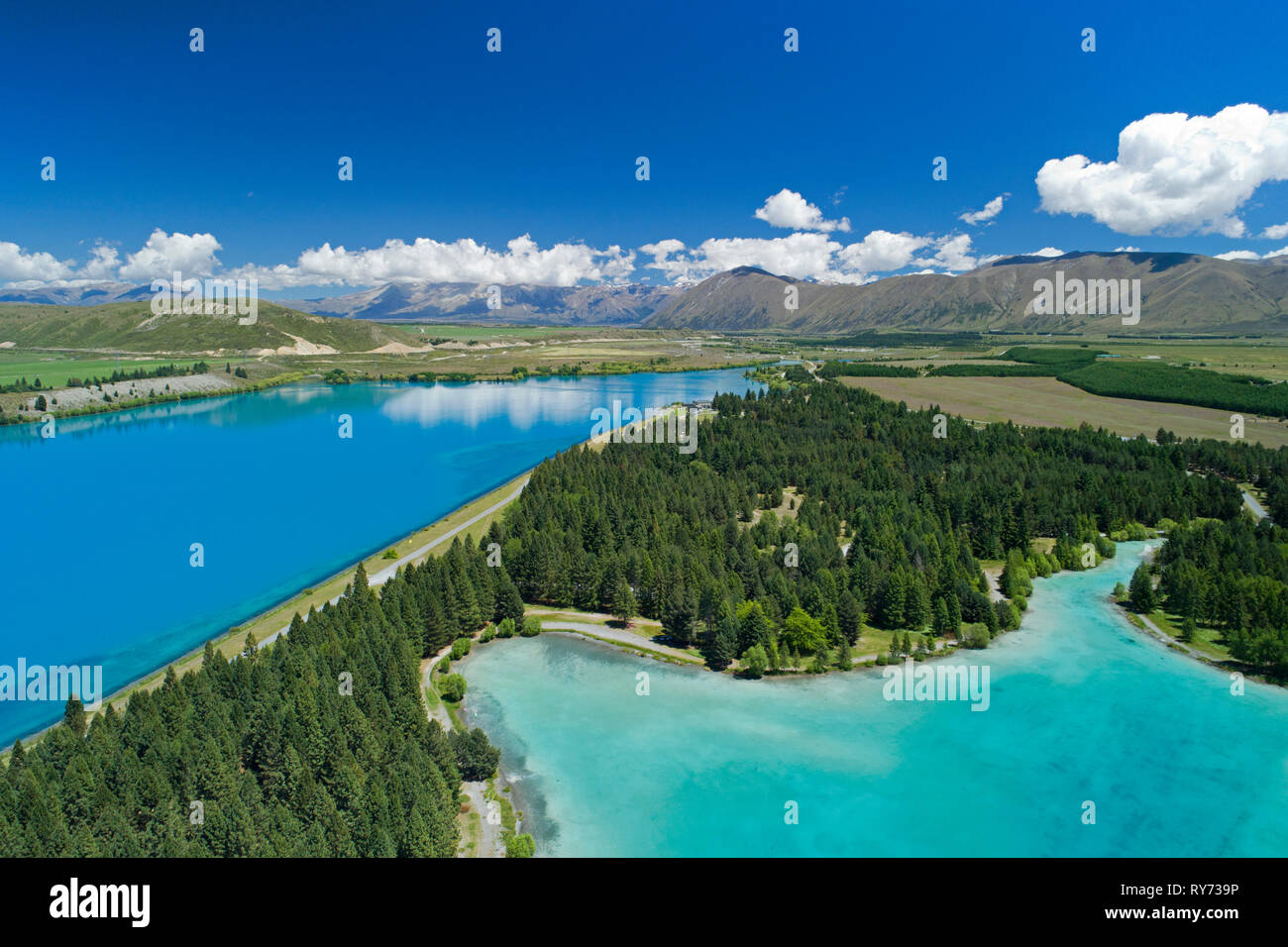
The occurrence of this phenomenon in the Mackenzie Country was not a random accident of geography. This region is home to the Aoraki Mackenzie International Dark Sky Reserve, one of the largest gold-rated dark sky reserves in the world. This designation is not merely a title; it is a commitment to limiting light pollution to preserve the visibility of the cosmos.
Light pollution is the primary enemy of the moonbow. In an urban environment, the artificial glow from streetlights, billboards, and buildings creates “skyglow,” which washes out the faint light of a lunar rainbow. Even if the atmospheric conditions—the rain and the moon’s position—were perfect in a city like Auckland or Christchurch, the moonbow would likely remain invisible to the human eye.
In the Mackenzie Country, the absence of artificial light allows the eye to adapt to the darkness, increasing the contrast between the night sky and the refracted moonlight. This makes the region a global hotspot for astronomical observations and rare optical events. For those interested in how light pollution affects our world, a related explainer on dark sky preservation provides further context on why these zones are vital for both science, and tourism.
The “Perfect Storm” of Conditions
For the event that led to the report “‘it made no sense’: rare moonbow spotted over Mackenzie Country – 1News,” several variables had to align simultaneously:
- Lunar Phase: The moon had to be near its full phase to provide enough luminosity to be refracted.
- Moon Altitude: The moon needed to be relatively low on the horizon. If the moon is too high, the arc of the bow is pushed below the horizon line, making it invisible.
- Atmospheric Moisture: A light rain or a fine mist had to be present in the air directly opposite the moon.
- Observer Position: The observer had to be positioned exactly between the moon and the rain, with their back to the lunar source.
The Psychological Impact of Rare Natural Events
The phrase “it made no sense” captures more than just a lack of scientific knowledge; it describes the cognitive dissonance that occurs when we witness something that contradicts our daily experience. We are conditioned to associate rainbows with the sun and daytime. Seeing one emerge from the darkness of a New Zealand night feels like a glitch in reality.
Psychologists suggest that these “awe-inspiring” moments trigger a state of diminished self-importance, often leading to a feeling of connection with the broader universe. In an era of digital saturation, the emergence of a moonbow over the Mackenzie Country provides a visceral, unmediated experience of nature’s complexity.
This specific event has also highlighted the growing trend of “astro-tourism” in New Zealand. Travelers are increasingly seeking out locations where the veil between the earth and the stars is thinnest, turning the Mackenzie Basin into a sanctuary for those chasing rare celestial sightings.
Capturing the Ghostly Glow: The Art of Moonbow Photography
One of the most fascinating aspects of the Mackenzie Country moonbow is the discrepancy between what the eye sees and what the camera captures. While a human observer might see a faint white arc, a photograph of the same scene often reveals a brilliant, multi-colored rainbow.
This happens because digital sensors can “collect” light over time in a way that the human retina cannot. To capture a moonbow, photographers use a technique called long exposure. By keeping the shutter open for several seconds, the camera accumulates the faint photons of refracted moonlight, eventually building up enough data to render the full color spectrum.
Technical Requirements for Moonbow Photography
- Tripod: Essential to prevent motion blur during long exposures.
- Low ISO: To minimize digital noise (grain) in the dark areas of the image.
- Wide Aperture: To let in as much light as possible.
- Slow Shutter Speed: Typically ranging from 5 to 30 seconds, depending on the moon’s brightness.
When these elements are combined, the result is an image that looks almost supernatural, further fueling the sentiment that the event “made no sense” to those who didn’t realize the camera was seeing “more” than they were.
Comparing Moonbows to Other Rare Optical Phenomena
The moonbow is part of a wider family of atmospheric optics. To understand its place in the natural world, it is helpful to compare it to other rare sightings that often confuse observers.
The Fogbow
Often mistaken for a moonbow, a fogbow occurs when sunlight interacts with very small droplets of fog. Because the droplets are much smaller than raindrops, the colors overlap and wash out, resulting in a bright white arc. Unlike the moonbow, however, fogbows occur during the day.
The Sun Dog (Parhelion)
While a moonbow involves liquid water, sun dogs involve ice crystals. These appear as bright spots of light on either side of the sun, often creating a “mock sun” effect. They are more common in extremely cold climates but can occasionally be seen in New Zealand during winter mornings.
The Lunar Halo
A lunar halo is a ring of light around the moon caused by the refraction of moonlight through ice crystals in high-altitude cirrus clouds. While a moonbow is an arc caused by rain, a halo is a circle caused by ice. Both are stunning, but they require entirely different atmospheric conditions.

Implications for Local Tourism and Conservation
The widespread sharing of the story “‘it made no sense’: rare moonbow spotted over Mackenzie Country – 1News” has a tangible impact on the region. The Mackenzie Country is already a hub for stargazing, but the “viral” nature of rare weather events brings a new type of visitor: the atmospheric hunter.
This influx of interest presents both an opportunity and a challenge. On one hand, it boosts the local economy and raises awareness about the importance of dark sky reserves. It increases the pressure on the delicate ecosystem of the Mackenzie Basin. Conservationists argue that the very thing that makes the region special—its isolation and darkness—must be protected from the encroachment of urban development and excessive lighting.
The preservation of these zones ensures that future generations will still be able to experience the “nonsense” of a moonbow, maintaining a window into the natural world that is rapidly closing in most other parts of the globe.
Common Misconceptions About Lunar Rainbows
Because they are so rare, several myths often circulate when a moonbow is spotted. It is important to clarify these points to provide a factual understanding of the event.
- Myth: Moonbows are only visible during a full moon.
Fact: While a full moon provides the best light, moonbows can occur during other phases, provided the moon is bright enough and the surroundings are sufficiently dark. - Myth: You can only see them in the tropics.
Fact: While famous moonbows occur at Victoria Falls in Africa, they can happen anywhere in the world where the conditions of rain, moonlight, and darkness coincide. - Myth: They are a sign of an impending storm.
Fact: A moonbow is simply an optical effect. While it requires rain, it is not a predictive meteorological tool for severe weather.
Frequently Asked Questions
What exactly is a moonbow?
A moonbow is a lunar rainbow. It is an atmospheric phenomenon created when moonlight is refracted through water droplets in the air, creating a spectrum of light similar to a daytime rainbow, though usually appearing white to the naked eye.
Why was the moonbow in Mackenzie Country so special?
The sighting was particularly notable because the Mackenzie Country is an International Dark Sky Reserve. The lack of light pollution made the faint light of the moonbow much more visible than it would be in almost any other location in New Zealand.
Can I see a moonbow without a camera?
Yes, but it is difficult. Because moonlight is so dim, your eyes may only perceive a white or silvery arc. To see the actual colors, you need an exceptionally dark environment and a high level of visual adaptation to the dark.
How often do moonbows occur?
They are extremely rare. They require a specific lunar phase, a low lunar angle, a rain shower, and a dark sky—all happening at the exact same time and place.
Is a moonbow the same as a lunar halo?
No. A moonbow is caused by liquid water droplets (rain) and forms an arc. A lunar halo is caused by ice crystals in high clouds and forms a complete circle around the moon.
The sighting that left many saying “it made no sense” is a reminder that the natural world still holds the power to surprise us. In the silence of the Mackenzie Country, the moonbow stands as a fleeting intersection of geometry, meteorology, and light, proving that some of the most beautiful things in life are those that seem, at first glance, to be impossible.
