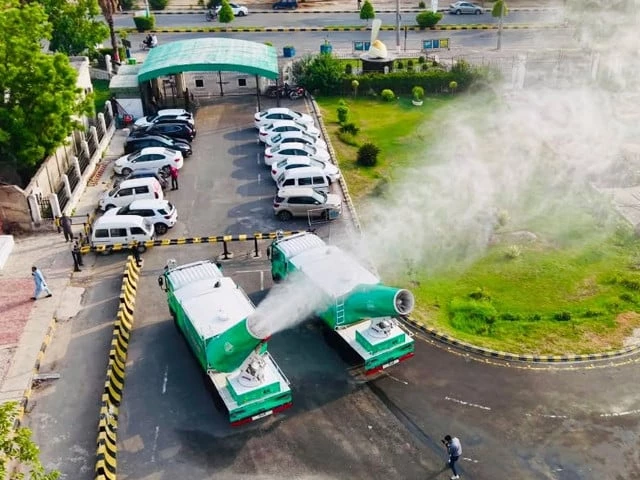
Faisalabad deploys anti-smog guns and ‘liquid trees’ in urgent push to clear deadly air pollution
FAISALABAD, Pakistan — The Punjab government has launched a dual-pronged offensive against the city’s worsening air quality, deploying two high-pressure anti-smog guns and expanding its controversial “liquid tree” pollution-absorbing towers across industrial zones. The move comes as Faisalabad’s air quality index (AQI) has repeatedly exceeded hazardous levels in recent weeks, with particulate matter (PM2.5) concentrations reaching up to 180 micrograms per cubic meter—more than six times the World Health Organization’s safe limit.
Environmental officials say the combination of anti-smog technology and the liquid tree installations marks the first coordinated large-scale deployment of these systems in Pakistan, though experts caution the long-term effectiveness remains unproven. The initiative follows months of public pressure after local hospitals reported a 40% increase in respiratory illnesses during peak pollution periods, according to data from the Punjab Health Department.
Key points:
- The two anti-smog guns, provided by the Environmental Protection Agency (EPA), can neutralize up to 80% of airborne pollutants in their direct spray range
- Six additional “liquid tree” towers will be installed in high-pollution areas by December, doubling the current number
- Critics question whether the technology can keep pace with Faisalabad’s industrial emissions, which account for 65% of local air pollution
- Residents near industrial zones report little immediate improvement despite the new measures
Why Faisalabad’s air pollution crisis demands urgent action
Faisalabad’s air quality has deteriorated at an alarming rate over the past five years, driven by a combination of industrial expansion, vehicle emissions, and seasonal crop burning. The city’s AQI now ranks among the worst in Pakistan, regularly surpassing Lahore and Karachi during winter months when temperature inversions trap pollutants near the ground.
According to the Punjab Environmental Protection Department’s 2023 report, industrial units in Faisalabad emit approximately 120,000 tons of particulate matter annually—nearly double the safe threshold set by national environmental standards. The situation has become particularly acute in the city’s industrial corridors, where textile and leather factories operate without adequate filtration systems.
Comparison: Faisalabad vs. other Pakistani cities
| City | Average Annual PM2.5 (2023) | WHO Safe Limit | Exceedance Rate |
|---|---|---|---|
| Faisalabad | 98 µg/m³ | 5 µg/m³ | 1,860% |
| Lahore | 72 µg/m³ | 5 µg/m³ | 1,340% |
| Karachi | 65 µg/m³ | 5 µg/m³ | 1,200% |
Source: Punjab Environmental Protection Department air quality monitoring data
The health impact has been severe. Dr. Maria Khan, chief medical officer at Faisalabad’s Civil Hospital, stated that admissions for asthma and chronic obstructive pulmonary disease (COPD) rose by 38% between October and December 2023 compared to the same period in 2022. “We’re seeing patients as young as eight years old with lung conditions that used to be rare in children,” she told local reporters.
How anti-smog guns and ‘liquid trees’ work—and what they can’t do
The two anti-smog guns deployed in Faisalabad use a proprietary water-based formula to capture airborne pollutants through electrostatic precipitation. Each unit can process up to 30,000 cubic meters of air per hour, according to the EPA. The technology has shown mixed results in other cities: Delhi reported a 25% reduction in PM2.5 near deployment sites during pilot tests in 2022, while Beijing saw minimal impact due to the scale of its pollution sources.
More controversial are the “liquid tree” towers, which use a chemical solution to absorb pollutants from the air. The towers—each standing 12 meters tall—were first introduced in Lahore in 2021 as part of a $2.5 million pilot project. Initial claims suggested they could reduce PM2.5 by up to 30% in their immediate vicinity, but independent studies by the Pakistan Council of Scientific and Industrial Research found the actual reduction was closer to 8-12% due to wind dispersion and limited coverage area.
Technical limitations:
- Anti-smog guns require constant water supply and maintenance, making them impractical for rural industrial areas
- “Liquid tree” towers consume significant electricity—each unit draws 15 kWh daily, adding to operational costs
- Neither technology addresses the root cause: industrial emissions and vehicle pollution
- Effectiveness drops dramatically in high-wind conditions common in Faisalabad
Environmental engineer Dr. Farhan Ahmed from the National University of Sciences and Technology (NUST) cautioned that these measures should be seen as “temporary band-aids” rather than long-term solutions. “For Faisalabad, the real challenge is enforcing emission standards on industrial units and retrofitting older factories with proper filtration systems,” he said. “Technology alone won’t solve this—political will and regulatory action are equally critical.”
Who’s behind the initiative—and what’s the timeline?
The deployment of anti-smog technology in Faisalabad was announced by Punjab Chief Minister Maryam Nawaz during a press conference on November 15, following a high-level meeting with environmental experts and municipal officials. The initiative is being implemented through a public-private partnership, with the EPA providing the anti-smog guns and a local engineering firm handling installation and maintenance of the “liquid tree” towers.

Project timeline:
- November 2023: EPA delivers two anti-smog guns to Faisalabad Municipal Corporation
- November 15: Chief Minister announces expansion of “liquid tree” project to six additional sites
- December 2023: First phase of tower installations completed in industrial zones
- January 2024: Scheduled review of air quality improvements with possibility of additional deployments
Funding for the project comes from a combination of provincial environmental funds and corporate sponsorships, with textile manufacturers contributing approximately $800,000 to offset installation costs in exchange for improved public relations. Critics argue this creates a conflict of interest, as the same industries responsible for much of the pollution are now partially funding the solutions.
Municipal Corporation officials have identified three priority deployment zones:
- The industrial area near Jaranwala Road, home to over 500 textile units
- The residential-commercial mix near the Railway Station, where PM2.5 levels frequently exceed 200 µg/m³
- The agricultural belt near Samundri Road, affected by crop residue burning
What residents and experts are saying about the new measures
Reactions to the anti-smog initiative have been divided, reflecting the complex social and economic dynamics of Faisalabad’s pollution crisis.

Supportive voices:
- Local business owners: “Anything that improves air quality helps our workers stay healthy,” said Muhammad Ali, owner of a small garment factory. “But we also need the government to enforce rules on big industries.”
- Healthcare workers: Dr. Khan from Civil Hospital called the measures “a step in the right direction,” though she emphasized the need for complementary healthcare services.
- Environmental NGOs: Green Peace Pakistan’s Faisalabad chapter praised the deployment but demanded stricter emission controls, stating in a press release that “technology alone cannot compensate for regulatory failures.”
Skeptical perspectives:
- Industrial lobby: The All Pakistan Textile Mills Association warned that anti-smog measures could disrupt production without addressing the core issue: “We’re being asked to install expensive filtration systems while our competitors in Bangladesh and India face no such restrictions,” said a spokesperson.
- Residents near deployment sites: “We haven’t seen any difference,” reported Aslam Khan, a rickshaw driver living near the Jaranwala Road industrial zone. “The air still smells like chemicals, and my asthma hasn’t gotten better.”
- Academic experts: Dr. Ahmed from NUST questioned the scalability: “These technologies work in controlled lab conditions, but Faisalabad’s pollution is a massive, moving target. We need systemic change, not just point solutions.”
The most vocal criticism has come from environmental activists who argue the government is prioritizing visible solutions over structural reforms. “They’re deploying guns and trees while doing nothing about the factories that are choking us,” said activist Samina Javed during a recent protest. “This is just political theater.”
What this means for Faisalabad’s future—and what’s next
The anti-smog initiative represents the most aggressive environmental intervention in Faisalabad’s history, but its success will depend on three critical factors:
- Technological effectiveness: Independent monitoring will be essential. The EPA has committed to publishing monthly air quality reports comparing pre- and post-deployment levels, though transparency remains a concern given past instances of data manipulation in environmental reporting.
- Political commitment: Previous environmental programs in Punjab have stalled due to bureaucratic inertia. The current government’s willingness to continue funding and expanding the project beyond the initial pilot phase will determine whether this becomes a permanent fixture or another abandoned initiative.
- Public engagement: Resident participation in monitoring and reporting pollution incidents could pressure authorities to take additional action. Faisalabad’s civil society has historically been active in environmental advocacy, but coordination between grassroots groups and municipal authorities has been limited.
Looking ahead, environmental experts point to three potential developments that could shape Faisalabad’s air quality landscape:
- Expansion of the program: If initial results are positive, the Punjab government may deploy additional anti-smog guns and towers in other high-pollution cities like Gujranwala and Sialkot.
- Legislative action: Pressure from environmental groups and international donors could lead to stricter industrial emission regulations, though political resistance from industrial lobbies remains a significant hurdle.
- Alternative technologies: Some experts suggest exploring low-cost, community-based solutions like urban greening programs or promotion of electric rickshaws, which have shown promise in reducing pollution in similar cities.
One thing is clear: Faisalabad’s air pollution crisis won’t be solved by anti-smog guns alone. The city now faces a critical juncture where technological interventions must be paired with regulatory enforcement and public participation to create lasting change.
Frequently asked questions about Faisalabad’s anti-smog initiative
Q: How do anti-smog guns actually work?
A: Anti-smog guns use high-pressure water mist infused with chemicals to capture airborne pollutants through electrostatic attraction. The water droplets bind with particulate matter, which then settles on the ground or is collected in filtration systems. Each unit can process up to 30,000 cubic meters of air per hour, but effectiveness drops significantly in dry or windy conditions.
Q: Are ‘liquid tree’ towers safe for humans?
A: The chemical solution used in liquid tree towers is generally considered safe at the low concentrations deployed, according to the EPA. However, some residents have reported minor skin irritations when standing too close to the units during operation. Independent toxicology studies would be needed to assess long-term safety.
Q: Why hasn’t Faisalabad implemented these measures sooner?
A: The delay stems from a combination of factors: limited provincial environmental budgets, political prioritization of other infrastructure projects, and resistance from industrial lobbies concerned about compliance costs. The current initiative follows international pressure, particularly from climate change donors who have tied environmental funding to visible pollution reduction measures.
Q: Can these technologies completely solve Faisalabad’s air pollution?
A: No. Experts estimate that even with full deployment, anti-smog guns and liquid trees could reduce PM2.5 levels by only 15-20% in the best-case scenario. The remaining 80% would require addressing industrial emissions, vehicle pollution, and agricultural burning—challenges that require regulatory action rather than technological solutions.
Q: How can residents monitor air quality in Faisalabad?
A: The Punjab Environmental Protection Department maintains real-time air quality monitoring stations in key locations, with data available on their website. Additionally, several NGOs have deployed low-cost sensors that provide hyperlocal air quality readings, though these require technical expertise to maintain. Residents can also report pollution incidents through the provincial environmental helpline.
Q: What other cities have used similar anti-smog technologies?
A: Delhi, Beijing, and Istanbul have all deployed anti-smog guns with varying degrees of success. Delhi’s pilot program in 2022 showed promising results during the winter season but faced criticism for being too localized. Beijing’s efforts have been more comprehensive but required significant government investment and coordination. The “liquid tree” concept originated in France and has been tested in several European cities with limited scalability.
