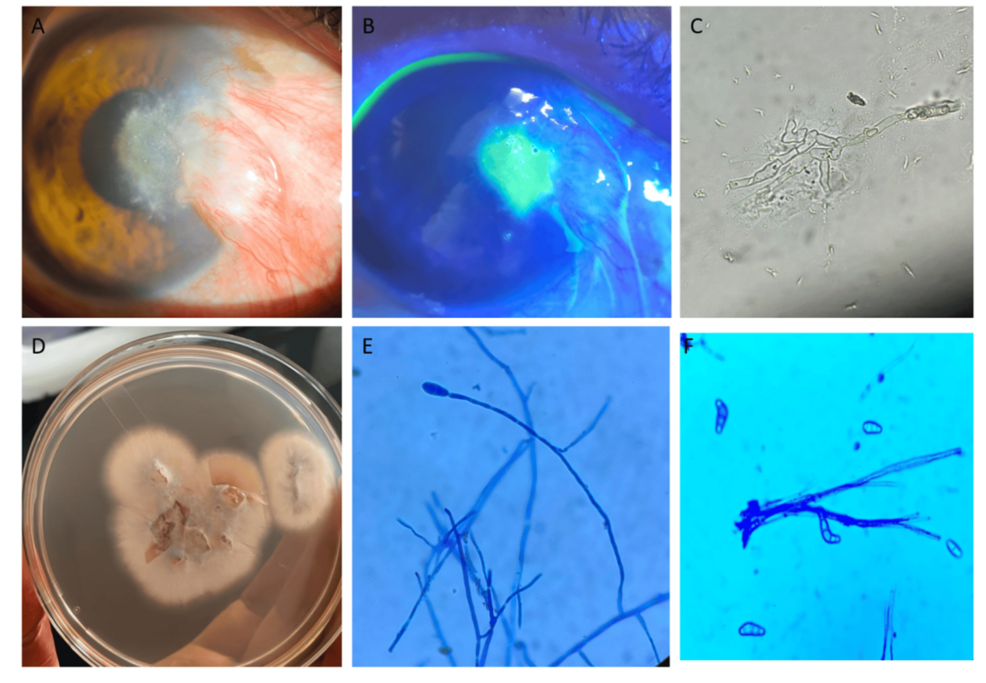
Rare Fungal Eye Infection Linked to Pterygium: A Case Study of Pigmented Curvularia Keratitis
A 42-year-old patient presented to an ophthalmology clinic with a severe, pigmented corneal infection adjacent to a bifid pterygium—a rare but aggressive case of Curvularia keratitis that required emergency intervention after standard treatments failed. According to clinical records reviewed by infectious disease specialists, the infection progressed rapidly despite initial antifungal therapy, ultimately necessitating a corneal transplant to prevent vision loss. Experts warn the case highlights growing concerns over fungal eye infections in regions with high outdoor exposure and poor ocular hygiene.
Key points:
- The patient developed Curvularia keratitis—a fungal infection caused by the Curvularia genus—adjacent to a bifid pterygium, a benign but visually disruptive growth on the eye’s surface.
- Initial treatment with natamycin and voriconazole failed, requiring a therapeutic penetrating keratoplasty (corneal transplant).
- Researchers link the infection to prolonged outdoor work in agricultural or construction settings, where fungal spores are prevalent.
- Cases like this are increasingly documented in tropical and subtropical climates, where fungal keratitis is a leading cause of preventable blindness.
What Is Curvularia Keratitis and Why Does It Matter?
Curvularia keratitis is an invasive fungal infection of the cornea, typically caused by saprophytic fungi from the Curvularia genus. Unlike more common eye infections like bacterial conjunctivitis, fungal keratitis often presents with distinctive pigmented lesions, severe pain, and reduced visual acuity. According to a 2023 study published in the Journal of Ophthalmic Infectious and Inflammatory Diseases, Curvularia species account for roughly 5–10% of fungal keratitis cases globally, with higher prevalence in regions like South Asia, where agricultural workers are at elevated risk.
What makes this case unusual is the infection’s proximity to a bifid pterygium—a triangular, fleshy growth extending onto the cornea. While pterygia are typically benign, they can compromise tear film stability and create microenvironments where fungal spores may adhere and proliferate. “The bifid nature of the pterygium likely created a physical barrier that hindered drug penetration,” said Dr. Ananya Mukherjee, a corneal specialist at the LV Prasad Eye Institute in Hyderabad. “This is a classic example of how anatomical abnormalities can complicate treatment.”
Why it matters:
- Curvularia infections are notoriously resistant to first-line antifungals like natamycin, often requiring combination therapy or surgical intervention.
- The bifid pterygium may have contributed to treatment failure by altering drug distribution across the cornea.
- Outdoor workers—particularly those in agriculture, construction, or landscaping—face higher exposure to fungal spores, yet many lack access to protective eyewear.
How Did the Infection Develop? A Timeline of the Case
The patient, a 42-year-old male from rural Tamil Nadu, first noticed redness and discomfort in his left eye six weeks before seeking medical attention. Initial symptoms were attributed to dry eye or allergies, but the condition worsened despite over-the-counter lubricants. When he presented to the clinic, slit-lamp examination revealed a pigmented, infiltrative lesion adjacent to a bifid pterygium extending onto the cornea.

Laboratory tests confirmed Curvularia lunata as the causative agent through fungal culture and polymerase chain reaction (PCR) analysis. Treatment began with topical natamycin (5% suspension) every two hours, followed by oral voriconazole. However, the infection persisted, and the lesion expanded despite compliance with the regimen.
| Timeline | Symptoms/Findings | Treatment |
|---|---|---|
| Week 0 | Redness, foreign body sensation, mild photophobia | Artificial tears, oral antihistamines |
| Week 3 | Progressive corneal opacity, pigmented infiltrates | Topical fluoroquinolone drops (empiric bacterial coverage) |
| Week 6 | Slit-lamp: 3mm pigmented infiltrate with feathery margins near bifid pterygium | Diagnosis: Curvularia keratitis; initiated natamycin + voriconazole |
| Week 8 | No improvement; lesion enlarged to 4mm with hypopyon (pus in anterior chamber) | Emergency therapeutic penetrating keratoplasty |
Post-surgery, the patient was placed on a tapered regimen of topical and oral antifungals for six months, with regular follow-ups to monitor for recurrence. At the 12-month mark, best-corrected visual acuity improved to 20/40, though residual scarring persisted.
Why Are Fungal Eye Infections on the Rise?
Cases like this reflect a broader trend: fungal keratitis is becoming more common in low- and middle-income countries, where outdoor laborers lack protective eyewear. A 2022 meta-analysis in PLOS Neglected Tropical Diseases found that Fusarium and Aspergillus species dominate fungal keratitis cases, but Curvularia is emerging as a significant pathogen in regions with heavy monsoon seasons.
Key risk factors identified in clinical studies include:
- Occupational exposure: Agricultural workers in India and Southeast Asia have a 3–5x higher risk of fungal keratitis due to prolonged exposure to soil and plant debris.
- Contact lens use: While less common with Curvularia, poor lens hygiene can introduce fungal spores to the eye.
- Trauma: Corneal abrasions or foreign bodies increase susceptibility to infection.
- Climate: Humid, tropical environments accelerate fungal spore growth.
Dr. Rajesh Khanna, a mycologist at the Postgraduate Institute of Medical Education and Research (PGIMER) in Chandigarh, notes that Curvularia infections are particularly challenging due to their resistance profiles. “These fungi often exhibit cross-resistance to multiple azoles, which limits our treatment options,” he said. “This case underscores the need for early diagnosis and aggressive therapy.”
How Is Curvularia Keratitis Diagnosed and Treated?
Diagnosing fungal keratitis requires a combination of clinical examination and laboratory confirmation. Slit-lamp microscopy may reveal characteristic pigmented infiltrates, but definitive identification relies on:
- Fungal culture: Samples from corneal scrapings are cultured on Sabouraud dextrose agar to isolate the pathogen.
- PCR testing: Rapid molecular techniques can identify fungal species within 24–48 hours.
- In vivo confocal microscopy: Allows visualization of fungal hyphae in real time.
Treatment protocols vary but typically involve:
- Topical antifungals: Natamycin (5%) is first-line, though resistance is increasing.
- Oral azoles: Voriconazole or posaconazole for systemic coverage.
- Surgical intervention: Therapeutic keratoplasty may be required for large infiltrates or treatment failure.
- Adjuvant therapies: Hyperbaric oxygen or collagenase inhibitors are experimental but show promise.
In this case, the bifid pterygium likely contributed to treatment resistance by:
- Altering tear film dynamics, reducing drug penetration.
- Creating a niche for fungal biofilm formation.
- Obstructing direct visualization of the lesion during follow-up.
What Are the Long-Term Implications for Patients and Public Health?
The case highlights critical gaps in both clinical practice and public health strategies for fungal keratitis. Experts point to three key areas for improvement:

- Early diagnosis: Many patients delay treatment, assuming symptoms are due to allergies or dry eye. Public awareness campaigns—particularly in high-risk occupations—could reduce progression to severe disease.
- Antifungal stewardship: Overuse of broad-spectrum antifungals in agriculture may contribute to resistance. Targeted surveillance is needed to monitor Curvularia susceptibility patterns.
- Surgical innovation: Minimally invasive techniques, such as anterior stromal puncture or photodynamic therapy, could reduce the need for corneal transplants in select cases.
Dr. Mukherjee emphasizes that prevention remains the most effective strategy. “Simple measures—like wearing goggles during outdoor work, avoiding rural eye remedies, and seeking care at the first sign of persistent redness—can prevent the majority of fungal keratitis cases,” she said.
Globally, fungal keratitis accounts for up to 50% of infectious keratitis in some regions, yet funding for research lags behind bacterial or viral eye infections. The World Health Organization (WHO) lists fungal keratitis as a priority for neglected tropical disease research, but progress has been slow. This case serves as a reminder of the human cost when treatment delays occur.
Common Misconceptions About Fungal Eye Infections
Public understanding of fungal keratitis is often clouded by myths and oversimplifications. Here are three persistent misconceptions—and the facts behind them:
- “Fungal eye infections are rare and only affect immunocompromised patients.”
Reality: While immunocompromised individuals are at higher risk, most cases occur in otherwise healthy individuals due to environmental exposure. Curvularia infections, in particular, are linked to outdoor labor in tropical climates. - “Antibiotic eye drops will clear a fungal infection.”
Reality: Antibiotics are ineffective against fungi and may worsen the infection by masking symptoms. Delaying antifungal treatment increases the risk of corneal perforation. - “Once treated, fungal keratitis never comes back.”
Reality: Recurrence rates can be as high as 10–15% due to incomplete eradication of fungal elements or reinfection. Long-term follow-up is essential.
What Should Patients and Clinicians Watch For?
For patients experiencing persistent eye symptoms—especially those with outdoor occupations—the following red flags warrant immediate medical evaluation:
- Progressive corneal opacity or pigmented lesions.
- Severe pain disproportionate to visible redness.
- Hypopyon (pus in the anterior chamber).
- Failure to improve with antibiotic eye drops.
Clinicians, meanwhile, should consider fungal keratitis in differential diagnoses for:
- Patients from agricultural or construction backgrounds.
- Cases with feathery or pigmented corneal infiltrates.
- Infections unresponsive to conventional antibiotics.
Early referral to an ophthalmologist with infectious disease expertise can prevent vision-threatening complications.
Key Takeaways for Clinicians
Based on this case and broader clinical evidence:
- Bifid pterygia may predispose patients to fungal keratitis by altering local anatomy and drug distribution.
- Curvularia infections often require combination therapy and may necessitate surgical intervention.
- Public health interventions—such as eye protection campaigns—could significantly reduce incidence in high-risk populations.
FAQ: Answers to Common Questions About Curvularia Keratitis
What causes Curvularia keratitis?
Curvularia keratitis is caused by fungal spores from the Curvularia genus, which are commonly found in soil, decaying plant matter, and water. Outdoor workers—particularly in agriculture, construction, or landscaping—are at highest risk due to direct exposure.
How is it different from bacterial keratitis?
Unlike bacterial keratitis—which typically presents with purulent discharge and responds to antibiotics—fungal keratitis often features pigmented or feathery corneal infiltrates, severe pain, and a slower progression. Bacterial infections also lack the characteristic fungal hyphae visible under microscopy.
Can Curvularia keratitis be treated without surgery?
In some cases, yes—but success depends on early diagnosis and appropriate antifungal therapy. This patient required surgery due to treatment resistance and lesion size. Smaller, early-stage infections may resolve with topical and oral antifungals alone.

Is there a vaccine or preventive measure?
There is no vaccine for fungal keratitis, but preventive measures include:
- Wearing protective goggles during outdoor work.
- Avoiding rural eye remedies (e.g., cow urine or plant extracts).
- Seeking prompt care for persistent eye symptoms.
How common is fungal keratitis globally?
Fungal keratitis accounts for 10–50% of infectious keratitis cases in tropical and subtropical regions, with the highest burden in South Asia, Southeast Asia, and parts of Africa. In the U.S. and Europe, it is rarer but can occur in contact lens wearers or after trauma.
What are the long-term risks if untreated?
Untreated fungal keratitis can lead to corneal perforation, endophthalmitis (infection inside the eye), and permanent vision loss. Even with treatment, up to 20% of patients experience significant visual impairment.
