One Drink a Day May Be the New Upper Limit for Safer Alcohol Guidance – News-Medical
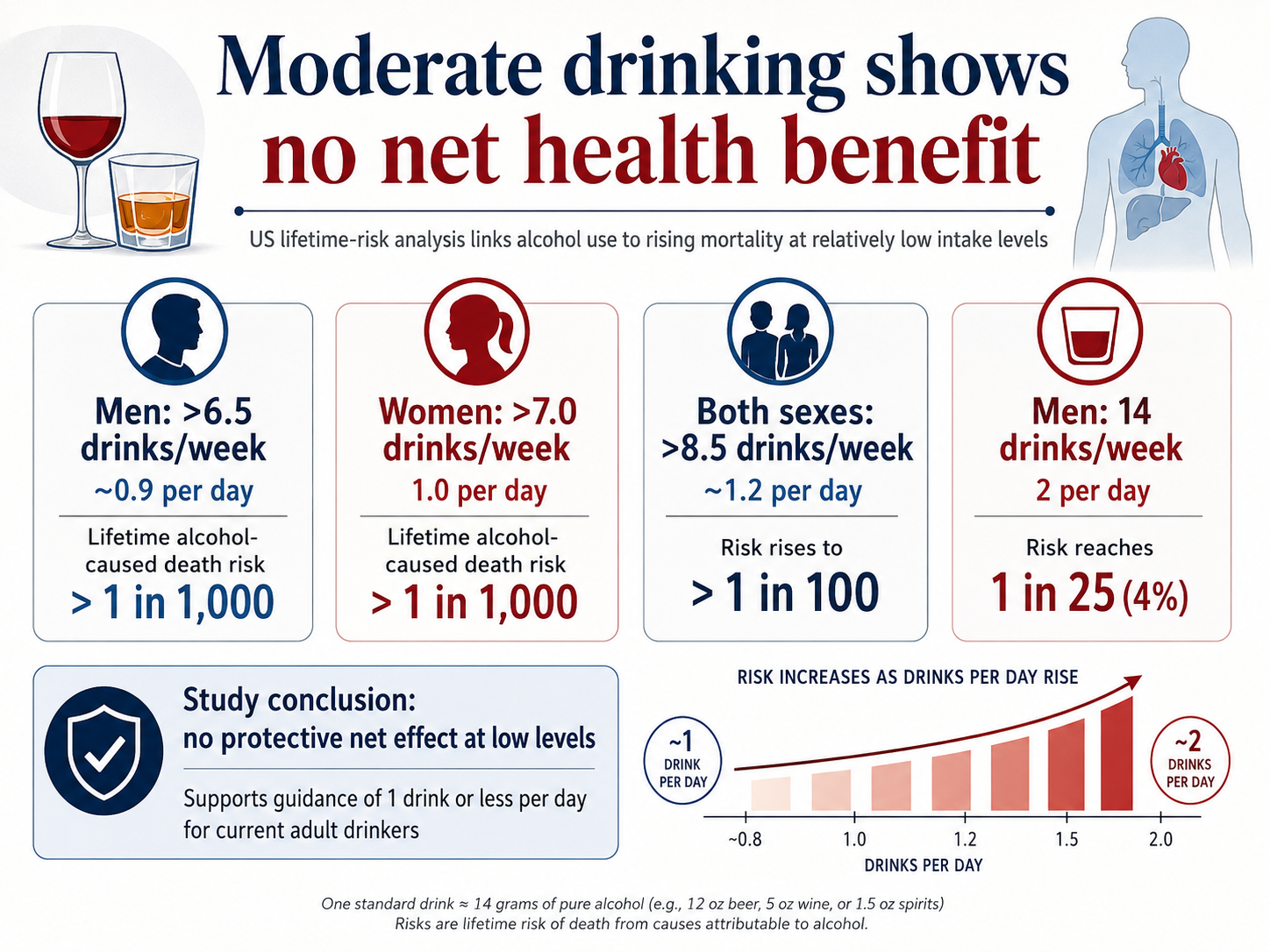
Health risks associated with alcohol consumption, specifically cancer and heart disease, accelerate after a person consumes more than one drink per day, according to reports from News-Medical and the New York Times. This finding suggests that previous guidance allowing for more moderate intake may overstate the safety of daily drinking.
Why One Drink a Day is Now Seen as the Critical Threshold
Recent analysis indicates that the physiological toll of alcohol does not increase linearly, but rather accelerates once a specific daily threshold is crossed. According to the New York Times, health risks climb more sharply after a person consumes more than one drink per day. This suggests that the margin between “moderate” and “high-risk” drinking is narrower than previously understood by the general public.
For decades, many health guidelines suggested that one to two drinks a day for men and one for women was a safe or even potentially beneficial range. However, the data highlighted by News-Medical indicates that this upper limit may need to be lowered. The acceleration of risk means that the second drink in a day provides a disproportionately higher increase in health danger than the first.
This shift in understanding moves the conversation from “how much is too much” to “at what point does the risk spike.” The current evidence suggests that for many individuals, that spike occurs immediately after the first standard drink.
How Alcohol Consumption Increases Colorectal Cancer Risk
The link between alcohol and malignancy is not limited to the liver. Medscape reports that alcohol intake is specifically tied to an increased risk of colorectal cancer. This connection is a primary driver behind the push for stricter daily limits.
Alcohol breaks down into acetaldehyde, a toxic chemical that can damage DNA and prevent cells from repairing the damage. According to Medscape, this process is a significant contributor to the development of tumors in the colon and rectum. While the risk exists at low levels, it compounds as daily intake increases, making the “one drink” limit a critical marker for cancer prevention.
The biological impact is not limited to heavy drinkers. Even those who consider themselves moderate drinkers may be increasing their susceptibility to colorectal cancers if they consistently exceed the one-drink-per-day threshold.
Key Risks Associated with Daily Alcohol Intake
- DNA Damage: Acetaldehyde production leads to chromosomal breaks.
- Inflammation: Chronic alcohol use triggers systemic inflammation, a precursor to many cancers.
- Nutrient Depletion: Alcohol interferes with the absorption of folate, which is essential for DNA methylation and repair.
The Connection Between Daily Drinking and Heart Disease
For years, a common narrative suggested that a glass of red wine could protect the heart. However, Star Local Media reports that even a single glass of wine or beer daily can be enough to raise the risk of heart disease. This contradicts earlier beliefs that small amounts of alcohol provided cardiovascular benefits.
The reported data suggests that the risks—such as hypertension and cardiac arrhythmia—outweigh any perceived benefits of antioxidants like resveratrol found in red wine. When consumption exceeds one drink, these cardiovascular risks accelerate, potentially leading to long-term heart dysfunction.
This finding is particularly significant because it challenges the “heart-healthy” justification many people use to maintain a daily drinking habit. The evidence now suggests that the safest amount of alcohol for heart health may be none at all, or at the very least, no more than one standard drink.
| Health Metric | Low Intake (0-1 Drink/Day) | Moderate to High Intake (>1 Drink/Day) |
|---|---|---|
| Colorectal Cancer Risk | Baseline / Low Increase | Accelerated Increase (per Medscape) |
| Heart Disease Risk | Minimal to Low | Increased Risk (per Star Local Media) |
| Overall Health Risk | Stable | Sharp Acceleration (per NYT) |
Comparing Medical Findings with Official Health Guidance
A significant gap has emerged between emerging medical research and official government health guidelines. The Washington Post reports that recent studies finding lower safety limits are at odds with health guidance provided by some officials, including those associated with the Trump administration.
While medical researchers are pointing toward a “one drink” ceiling to avoid accelerated health risks, some official guidelines have remained more permissive. This discrepancy creates confusion for consumers who receive conflicting messages from their doctors and from government health brochures.
“The tension between clinical data and official policy highlights a lag in how quickly government guidelines adapt to new evidence regarding alcohol’s carcinogenic properties.”
The Washington Post suggests that this conflict is not merely academic; it affects public health campaigns and how doctors counsel their patients on lifestyle changes. When official guidance allows for more than one drink, patients may ignore the warning signs of accelerated risk until a diagnosis occurs.
Differing Perspectives on Alcohol Limits
- Clinical Researchers: Advocate for lower limits based on the acceleration of cancer and heart disease risks.
- Government Officials: Often rely on older, broader datasets that categorize “moderate” drinking as up to two drinks per day for men.
- Public Health Advocates: Push for a “precautionary principle” where the lowest possible intake is recommended.
Defining the “Standard Drink”
To understand the “one drink a day” limit, it is necessary to define what constitutes a “standard drink.” Many consumers underestimate their intake because they confuse a “glass” of alcohol with a “standard drink.”
According to general medical standards, a standard drink contains roughly 14 grams of pure alcohol. This typically translates to:
- Beer: 12 fluid ounces of regular beer (approximately 5% alcohol).
- Wine: 5 fluid ounces of wine (approximately 12% alcohol).
- Distilled Spirits: 1.5 fluid ounces of 80-proof spirits (approximately 40% alcohol).
The risk acceleration mentioned by the New York Times occurs when these units are exceeded. For example, a large 16-ounce glass of wine is not “one drink” but is actually more than three standard drinks. In such a case, a person drinking one large glass of wine a day is already well into the “accelerated risk” zone.
This distinction is critical for those attempting to follow the new guidance. Without a strict adherence to standard measurements, individuals may believe they are staying within the safer limit while actually doubling or tripling their risk exposure.
The Long-Term Implications for Public Health
The shift toward a one-drink-per-day limit has broad implications for how society views alcohol. If the “moderate drinking” myth is fully dismantled, it could lead to a significant change in dietary habits and social norms.
One immediate consequence is the potential for updated labeling and warnings on alcohol products. If the risk of colorectal cancer and heart disease is proven to spike after a single drink, public health agencies may be pressured to include more explicit warnings about daily consumption, similar to those found on tobacco products.
Furthermore, this data supports the growing “sober curious” movement. As the perceived benefit of a daily glass of wine vanishes, more individuals are choosing to eliminate alcohol entirely to avoid the accelerated risks identified by News-Medical and other outlets.
There is also an economic dimension. A widespread adoption of lower alcohol limits could impact the beverage industry, particularly the wine and craft beer sectors that market themselves as part of a “healthy, sophisticated lifestyle.”
Common Misconceptions About Moderate Drinking
Several myths persist regarding alcohol that the current research seeks to correct. Understanding these misconceptions is vital for anyone evaluating their own health risks.
“Red wine is good for the heart”
As noted by Star Local Media, the idea that red wine is a cardiovascular tonic is increasingly questioned. While red wine contains antioxidants, the ethanol itself is a toxin. The risk of heart disease increases even with daily moderate use, suggesting that the alcohol cancels out the benefits of the antioxidants.
“I only drink on weekends, so I’m safe”
While the “one drink a day” limit focuses on daily acceleration, “binge drinking” (consuming several drinks in one sitting) carries its own set of acute risks. However, the cumulative damage to DNA and the liver occurs regardless of whether the drinks are spread out or concentrated, though the patterns of damage differ.
“Alcohol helps me sleep, which is healthy”
While alcohol can act as a sedative to help a person fall asleep, it severely disrupts the REM cycle. Combined with the heart disease risks reported by Star Local Media, using alcohol as a sleep aid may actually degrade overall cardiovascular and neurological health over time.
For more information on lifestyle adjustments, you may find a related explainer on metabolic health useful in understanding how alcohol affects blood sugar and weight.
Frequently Asked Questions
Is any amount of alcohol actually safe?
According to the trends reported by News-Medical and the New York Times, the safest level of consumption is zero. However, for those who do drink, the data suggests that risks accelerate significantly after one standard drink per day.

Why does the risk of cancer increase with alcohol?
As Medscape explains, alcohol is metabolized into acetaldehyde, which damages DNA and prevents cells from repairing themselves. This process is specifically linked to an increase in colorectal cancer risks.
Does the “one drink” rule apply to everyone?
While the general trend shows risk acceleration after one drink, individual susceptibility varies based on genetics, weight, and pre-existing health conditions. Those with a family history of cancer or heart disease may be at higher risk even at lower levels of consumption.
What is the difference between a “glass” and a “standard drink”?
A standard drink is a specific measure of pure alcohol (14 grams). A “glass” is an arbitrary size. For example, a standard drink of wine is only 5 ounces, whereas many restaurant pours are 6 to 9 ounces, meaning one glass can equal nearly two standard drinks.
How does this new guidance differ from previous advice?
Previous guidance often suggested that up to two drinks a day for men and one for women was “moderate” and potentially safe. The new research highlighted by the New York Times suggests that the risk does not stay flat during that window but begins to accelerate after the first drink.
The evidence gathered from various medical reports indicates a clear trend: the threshold for alcohol safety is lower than previously believed. By focusing on the acceleration of risk—particularly regarding colorectal cancer and heart disease—medical professionals are urging a more cautious approach to daily consumption. Whether through official policy changes or individual lifestyle shifts, the “one drink a day” limit is becoming the new benchmark for reducing long-term health complications.
