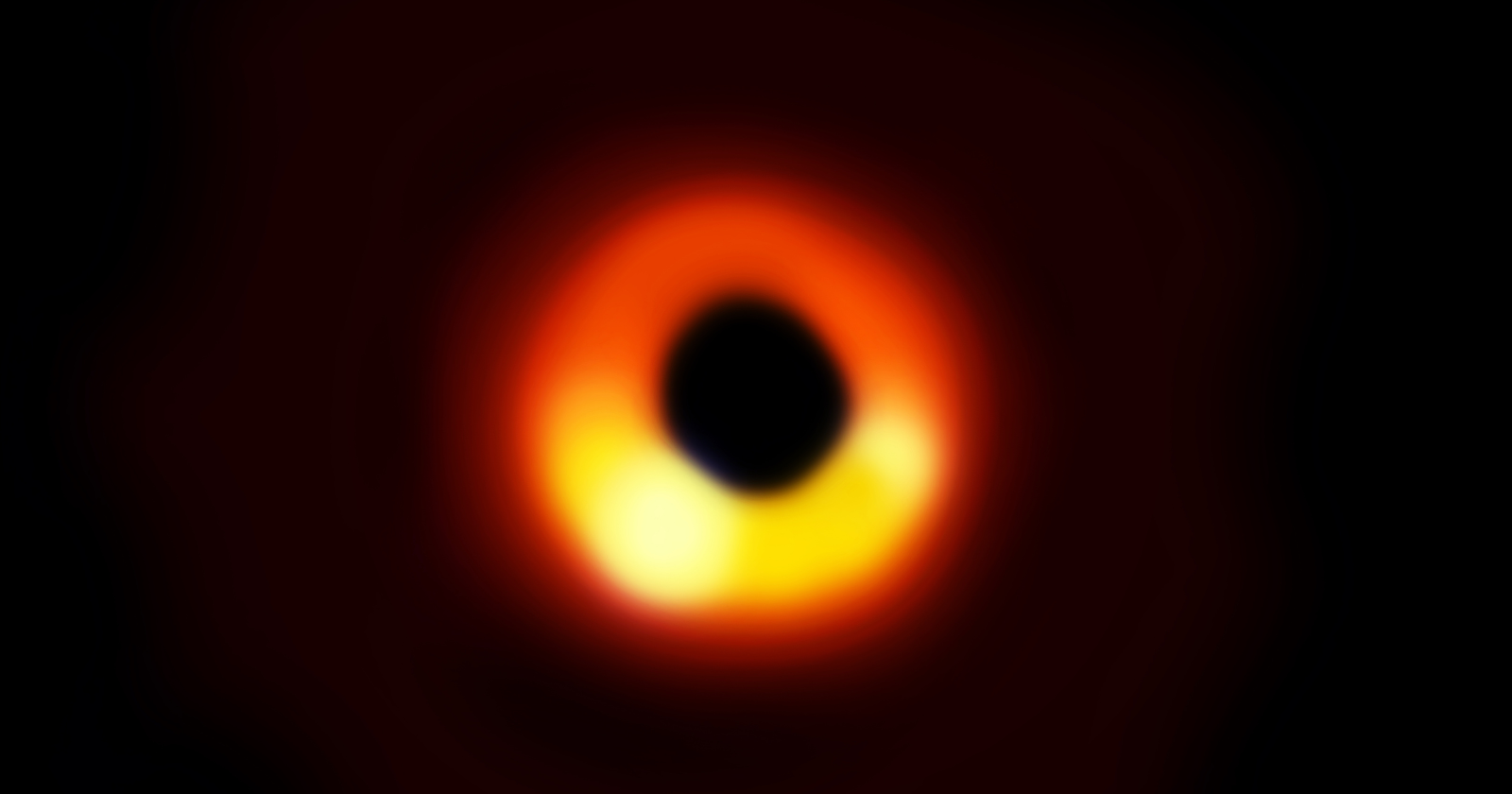
In 2022, the Event Horizon Telescope Captured the First Image of Sagittarius A*, a Supermassive Black Hole at the Heart of Our Galaxy
In 2022, astronomers unveiled the first direct visual evidence of Sagittarius A*, the supermassive black hole at the center of the Milky Way. This groundbreaking achievement, made possible by the Event Horizon Telescope (EHT), provided a tangible glimpse into one of the universe’s most enigmatic phenomena. The image, released after years of data collection and analysis, confirmed long-standing theories about black holes and offered new insights into their behavior. Sagittarius A*—a cosmic giant with a mass equivalent to 4 million suns—resides 27,000 light-years from Earth, yet its presence has shaped the evolution of our galaxy for billions of years.
What Is Sagittarius A* and Why Does It Matter?
Sagittarius A* (Sgr A*) is the supermassive black hole that anchors the Milky Way. Its existence was first inferred in the 1970s through observations of stars orbiting an invisible, massive object at the galaxy’s core. By the 2000s, astronomers had gathered enough evidence to confirm its presence, but visual confirmation remained elusive. Unlike the more distant M87*, another supermassive black hole imaged by the EHT in 2019, Sgr A* is much closer to Earth, yet its smaller apparent size and the dynamic environment around it made imaging it significantly more complex.
The black hole’s mass—4 million times that of the Sun—creates an immense gravitational pull, warping spacetime and influencing the motion of nearby stars. Despite its size, Sgr A* is relatively quiet compared to other supermassive black holes, which can emit powerful jets of radiation. This quiescence has puzzled scientists, leading to questions about how such a massive object remains dormant while others actively consume surrounding matter.
How Did the Event Horizon Telescope Capture the Image?
The Event Horizon Telescope is not a single instrument but a global network of radio telescopes that work in unison to create a virtual telescope the size of Earth. By combining data from observatories in Antarctica, Chile, Mexico, Spain, and the United States, the EHT achieved the resolution needed to image the event horizon—the boundary beyond which nothing, not even light, can escape a black hole’s gravity.

Capturing Sgr A* required overcoming unique challenges. The black hole’s rapid rotation and the turbulent gas swirling around it created a “flickering” signal that was difficult to stabilize. Researchers spent years developing algorithms to filter out noise and reconstruct a coherent image. The result, released in May 2022, showed a glowing ring of hot gas surrounding a dark central region, precisely matching predictions from Einstein’s theory of general relativity.
“This image is a testament to decades of scientific collaboration and technological innovation,” said an EHT spokesperson. “It not only confirms our understanding of black holes but also opens new avenues for studying their role in galaxy formation.”
What Does the Image Reveal About Black Holes?
The image of Sgr A* provided critical data about the structure and behavior of supermassive black holes. The bright ring observed around the black hole is caused by radiation from matter heated to extreme temperatures as it spirals into the event horizon. The darkness at the center represents the point of no return, where gravity is so strong that not even light can escape.
Comparisons between Sgr A* and M87* revealed striking similarities. Both black holes exhibit a “shadow” region surrounded by a luminous ring, validating the predictions of general relativity. However, Sgr A*’s smaller mass and closer proximity offered unique opportunities to study how black holes interact with their surroundings. For example, the image helped scientists better understand the accretion disk—the swirling mass of gas and dust that feeds the black hole—and how it regulates the growth of galaxies.
Additionally, the data shed light on the black hole’s feeding habits. While Sgr A* appears dormant, it occasionally flares as it consumes nearby material. These events, observed through X-ray and radio telescopes, provide clues about the mechanisms that govern black hole activity. “Sagittarius A* is like a sleeping giant,” said Dr. Laura García, an astrophysicist at the Max Planck Institute. “But even in its quiet state, it plays a crucial role in shaping the Milky Way.”
Who Was Involved in the Discovery?
The EHT project involves over 300 scientists from 20 countries, representing a diverse array of institutions, including universities, research labs, and observatories. Key contributions came from teams in the United States, Europe, and Asia, each bringing expertise in radio astronomy, data processing, and theoretical physics. The collaboration was led by the Harvard-Smithsonian Center for Astrophysics and the Max Planck Institute for Radio Astronomy.

The project built on decades of foundational research. In the 1990s, astronomers like Andrea Ghez and Reinhard Genzel used ground-based telescopes to track the motion of stars near the galactic center, providing early evidence of Sgr A*’s existence. Their work earned them the 2020 Nobel Prize in Physics. The EHT’s success also relied on advances in computational power and machine learning, which enabled the processing of vast datasets collected over multiple observing campaigns.
“This is a milestone that would have been impossible a generation ago,” said Dr. Sheperd Doeleman, director of the EHT. “It’s a reminder of how far we’ve come in our quest to understand the universe.”
Why Is This Discovery Significant?
The imaging of Sgr A* marks a major step forward in astrophysics, bridging the gap between theoretical models and observational evidence. It provides a direct test of general relativity in extreme conditions, where the theory’s predictions have never been fully confirmed. The image also offers insights into the life cycles of galaxies, as supermassive black holes are believed to influence star formation and cosmic evolution.
From a practical standpoint, the discovery has implications for future space missions. Understanding how black holes interact with their environments could help scientists predict the behavior of other celestial objects, such as neutron stars and quasars. Additionally, the techniques developed for the EHT may be applied to study other phenomena, including the formation of stars and the structure of the early universe.
“This isn’t just about black holes,” said Dr. Emily Rice, an astrophysicist at the American Museum of Natural History. ”
