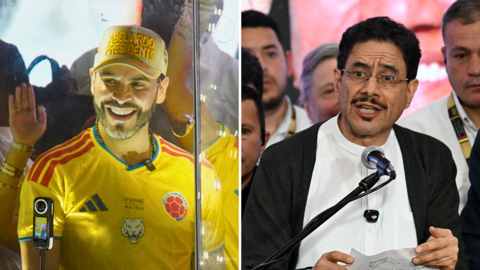
The Colombian presidential race has taken a dramatic turn as the country’s political drama unfolds in real time, with two candidates now locked in a high-stakes runoff after a first-round vote that left one of the frontrunners refusing to concede.
Former Bogotá mayor Gustavo Petro, the leftist candidate running under the Historic Pact coalition, has flatly rejected preliminary results that show Rodrigo De la Espriella, a conservative former governor, leading the field. Petro’s team accused election officials of discrepancies in the vote count, claiming a discrepancy of nearly 900,000 votes—a figure Petro dismissed outright, declaring, “As president, I do not accept these results.” The statement, shared widely across Colombian media, marks the most public escalation yet in a process already marred by accusations of irregularities and delays.
The tension stems from Petro’s Petro 2024 campaign, which has repeatedly questioned the transparency of the National Electoral Council’s preliminary tallies. In a live address, Petro’s running mate, Francia Márquez, echoed the skepticism, while Iván Cepeda, another leftist candidate who finished third, pointed to a specific discrepancy: “There’s a mismatch of 885,000 votes in the preliminary data,” he told Caracol Radio, adding that such a gap could swing the outcome. Cepeda’s own campaign had earlier called for a full audit, though he has since stepped aside in favor of Petro’s push to challenge the results.
A Race Without a Clear Winner
The first-round vote, held June 29, saw De la Espriella emerge with 27.5% of the vote, narrowly ahead of Petro’s 25.1%, according to the Electoral Council. But Petro’s refusal to acknowledge the results has thrown the process into uncertainty. His campaign has demanded a manual recount of ballots, citing what they describe as “technical failures” in the electronic tallying system—a claim the council has yet to address publicly.
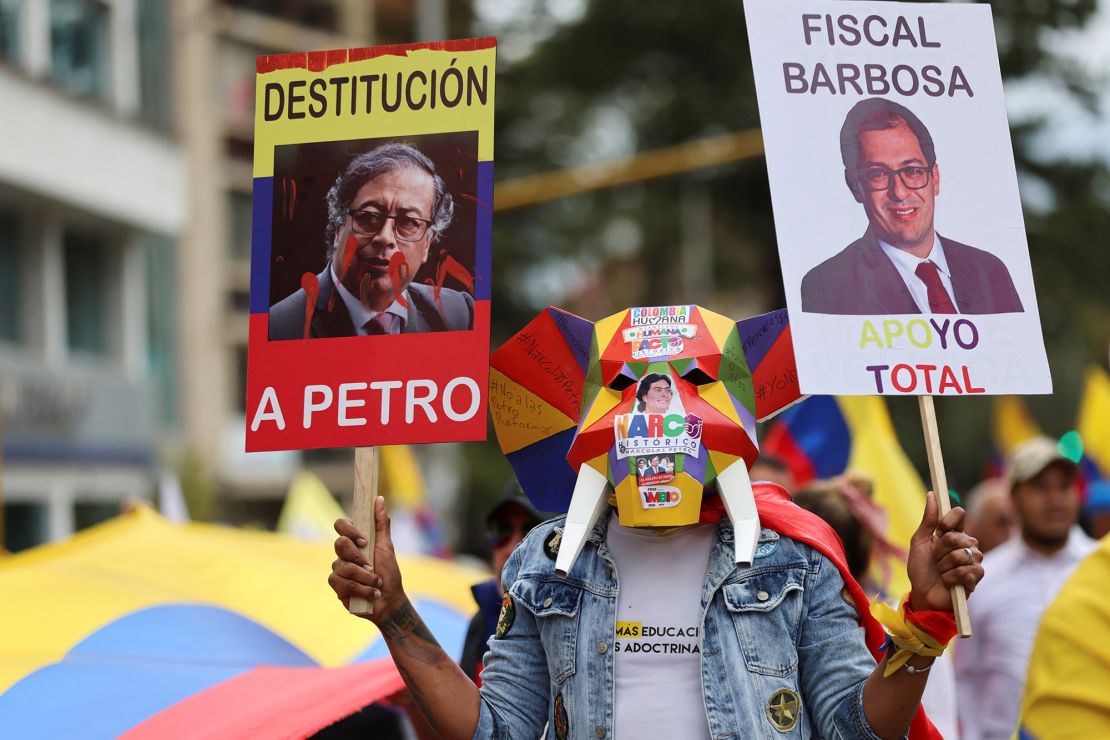
The stakes could not be higher. If Petro’s objections hold, Colombia could face a constitutional crisis, with the runoff now in jeopardy. De la Espriella, a former mayor of Antioquia, has remained silent on the dispute, though his campaign has not formally contested the results. The conservative candidate’s rise reflects a shifting political landscape in Latin America, where populist and leftist movements have dominated headlines in recent years.
Why This Matters Beyond the Ballot Box
Petro’s candidacy has long been a cultural and political lightning rod. As the first serious leftist contender to reach a runoff in Colombia’s history, his campaign has energized youth voters and progressive movements, while his rhetoric—blending environmentalism, social justice and anti-corruption—has resonated in a country weary of traditional parties. His refusal to accept the results, however, risks overshadowing the broader narrative of his campaign: a challenge to Colombia’s establishment.
For De la Espriella, the moment represents a rare conservative victory in a region where leftist leaders like Petro, Lula da Silva in Brazil, and Gabriel Boric in Chile have dominated recent elections. His campaign has leaned into a message of stability and economic pragmatism, positioning him as a counterbalance to Petro’s more radical proposals. But with the runoff now in doubt, the question remains: Can Colombia’s electoral system withstand this test, or is this just the beginning of a deeper crisis?
The Path Forward
With no official announcement on next steps, the focus remains on Petro’s demands for a recount and the Electoral Council’s response. If the council stands by its initial results, Petro’s campaign has signaled it may pursue legal challenges, potentially delaying the runoff scheduled for June 29. Meanwhile, De la Espriella’s team has not commented on whether they will participate in any recount process, leaving the country’s political future in limbo.
One thing is certain: This election is far from over. For Colombians, the outcome will determine not just who leads the country but whether their democracy can weather the storm of distrust and uncertainty that now clouds the process.
