
Alan Greenspan, Former Federal Reserve Chair Who Shaped Decades of U.S. Economic Policy, Dies at 100
Washington, D.C. — Alan Greenspan, the economist whose 18-year tenure as Federal Reserve chairman steered the U.S. through economic booms, recessions, and financial crises, has died at 100, according to family and official statements. His leadership during the 1990s tech bubble, the 2001 recession, and the early stages of the 2008 financial meltdown cemented his legacy as one of the most consequential central bankers in modern history.
Greenspan’s death marks the end of an era in monetary policy, where his unorthodox approach—often described as “Greenspan Put,” a strategy of cutting interest rates preemptively to prevent market downturns—became a defining feature of American finance. Critics and supporters alike will remember him for his intellectual rigor, his ability to communicate complex economic ideas to policymakers, and the debates his policies sparked over the Fed’s role in shaping the economy.
This article examines Greenspan’s life, his impact on global finance, and the lasting influence of his tenure on central banking today.
—
Who Was Alan Greenspan, and Why Did His Death Spark Global Attention?
Alan Greenspan served as the 13th chairman of the Federal Reserve from 1987 to 2006, the longest tenure in the institution’s history. Before that, he was a prominent economist and adviser to multiple U.S. presidents, including Richard Nixon and Gerald Ford. His appointment by President Ronald Reagan in 1987 began a period where the Fed’s influence expanded dramatically, shifting from a reactive institution to one that actively shaped economic expectations.
Greenspan’s death has drawn comparisons to other long-serving central bankers, such as Paul Volcker, whose 1979–1987 tenure tackled inflation, or Ben Bernanke, who took over during the 2008 crisis. But Greenspan’s tenure was unique in its duration and the economic conditions he navigated, from the dot-com bubble to the early signs of the housing crisis.
Key facts about Greenspan’s life and career:
- Born: March 6, 1926, in New York City.
- Education: Bachelor’s in economics from New York University, later a PhD in economics from Columbia University.
- Early career: Worked as an economist for the Treasury Department and later as a consultant before joining the Fed.
- Fed tenure: 1987–2006 (18 years, 9 months).
- Post-Fed roles: Served on corporate boards, including JPMorgan Chase and Paulson & Co..
- Notable awards: Presidential Medal of Freedom (2005), among others.
Greenspan’s death was confirmed by his family, with no immediate details on the cause. His passing follows a period of declining public attention to central banking, yet his policies remain deeply embedded in how markets and governments respond to economic shocks.
—
How Did Greenspan’s Policies Shape the U.S. Economy?
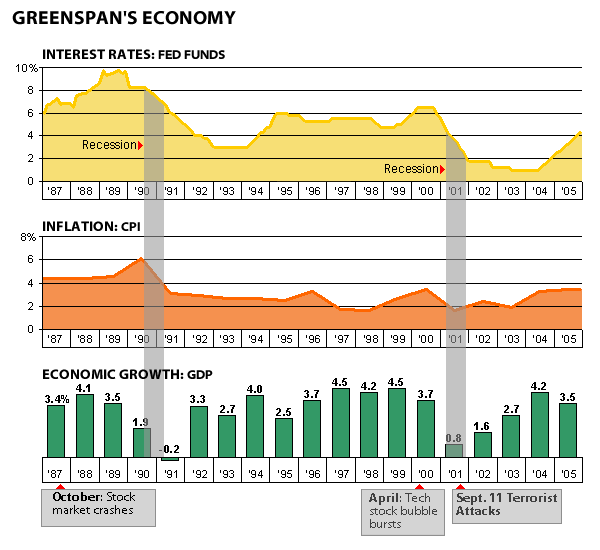
Greenspan’s legacy is often measured by two competing narratives: the architect of America’s longest peacetime economic expansion, or the enabler of financial excesses that contributed to the 2008 crisis. Both perspectives highlight how his decisions redefined the Fed’s role in the global economy.
1. The “Greenspan Put” and Market Stability
One of Greenspan’s most enduring contributions was the concept of the “Greenspan Put”—the idea that the Fed would intervene to prevent market downturns by cutting interest rates. This strategy, though never formally named by Greenspan, became a market expectation during his tenure.

According to The New York Times, Greenspan’s willingness to adjust policy in real time—rather than following rigid rules—helped stabilize markets during the 1990s tech bubble and the 2001 recession. His famous 1996 speech warning of “irrational exuberance” in stock markets is often cited as a turning point, though critics argue it came too late to prevent the dot-com crash.
Key policy moves:
- 1990s: Seven interest rate cuts in 1995 alone to combat a recession.
- 2001: Aggressive rate cuts (from 6.5% to 1.75%) after the 9/11 attacks and a slowdown.
- 2003–2004: Held rates near historic lows to spur growth, contributing to the housing boom.
2. The Housing Bubble and Criticism
Greenspan’s later years at the Fed were marked by criticism over his handling of the housing market. While he acknowledged in 2005 that “the housing boom has been fueled by a number of factors, including low interest rates,” many economists argue his prolonged low-rate policy contributed to the subprime mortgage crisis.
A 2010 report by the Federal Reserve Bank of Minneapolis noted that Greenspan’s focus on inflation targeting may have downplayed risks in the housing sector. His successor, Ben Bernanke, later faced the fallout of the crisis, which Greenspan had warned about in private but did not act to prevent.
3. Global Influence
Greenspan’s tenure coincided with the rise of the U.S. dollar as the world’s reserve currency. His policies set a precedent for central banks globally, including the European Central Bank and the Bank of Japan, which adopted similar strategies to manage economic stability.
According to the International Monetary Fund, Greenspan’s approach to transparency—holding regular press conferences and explaining policy shifts—became a model for central bank communications worldwide.
—
What Were the Major Criticisms of Greenspan’s Tenure?
Greenspan’s legacy is not without controversy. Economists and policymakers have debated his decisions for decades, with criticisms focusing on three main areas:
1. Overconfidence in Market Self-Correction
Greenspan’s belief in the efficiency of financial markets led him to resist regulatory interventions, even as risks mounted. In a 2002 speech, he famously stated, “Markets are always right,” a phrase that later became a symbol of his perceived blind spots.
The Financial Crisis Inquiry Report (2011) noted that Greenspan’s reluctance to tighten regulations contributed to the 2008 collapse. His opposition to stricter mortgage lending rules, for example, was later reversed under his successor, Bernanke.
2. The Fed’s Role in Inequality
Critics argue that Greenspan’s policies widened economic inequality. By keeping interest rates low for extended periods, he made borrowing cheaper for corporations and wealthy investors, while wage growth stagnated for many Americans.
A 2017 study by the Brookings Institution found that the period of Greenspan’s chairmanship saw a sharp rise in income disparity, particularly in the top 1% of earners. His policies, while boosting asset prices, did little to address wage stagnation.
3. The “Greenspan Doctrine” and Geopolitical Risks
Beyond economics, Greenspan’s influence extended to geopolitics. His 1998 testimony to Congress, where he argued that the U.S. should not intervene in the Asian financial crisis, was later dubbed the “Greenspan Doctrine.” Critics accused him of prioritizing market stability over humanitarian concerns.
The Council on Foreign Relations noted that his approach—letting markets correct imbalances—had unintended consequences, including currency collapses and social unrest in affected countries.
—
How Will Greenspan’s Death Be Remembered?
Greenspan’s passing has prompted reflections on his impact, with reactions ranging from admiration for his intellectual leadership to criticism of his policy choices. His death also raises questions about the future of central banking in an era of rising inflation and geopolitical tensions.
Tributes from Peers and Policymakers
Former Fed chairs and economists have offered mixed assessments:
“Alan Greenspan was a giant in economics—a man who shaped not just the Fed, but global finance. His ability to navigate crises while maintaining credibility was unparalleled.”
“Greenspan’s legacy is a cautionary tale. His policies worked in the short term but left the system vulnerable to the very crises he sought to prevent.”
Markets reacted modestly to the news, with U.S. stock indexes showing little movement, reflecting Greenspan’s diminished direct influence in recent years. However, his ideas continue to shape discussions on monetary policy.
The End of an Era for Central Banking
Greenspan’s death comes at a time when central banks face new challenges, including:
- Rising inflation: Unlike Greenspan’s era, today’s Fed must balance price stability with labor market strength.
- Digital currencies: The rise of cryptocurrencies and CBDCs (central bank digital currencies) was not a concern during his tenure.
- Geopolitical fragmentation: Greenspan operated in a unipolar economic world; today’s Fed must navigate trade wars and sanctions.
Economists suggest that Greenspan’s greatest lesson may be the need for adaptability. His ability to pivot—from fighting inflation in the 1980s to managing asset bubbles in the 1990s—offers a model for future central bankers in an unpredictable world.
—
What Happens Next for the Fed and Economic Policy?
Greenspan’s death does not immediately alter the Fed’s current course, but his legacy will influence debates over monetary policy for years to come. Key questions include:
1. Will the Fed Reassess Its Approach?
The current Fed chair, Jerome Powell, has already signaled a shift toward tighter monetary policy to combat inflation. Greenspan’s tenure, however, was defined by his willingness to cut rates preemptively—a strategy that may now be reconsidered.
According to the Federal Reserve Bank of St. Louis, Powell has cited Greenspan’s 1990s policies as a reference point but has emphasized the need for a more rules-based approach to avoid past mistakes.
2. The Role of the Fed in Inequality
Greenspan’s policies contributed to rising inequality, a issue that remains unresolved. The current Fed faces pressure to address wage stagnation and asset price bubbles without stifling growth.
A 2023 report by the Congressional Budget Office found that income inequality has worsened since the 2008 crisis, raising questions about whether the Fed’s tools are sufficient to tackle structural economic disparities.
3. The Future of Central Bank Transparency
Greenspan pioneered the Fed’s communication strategy, holding regular press conferences and explaining policy shifts. Today, central banks worldwide follow his model, but some argue more transparency is needed.
The Bank for International Settlements notes that while Greenspan’s approach improved market confidence, it also created expectations that the Fed would always intervene—a dynamic that may have contributed to the 2008 crisis.
—
Frequently Asked Questions About Alan Greenspan’s Legacy
What was Alan Greenspan’s biggest policy mistake?
Critics often point to his handling of the housing bubble in the early 2000s, where his low-interest-rate policy contributed to the subprime mortgage crisis. Greenspan himself later acknowledged that the Fed’s regulatory oversight was insufficient.
Did Greenspan predict the 2008 financial crisis?
Yes, but not publicly. In private meetings, Greenspan warned about risks in the housing market as early as 2005. However, he did not take steps to prevent the crisis, leading to widespread criticism.
How did Greenspan influence global central banking?
His approach to transparency—explaining policy decisions to markets—became a global standard. Central banks in Europe, Japan, and emerging markets adopted similar communication strategies.
What was the “Greenspan Put”?
A market term describing the Fed’s strategy of cutting interest rates to prevent downturns. The phrase was never officially used by Greenspan but became shorthand for his reactive policy approach.
Will Greenspan’s policies be revisited in the next Fed chair?
Likely, but with caution. While his intellectual influence remains, the Fed is now focused on inflation and inequality—issues Greenspan did not prioritize as aggressively.
How did Greenspan’s death affect financial markets?
Markets showed little immediate reaction, reflecting his diminished direct role. However, his ideas continue to shape discussions on monetary policy and financial regulation.
—
Alan Greenspan’s life spanned nearly a century of economic transformation, from the post-WWII boom to the digital age. His policies shaped generations of policymakers, and his death leaves a void in the world of central banking. As the Fed navigates new challenges—rising inflation, geopolitical tensions, and technological disruption—Greenspan’s legacy serves as both a guide and a warning.
For readers seeking deeper insights, explore our explainer on how the Federal Reserve sets interest rates or our analysis of the 2008 financial crisis and its lessons.
