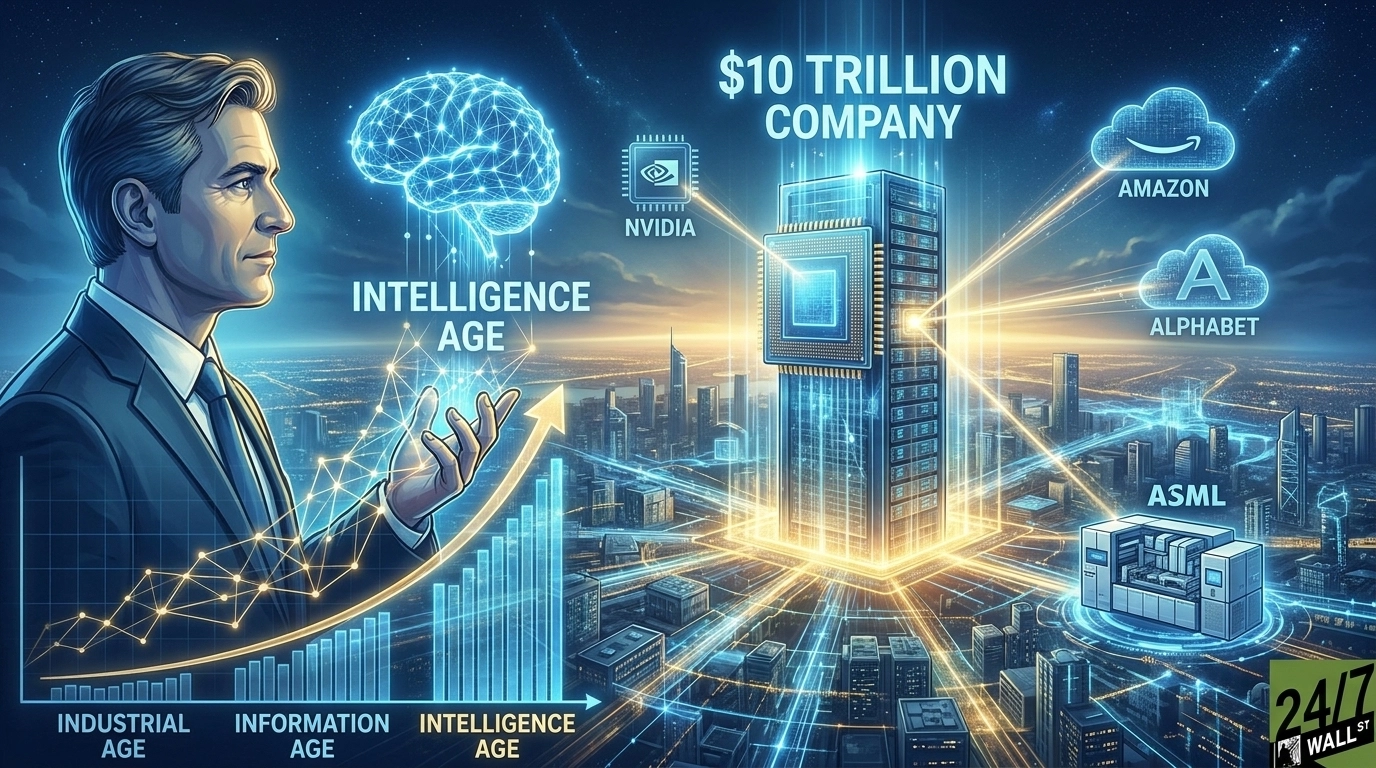
How AI Could Create the First $10 Trillion Company—and Why a Billionaire Hedge Fund Manager Calls It the Dawn of the ‘Intelligence Age’
Billionaire hedge fund manager Chamath Palihapitiya predicts artificial intelligence will enable the first company valued at $10 trillion within a decade, marking the arrival of what he calls the “Intelligence Age.” His vision—rooted in AI-driven productivity gains, automation, and the emergence of “intelligence-as-a-service” models—challenges conventional notions of corporate valuation and economic growth. But how plausible is this timeline, and what would it mean for industries, workers, and global markets?
Palihapitiya, founder of Social Capital and a vocal advocate for AI investment, made the remarks during a recent interview, arguing that AI’s exponential improvements in efficiency could unlock trillions in value. His perspective aligns with a growing consensus among tech leaders, economists, and investors that AI is not just a tool but a foundational shift in how value is created. Yet skeptics warn of overestimation, regulatory hurdles, and unforeseen risks. Below, we break down the claim, its economic underpinnings, and the forces that could accelerate—or derail—this transformation.
What Does a $10 Trillion Company Look Like—and How Could AI Get Us There?
A $10 trillion company would dwarf today’s largest firms. For context, Apple, the world’s most valuable public company, sits at roughly $3 trillion in market capitalization. A single entity worth 10 times that would require a business model capable of capturing unprecedented scale, efficiency, and market dominance—something Palihapitiya attributes to AI.
His argument hinges on three key mechanisms:
- Automation of cognitive labor: AI systems could handle tasks currently requiring human expertise—legal analysis, medical diagnostics, financial modeling—at a fraction of the cost, freeing up human workers for higher-value roles.
- Intelligence-as-a-service: Instead of companies building proprietary AI infrastructure, they could subscribe to cloud-based “intelligence layers,” reducing capital expenditures and accelerating innovation.
- Network effects amplified by AI: Platforms leveraging AI to personalize services (e.g., recommendation engines, autonomous logistics) could create self-reinforcing loops of user engagement and data collection, similar to how Google or Amazon scaled.
Palihapitiya points to early examples like Nvidia, whose stock surged over 200% in 2023 as demand for AI chips exploded. “The next Microsoft or Apple won’t be built by humans alone,” he said. “It will be built by AI collaborating with humans.”
Key point: Palihapitiya’s $10 trillion figure isn’t a random guess—it reflects a calculation where AI-driven productivity gains compound across entire economies. McKinsey estimates AI could add $13 trillion to global GDP by 2030, though achieving that scale depends on adoption rates, regulatory clarity, and technological breakthroughs.
Who Is Chamath Palihapitiya—and Why Should We Listen?
Palihapitiya is no ordinary investor. The Sri Lanka-born entrepreneur co-founded Social Capital, a $4 billion hedge fund with stakes in companies like Virgin Galactic, Slack, and Roblox. His net worth exceeds $1.5 billion, and his public persona blends Silicon Valley optimism with blunt critiques of legacy industries.
His predictions carry weight because he’s not just theorizing—he’s betting his capital on AI. Social Capital’s AI-focused fund, launched in 2023, has already deployed billions into startups like Anthropic, a leading AI lab. “We’re in the early innings of a new era,” he told Bloomberg in 2024. “The companies that win will be those that treat AI as their operating system, not just a tool.”
Yet Palihapitiya’s track record is mixed. His early bets on social media (he was an early Facebook executive) paid off, but his later ventures, like a $500 million investment in a failed electric scooter company, highlight the risks of overconfidence. Still, his ability to spot macro trends—such as the rise of fintech or the metaverse—has kept him relevant in tech circles.
Why it matters: Palihapitiya’s influence extends beyond capital. As a vocal advocate for AI regulation (he co-founded the AI Policy Institute), he bridges the gap between Silicon Valley’s ambitions and policymakers’ concerns. His $10 trillion prediction isn’t just about market cap—it’s a call to rethink how societies measure progress in an AI-driven world.
When Could This Happen—and What Would It Take?
Palihapitiya’s timeline is aggressive: the first $10 trillion company could emerge within 5–10 years. To put that in perspective, Amazon took 27 years to reach a $1 trillion valuation, while Apple hit that milestone in 33 years. AI could compress that timeline by orders of magnitude.
Three factors could accelerate this:
1. Breakthroughs in AGI (Artificial General Intelligence): Current AI excels at narrow tasks (e.g., language, image recognition), but true AGI—systems that can reason across domains—would unlock far greater value. Companies like Google DeepMind and OpenAI are racing toward this, though ethical and technical challenges remain.
2. Regulatory clarity: Governments are scrambling to define AI rules. The U.S. AI Bill of Rights and the EU’s AI Act set early precedents, but inconsistencies could stifle innovation. Palihapitiya has argued for a “permissionless innovation” approach, allowing companies to experiment while mitigating risks.
3. Infrastructure scaling: AI demands massive computing power. Nvidia’s dominance in GPUs is a sign of this trend, but bottlenecks in data centers, energy grids, and semiconductor supply chains could delay progress. Palihapitiya has invested in data centers and quantum computing to address these gaps.
Potential roadblocks:
- Labor displacement: If AI automates jobs faster than new roles emerge, social unrest could hinder growth. The OECD warns that 14% of jobs in advanced economies are at high risk of automation.
- Monopoly risks: A $10 trillion company could wield outsized influence, raising antitrust concerns. Microsoft’s $80 billion acquisition of Activision Blizzard in 2023 sparked regulatory scrutiny—imagine that on a 100x larger scale.
- Ethical dilemmas: AI systems trained on biased data or used for surveillance could erode public trust. Palihapitiya has called for “alignment research” to ensure AI systems act in humanity’s best interest.
Timeline comparison:
| Company | Valuation Milestone | Years to Reach | Key Enabler |
|---|---|---|---|
| Amazon | $1 trillion | 27 | E-commerce, cloud computing |
| Apple | $1 trillion | 33 | Hardware innovation, ecosystem lock-in |
| Hypothetical AI Company (Palihapitiya) | $10 trillion | 5–10 (predicted) | Automation, intelligence-as-a-service, AGI |
Expert reaction: Economist Raj Chetty of Harvard, who studies inequality, cautions that AI’s benefits won’t be evenly distributed. “The first $10 trillion company will likely be owned by a small group of shareholders and tech elites,” he told The Economist. “Unless we address this, we risk exacerbating wealth gaps.”
Why This Matters: The Shift from the ‘Information Age’ to the ‘Intelligence Age’
Palihapitiya’s framing of this as an “Intelligence Age” reflects a broader shift in how societies organize work and value. The Information Age (1970s–2000s) was defined by the digitization of data and the rise of platforms like Google and Facebook. The Intelligence Age, as he envisions it, would be defined by AI’s ability to process, analyze, and act on that data autonomously.
This transition has three major implications:
1. Corporate valuation metrics will evolve: Today, companies are valued based on revenue, profit margins, and assets. In an AI-driven world, intangible assets—such as proprietary algorithms, data ownership, and “intelligence capital”—could dominate. Palihapitiya suggests we may need new accounting standards to reflect these changes.
2. Geopolitical power will shift: Nations leading in AI research and infrastructure could gain economic and military advantages. China’s Made in China 2025 plan and the U.S. CHIPS Act are early signs of this competition. A $10 trillion AI company could become a de facto national champion, blurring the lines between corporate and state power.
3. Workforce reskilling will be critical: Jobs that require creativity, emotional intelligence, and complex problem-solving will thrive, while routine tasks disappear. The World Economic Forum estimates that by 2025, 50% of all employees will need reskilling. Governments and companies are already investing in AI literacy programs, but the scale of change may outpace these efforts.
Historical parallel: The Industrial Revolution saw similar upheaval. In the 1800s, Luddites protested mechanized looms, fearing job losses—yet the long-term effect was higher living standards. Palihapitiya draws this parallel: “AI is like the steam engine of our time. The companies that embrace it will dominate the 21st century.”
However, history also shows that unchecked technological disruption can lead to instability. The Great Depression followed the 1929 stock market crash, partly because economic policies failed to adapt to the shift from agrarian to industrial economies. Economists like Nouriel Roubini warn that without proactive policies, AI could deepen inequality and trigger social backlash.
What Industries Are Most at Risk—and Which Could Benefit?
Not all sectors will benefit equally from AI-driven growth. Below, we break down the winners and potential losers:
| Sector | AI Impact | Potential Winners | Potential Losers |
|---|---|---|---|
| Technology | AI accelerates R&D, automates software development | Nvidia, Microsoft, AI startups | Legacy tech firms slow to adopt AI |
| Healthcare | AI diagnostics, drug discovery, personalized medicine | Biotech firms, AI-driven hospitals | Traditional pharmaceutical companies resistant to change |
| Finance | Algorithmic trading, fraud detection, automated lending | Fintech (e.g., Stripe, Square), AI-driven banks | Regional banks with outdated systems |
| Manufacturing | Autonomous robots, predictive maintenance, supply chain optimization | TSMC, industrial AI firms | Low-cost labor-dependent industries |
| Legal & Consulting | Automated contract review, AI-driven legal research | AI-powered law firms, consulting boutiques | Traditional law firms with high overhead |
| Media & Entertainment | AI-generated content, hyper-personalized ads | Netflix, Spotify, AI content creators | Small creators struggling with AI competition |
Case study: Nvidia’s rise illustrates this dynamic. The company’s stock surged from $100 in 2020 to over $1,000 in 2024 as demand for AI chips exploded. Its market cap now exceeds $2 trillion, making it one of the fastest-growing firms in history. Palihapitiya sees this as a template: “The next Nvidia will be a company that doesn’t just sell hardware but intelligence itself.”
Expert view: Andrew Ng, co-founder of Coursera and former Baidu AI chief, predicts that AI will create new industries we can’t yet imagine. “The companies that thrive will be those that treat AI as a co-founder,” he said in a 2024 interview. “They won’t just use it—they’ll let it drive their strategy.”
What Would a $10 Trillion Company Mean for the Global Economy?
A company valued at $10 trillion would reshape global economics in ways we’re only beginning to grasp. Here’s what could happen:
- Market dominance: Such a company would control a share of global GDP equivalent to the economies of Germany or Japan. Antitrust regulators would face unprecedented challenges in policing its influence. The Sherman Antitrust Act was designed for 19th-century monopolies, not AI-driven superplatforms.
- Labor market disruption: If AI automates 30% of jobs (as some estimates suggest), unemployment could spike in sectors like retail, customer service, and transportation. Governments may need to implement universal basic income (UBI) or expanded social safety nets.
- Geopolitical realignment: A $10 trillion company could become a de facto sovereign entity, with its own lobbying power, legal teams, and global reach. This could lead to conflicts with nation-states over taxation, data sovereignty, and regulatory oversight.
- New wealth inequality: The owners and executives of such a company could accumulate wealth beyond historical precedent. Palihapitiya has suggested that tokenized equity (using blockchain to fractionalize ownership) could democratize access—but critics argue this could also concentrate power in the hands of a few.
Historical comparison: The rise of Standard Oil in the late 1800s led to antitrust laws that still shape corporate America today. Similarly, the emergence of a $10 trillion AI company could force a rethink of capitalism itself. Economist Branko Milanovic warns that without safeguards, this could lead to a “plutocratic AI economy”, where a tiny elite controls the means of production.
Regulatory response: The U.S. and EU are already debating how to govern AI. Proposals include:
- AI-specific antitrust rules to prevent monopolies.
- Data ownership reforms to ensure fair compensation for those whose data trains AI models.
- Transparency requirements for AI systems used in critical sectors like healthcare and finance.
Palihapitiya advocates for a “light-touch” regulatory approach, arguing that overregulation could stifle innovation. “We need guardrails, not handcuffs,” he said. “The goal should be to encourage experimentation while protecting society.”
What Are the Biggest Risks—and Could This Prediction Backfire?
Palihapitiya’s vision is ambitious, but risks could derail it. Here are the top concerns:
1. Overestimation of AI’s capabilities: Current AI systems are powerful but still lack common sense, creativity, and true reasoning. A 2023 MIT study found that AI’s ability to generalize beyond its training data remains limited. If AGI proves elusive, the $10 trillion timeline could slip by decades.
2. Ethical and safety failures: AI systems have already shown vulnerabilities, from bias in hiring algorithms to deepfake scams. A high-profile AI disaster—such as an autonomous system causing mass unemployment or a cyberattack—could trigger public backlash and regulatory crackdowns.
3. Economic misalignment: If AI-driven productivity gains aren’t distributed equitably, consumer demand could stagnate. Historically, economic growth has relied on a rising middle class with disposable income. If wealth concentrates at the top, demand for goods and services could shrink, limiting corporate growth.
4. Geopolitical fragmentation: If the U.S. and China fail to cooperate on AI standards, we could see a “splinternet” of AI, with competing systems developed in isolation. This could fragment markets and slow innovation.
Alternative scenario: Some economists, like Tyler Cowen of George Mason University, argue that AI’s impact may be overhyped in the short term. “We’ve seen this before with every new technology,” he wrote in The New York Times. “The hype peaks, then reality sets in.” Cowen predicts that while AI will transform industries, a $10 trillion company may not emerge until 2040 or later.
Palihapitiya’s rebuttal: He acknowledges the risks but counters that exponential growth in AI capabilities—such as neural scaling laws—suggests rapid progress. “The curve isn’t linear,” he said. “It’s logarithmic. What seems impossible today could happen faster than we think.”
What Should Investors, Workers, and Policymakers Do Now?
The implications of Palihapitiya’s prediction extend beyond market cap—they demand action from three key groups:
Investors: Portfolio diversification is critical. While AI stocks may outperform in the short term, sectors like healthcare, education, and infrastructure could become safe havens as AI reshapes others. Palihapitiya recommends allocating 10–20% of portfolios to AI-exposed companies while hedging with traditional assets.
Workers: Reskilling is non-negotiable. The World Economic Forum advises focusing on AI-complementary skills, such as critical thinking, emotional intelligence, and complex problem-solving. Online platforms like Coursera and edX offer AI-specific courses, but many workers will need employer-sponsored training.
Policymakers: Proactive regulation is essential. Proposals include:
- AI literacy programs in schools to prepare future workers.
- Tax reforms to fund social safety nets as automation accelerates.
- Global AI governance frameworks to prevent a race to the bottom in ethics and safety.
Palihapitiya supports a “sandbox approach”, where companies can test AI innovations in controlled environments before full deployment.
Key takeaway: The next decade will determine whether Palihapitiya’s vision becomes reality or remains a bold prediction. What’s clear is that AI is already reshaping industries, and the companies that adapt fastest will define the 21st century.
Frequently Asked Questions
Q: Is a $10 trillion company even possible?
A: While unprecedented, Palihapitiya’s prediction isn’t without precedent. Amazon, Apple, and Microsoft all grew at exponential rates, and AI could accelerate this further. However, achieving $10 trillion would require a business model that captures a significant portion of global economic activity—something no company has done before.
Q: Which companies are positioned to become the first $10 trillion firm?
A: Candidates include AI infrastructure providers like Nvidia, cloud computing giants (Microsoft, Google), and platform companies (Amazon, Meta) that could integrate AI into their core offerings. Palihapitiya has hinted that a new category of “intelligence companies”—those built from the ground up with AI at their core—could emerge.
Q: How would a $10 trillion company affect the stock market?
A: The impact would be seismic. Such a company would likely dominate major indices (S&P 500, Nasdaq), potentially making the index itself a lagging indicator of economic reality. Investors might see increased volatility as markets grapple with valuation adjustments and regulatory uncertainty.
Q: Could this lead to a new economic crisis?
A: Historically, rapid technological shifts have caused disruptions—think of the Dot-Com Bubble or the 2008 Financial Crisis. If AI-driven automation outpaces job creation, consumer demand could collapse, leading to a recession. Economists like Ruchir Sharma warn that without proper safeguards, this scenario is plausible.
Q: What role will governments play in regulating AI?
A: Governments are still figuring this out. The U.S. and EU are leading with frameworks like the AI Bill of Rights and the EU AI Act, but enforcement remains inconsistent. Palihapitiya advocates for self-regulation within industry, while critics argue that only government intervention can prevent abuse.
Q: How can individuals prepare for this shift?
A: Focus on skills that AI can’t easily replicate, such as creativity, leadership, and emotional intelligence. Investing in AI-adjacent fields (e.g., data science, cybersecurity, ethics) can also future-proof careers. Palihapitiya recommends treating AI as a “force multiplier” rather than a replacement for human judgment.
Q: Is Palihapitiya’s timeline realistic?
A: It’s aggressive but not impossible. If AI achieves Artificial General Intelligence (AGI) within a decade—something experts like Yann LeCun (Meta’s AI chief) consider plausible—then Palihapitiya’s prediction could hold. However, if AGI remains out of reach, the timeline could extend to 2040 or beyond.
Final note: Whether a $10 trillion company emerges or not, one thing is certain: AI is already rewriting the rules of business, economics, and society. The question isn’t if this transformation will happen, but how we’ll navigate it.
