US Manufacturing Jobs Shrink Faster Than Any Time Since the Pandemic—What It Means for the Economy
The U.S. manufacturing sector shed jobs at its fastest pace since the early months of the COVID-19 pandemic, a sharp reversal that underscores deepening challenges in an industry already struggling with labor shortages, rising costs, and shifting global supply chains. According to the latest data, manufacturing employment declined by 22,000 in June alone, with economists warning the trend could accelerate if demand weakens further. The drop follows months of stagnant hiring and signals growing pressure on factories at a time when inflation remains elevated and consumer spending shows signs of cooling.
While broader economic indicators—such as a slight uptick in the S&P Global Composite PMI to 52.2 in June—suggest some sectors are still expanding, manufacturing remains a critical weak spot. The sector employs nearly 13 million workers nationwide, and its struggles could ripple through wages, regional economies, and even political debates over trade and industrial policy. Experts say the decline reflects a combination of automation, offshoring pressures, and waning demand for certain goods, but the pace of job losses now exceeds even the darkest pandemic months.
This report synthesizes the latest data on manufacturing employment, contrasts it with broader economic trends, and examines what the decline could mean for workers, businesses, and policymakers. It also addresses common misconceptions about whether this downturn is temporary or part of a longer-term shift in U.S. industry.
Manufacturing Jobs Vanished at a Pandemic-Worst Rate—Here’s the Latest Data
The U.S. Bureau of Labor Statistics reported that manufacturing employment fell by 22,000 in June, marking the largest monthly decline since April 2020, when COVID-19 lockdowns forced mass layoffs. The sector has now lost 110,000 jobs over the past year, according to government figures. While some industries, like semiconductors and renewable energy equipment, have added workers, others—particularly durable goods producers—have cut payrolls aggressively.
Industry analysts cite several drivers behind the acceleration:
- Labor shortages: Many factories still struggle to fill roles, even as hiring slows. A survey by the National Association of Manufacturers found that 74% of firms report difficulty finding skilled workers, yet June’s job cuts suggest some are now downsizing rather than expanding.
- Rising costs: Energy prices, shipping fees, and interest rates have squeezed margins, prompting layoffs in sectors like appliances and furniture. The Federal Reserve’s aggressive rate hikes have also made borrowing for expansion riskier.
- Demand shifts: Consumer spending on big-ticket manufactured goods—like cars and home appliances—has softened as savings rates dip and credit card debt hits records. Meanwhile, global demand for U.S.-made products has not rebounded as quickly as hoped.
Key figures:
| Metric | June 2024 | June 2023 | Change |
|---|---|---|---|
| Manufacturing employment (thousands) | 12,987 | 13,097 | -110,000 YoY |
| Monthly job losses (June) | 22,000 | +18,000 (gain) | Largest decline since April 2020 |
| Unemployment rate (manufacturing) | 3.2% | 3.0% | Rising slightly |
Source: U.S. Bureau of Labor Statistics, adjusted for seasonality
Contrast this with the broader economy: The S&P Global Composite PMI—a measure of private-sector activity—rose to 52.2 in June, indicating expansion. However, manufacturing-specific PMI readings have lagged, with the Institute for Supply Management’s (ISM) index hovering just above the 50 threshold, signaling minimal growth. “The divergence between services and manufacturing is stark,” said Chris Christopher, chief economist at IHS Markit. “While tech and healthcare are hiring, factories are cutting back—often because they can’t find enough workers to meet even reduced demand.”
Which Sectors Are Hit Hardest?
Not all of manufacturing is contracting equally. A breakdown of job losses by subsector reveals:
- Durable goods: Down 35,000 in June, led by declines in machinery, electrical equipment, and transportation equipment (including aerospace). Boeing’s ongoing labor disputes and supply chain delays have exacerbated cuts in this sector.
- Nondurable goods: Slightly better, with food and beverage manufacturing adding jobs, but textile and apparel firms continuing to shrink.
- Automotive: The biggest outlier. After years of chip shortages, automakers are now dealing with overcapacity and weak consumer demand for new vehicles. Ford and GM have announced thousands of layoffs in 2024, with more expected.
Regional disparities are also sharp. States like Ohio, Michigan, and Indiana—home to major automotive and machinery plants—have seen the steepest declines. In contrast, Texas and Florida, where energy-related manufacturing has grown, have held onto jobs.
Why Is This Happening Now? The Forces Behind the Job Cuts
The current wave of layoffs isn’t just a continuation of pre-pandemic trends; it reflects a convergence of factors that have intensified in 2024. Economists point to three primary drivers:
1. The Fed’s Rate Hikes Are Finally Biting
For over a year, manufacturers have absorbed higher borrowing costs by passing along price increases to consumers. But with inflation cooling and demand softening, many can no longer justify keeping uneconomic production lines running. “The lagged effect of interest rates is now hitting manufacturing harder than other sectors,” said Lydia Boussour, lead U.S. economist at Oxford Economics. “Factories that relied on cheap credit for expansion are now cutting back.”
Data shows that capital expenditures in manufacturing fell by 1.2% in the first quarter of 2024, the first decline since 2020. Smaller firms, which often lack financial cushions, are most vulnerable.
2. Global Trade Wars and Reshoring Fatigue
The Biden administration’s push to “onshore” critical supply chains—such as semiconductors and pharmaceuticals—has created jobs in some areas, but it has also exposed weaknesses. Many manufacturers that relocated production back to the U.S. after the pandemic now face higher costs without guaranteed demand. “The reshoring boom has plateaued,” said Scott Paul, president of the Alliance for American Manufacturing. “Companies are realizing they can’t just move production back and expect instant sales—global competition is still fierce.”
Tariffs on Chinese goods, meant to protect U.S. factories, have also backfired in some cases. For example, steel and aluminum producers have benefited from tariffs, but downstream manufacturers—like auto parts makers—have struggled with higher input costs, leading to layoffs.
3. Automation Is Replacing More Than Just Low-Skilled Work
Contrary to the narrative that automation only eliminates entry-level jobs, the latest cuts are hitting mid-skill roles hardest. A 2024 report by McKinsey found that 30% of manufacturing job losses in the past two years were in roles requiring moderate technical skills—such as machine operators and quality inspectors—where robots and AI are now cost-effective substitutes.
For example, Tesla’s Gigafactory in Texas has reduced its workforce by 10% since 2023, citing increased automation in battery production. Meanwhile, traditional automakers like Ford are using AI-driven predictive maintenance to reduce the need for human technicians.
What This Means for Workers—and the Economy
The manufacturing job losses come as the U.S. unemployment rate hovers near 4%, raising concerns about broader economic stability. Here’s how the decline could play out:
Short-Term: Wage Pressures and Regional Strains
Manufacturing jobs tend to pay 20–30% more than the average private-sector role, so layoffs in this sector could drag down wage growth. Already, average hourly earnings in manufacturing have slowed to 3.5% year-over-year, down from 4.2% in early 2023. “This is a double whammy for workers,” said Nick Bunker, economic research director at Indeed. “Not only are jobs disappearing, but the remaining ones are offering smaller raises.”
Regional economies tied to manufacturing—like Youngstown, Ohio, or Detroit—could face renewed strain. In June, the Midwest saw its first job losses in manufacturing since 2021, according to the Federal Reserve Bank of Chicago. “These are communities that haven’t fully recovered from the 2008 crisis,” said Mark Muro, policy director at the Brookings Institution. “Another round of layoffs could trigger outmigration and further economic decline.”
Long-Term: A Structural Shift or a Cyclical Downturn?
The bigger question is whether this is a temporary slowdown or evidence of a lasting decline in U.S. manufacturing employment. Economists are divided:
- Cyclical view: Some argue the downturn is tied to the post-pandemic boom-bust cycle. “Manufacturing employment is volatile,” said Jason Furman, former chairman of the Council of Economic Advisers. “We saw similar drops in 2015–2016 after the shale boom, and jobs rebounded when energy prices fell.”
- Structural view: Others warn that automation, offshoring, and shifting consumer preferences (e.g., services over goods) are permanently reducing demand for factory labor. A 2023 study by the Boston Federal Reserve estimated that 25% of U.S. manufacturing jobs could be automated by 2030.
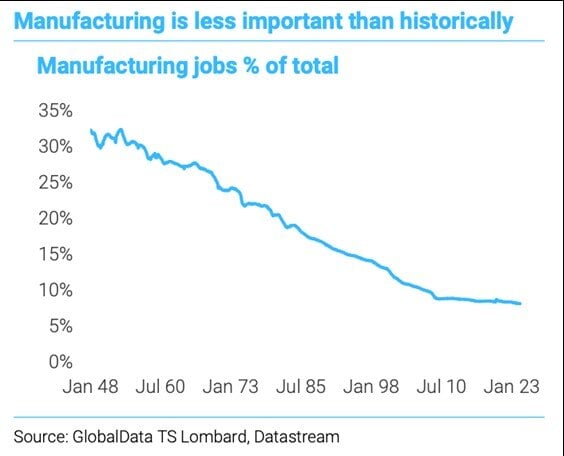
One clear signal: Manufacturing’s share of total U.S. employment has fallen from 17% in 1980 to just 8.5% today. Even if jobs stabilize, the sector’s role in the economy may continue shrinking.
How Companies and Policymakers Are Responding
Facing the job cuts, manufacturers and lawmakers are pursuing a mix of cost-cutting measures and policy pushes. Here’s what’s happening:
Corporate Strategies: Layoffs, Automation, and Offshoring
Companies are taking three main approaches:
- Layoffs and hiring freezes: General Electric announced 1,200 job cuts in June, citing “structural shifts” in its appliance division. Honeywell followed with plans to eliminate 2,000 roles globally.
- Accelerated automation: Rockwell Automation, a major industrial software firm, reported a 15% increase in robotics sales in 2024, as factories invest in AI-driven production lines.
- Selective offshoring: Some firms are moving lower-skilled production back to lower-cost countries (e.g., Vietnam, Mexico) while keeping high-tech manufacturing in the U.S. Intel’s recent decision to expand chip plants in Arizona reflects this strategy.
Policy Moves: Bipartisan Push for Manufacturing Support
Lawmakers from both parties are proposing measures to stem the decline:
- CHIPS and Science Act follow-ups: Senators Sherrod Brown (D-OH) and Todd Young (R-IN) introduced the “Made in America Act” to extend tax breaks for semiconductor and battery manufacturers, arguing that the original CHIPS Act didn’t go far enough.
- Apprenticeship expansions: The Biden administration’s new “Manufacturing Institute” program, announced in June, will fund 50,000 new apprenticeships in high-tech fields like advanced materials and AI-driven manufacturing.
- Trade adjustments: The U.S. Trade Representative is reviewing tariffs on Chinese electric vehicles, a move that could either protect U.S. auto jobs or trigger retaliation and higher costs for manufacturers.
However, critics argue these efforts may be too little, too late. “We’re playing catch-up,” said Robert Scott, director of the Economic Policy Institute. “China and Europe are investing billions in green manufacturing and AI—we’re still debating whether to extend tax credits.”
Misconceptions About Manufacturing Jobs—and Why They’re Wrong
Public perception of manufacturing often lags behind reality. Here are three common myths—and the facts:
Myth 1: “Manufacturing Jobs Are Only for Low-Skilled Workers”
Reality: While entry-level roles exist, over 60% of manufacturing jobs now require at least some post-secondary education or vocational training, according to the Manufacturing Institute. Roles in advanced materials, robotics programming, and quality assurance are in high demand—and pay well. For example, a machinist with CNC certification in Michigan earns an average of $65,000 annually.
Myth 2: “Reshoring Will Bring Back All the Jobs Lost to China”
Reality: The U.S. has added about 1.2 million manufacturing jobs since 2010, but most of those are in high-tech or defense-related sectors. Traditional labor-intensive industries (like apparel or basic electronics) have not returned in large numbers. “Reshoring is happening, but it’s selective,” said Daniel Ikenson, director of the Cato Institute’s trade policy program. “We’re not seeing a broad-based revival of old-school manufacturing.”
Myth 3: “Automation Only Hurts Unskilled Workers”
Reality: Mid-skill roles—such as assembly line supervisors and quality control inspectors—are being automated at record rates. A 2024 Deloitte study found that 40% of manufacturing tasks currently performed by workers with moderate technical skills could be automated within five years. Meanwhile, jobs requiring creative problem-solving (e.g., designing new production processes) are growing.
What’s Next? Watching the Manufacturing Job Market
The next few months will be critical in determining whether the manufacturing downturn deepens or stabilizes. Key data points to watch:
- July jobs report (August 2): Economists expect another decline, with forecasts calling for a 15,000–25,000 drop in manufacturing employment.
- ISM Manufacturing PMI (July release): A reading below 50 would signal contraction, while above 55 could indicate a rebound.
- Federal Reserve policy: If the Fed cuts rates later this year, manufacturers could see a modest hiring rebound—but only if demand picks up.
- Election-year politics: Manufacturing will be a major issue in the 2024 campaign, with both parties likely proposing new industrial policies. Expect debates over tariffs, subsidies, and trade deals.
For workers, the outlook depends on geography and skill level. Those in high-tech manufacturing hubs (e.g., Silicon Valley, Austin, Detroit) may see opportunities, while workers in declining rust-belt towns face tougher prospects. “This isn’t a uniform story,” said Heather Boushey, president of the Washington Center for Equitable Growth. “The future of manufacturing is concentrated in specific regions and skill sets—and that’s where the next wave of job creation will happen.”
Key Questions About the Manufacturing Job Decline—Answered
Q: Are these job losses permanent, or will manufacturing recover?
A: The decline is likely structural in some sectors (e.g., traditional automotive, textiles) but cyclical in others (e.g., semiconductors, renewable energy equipment). Historically, manufacturing employment has rebounded after downturns—but the composition of jobs has changed. For example, the sector lost 5.7 million jobs between 2000 and 2010 but added 1.2 million since 2010, mostly in high-tech areas.
Q: Which states are losing the most manufacturing jobs?
A: The Midwest and Northeast have seen the steepest declines. Ohio (-32,000 jobs YoY), Michigan (-28,000), and Pennsylvania (-25,000) lead the losses. In contrast, Texas and Florida have added manufacturing jobs, driven by energy and aerospace growth.
Q: Could this hurt the broader economy?
A: Yes. Manufacturing supports 18% of U.S. GDP through supply chains, and every dollar spent in a factory generates $1.37 in economic activity elsewhere, according to the National Association of Manufacturers. A prolonged downturn could weigh on wages, consumer spending, and regional tax bases.
Q: Are there still good jobs in manufacturing?
A: Absolutely. High-demand roles include:
- Robotics technicians ($85,000+ average salary)
- Industrial engineers ($95,000+)
- Quality assurance specialists ($70,000+)
- Renewable energy equipment assemblers ($60,000+)
Companies like Tesla, Intel, and Lockheed Martin are actively hiring for these positions.
Q: What can workers do if they’re laid off?
A: Options include:
- Upskilling: Programs like the Manufacturing Institute’s “Skills for America’s Future” offer free training in advanced manufacturing.
- Relocating: States like Georgia, Tennessee, and Arizona offer incentives for workers in high-demand fields.
- Transitioning to services: Many manufacturers now hire for supply chain, logistics, and data analysis roles.
The U.S. Department of Labor’s CareerOneStop tool can help identify local opportunities.
Q: Will tariffs on China help manufacturing jobs?
A: Mixed evidence. Tariffs have protected some industries (e.g., steel, aluminum) but also raised costs for downstream manufacturers (e.g., auto parts makers). A 2023 study by the Peterson Institute for International Economics found that tariffs added $100 billion to U.S. manufacturing costs in 2022—offsetting some job gains.
Q: How does this compare to past manufacturing downturns?
A: The current decline is more concentrated in high-wage sectors than past crises. For example:
- 2008 financial crisis: Job losses were broad (including low-wage roles in textiles and furniture).
- 2015–2016 oil crash: Mostly hit energy-related manufacturing (e.g., drilling equipment).
- Today: Cuts are focused on durable goods, automation, and trade-exposed industries.
The speed of job losses—22,000 in a single month—is unusual even for a downturn.
