
PM to make fuel excise call early next week – Australian Broadcasting Corporation
The Australian Prime Minister will announce a decision early next week on whether to extend the current 50% fuel excise cut, according to the Australian Broadcasting Corporation. The announcement comes as the existing discount nears its expiration date, triggering warnings of petrol panic-buying and intensified calls for continued cost-of-living relief.
Will the 50% fuel excise cut be extended?
The federal government has not yet confirmed a permanent or temporary extension, but the Prime Minister has left the door open for a continuation of the 50% fuel excise reduction, according to reporting from The Australian. This tax relief measure was designed to lower the cost of petrol and diesel at the pump, providing a buffer for consumers against volatile global oil prices.
The decision expected early next week will determine whether the excise remains halved or returns to its standard rate. If the government allows the discount to expire, the cost per litre for motorists will increase immediately upon the reset. This uncertainty has led to a period of speculation among economists and political analysts regarding the government’s fiscal priorities and its commitment to inflation management.
Key factors influencing the Prime Minister’s decision include:
- Current retail fuel price trends across major capital cities.
- The impact of the excise cut on the overall Consumer Price Index (CPI).
- Budgetary constraints and the loss of revenue from the fuel tax.
- Political pressure from regional voters who are more dependent on private vehicle transport.
Why petrol panic-buying warnings are emerging
Retailers and industry observers have issued warnings regarding potential “panic-buying” behavior among motorists, according to The Age. This phenomenon typically occurs when consumers anticipate a sharp price increase and attempt to fill their tanks—and spare containers—before the price hike takes effect.
Panic-buying can create a secondary set of problems for the fuel supply chain. When a sudden surge of demand hits service stations simultaneously, it can lead to localized fuel shortages and longer queues. In some instances, this artificial demand spike can actually drive prices higher in the short term, offsetting the very savings motorists are trying to secure.
Industry experts note that the psychological impact of a “deadline” for fuel relief often outweighs the actual cent-per-litre difference. According to The Age, the risk is highest in suburban areas where a few high-volume service stations serve a large population, making them vulnerable to rapid stock depletion during a buying frenzy.
How international oil markets influence Australian prices
While domestic tax policy determines the excise, the baseline price of fuel is dictated by global benchmarks. SBS Australia has highlighted the role of international diplomacy, specifically the relationship between the United States and Iran, in shaping these costs. Recent rhetoric from U.S. leadership, including calls to “let the oil flow,” suggests a push for increased global supply to stabilize prices.
The potential for a U.S.-Iran peace deal is viewed as a critical variable for Australian relief. If diplomatic tensions ease and Iranian oil returns to the global market in larger volumes, the global supply of crude increases. According to SBS Australia, this increased supply generally leads to a decrease in the Brent crude benchmark, which is the primary reference for fuel pricing in the Asia-Pacific region.
However, the lag between a global price drop and a local price decrease can be significant. Australian fuel prices are influenced by several layers:
- International Crude Price: The raw cost of oil on the global market.
- Refining Margins: The cost of turning crude oil into petrol or diesel.
- Shipping and Freight: The cost of transporting fuel to Australian ports.
- Government Taxes: Including the fuel excise and GST.
- Retailer Margins: The profit margin added by the service station owner.
Because the Prime Minister only controls the “Government Taxes” portion of this chain, an excise cut is one of the few tools available to provide immediate, predictable relief, regardless of what happens in the Middle East.
The political pressure for continued fuel relief
There are growing calls from various sectors for the fuel relief measures to be extended indefinitely or tied to a specific price trigger. SMH.com.au reports that advocacy groups and some political factions are arguing that the cost-of-living crisis is too severe to allow the excise discount to lapse.
The argument for extension is rooted in the “multiplier effect” of fuel costs. Higher transport costs do not just affect the individual driver; they increase the cost of transporting goods, which in turn raises the price of groceries and essential services. According to SMH.com.au, this creates a cycle of inflation that the government is currently attempting to combat through other monetary and fiscal policies.
Opponents of the extension argue that fuel excise is a critical source of funding for road infrastructure and maintenance. They suggest that cutting the excise reduces the government’s ability to fix potholes, build new highways, and improve road safety. This creates a policy tension between providing immediate relief to households and ensuring long-term infrastructure viability.
| Scenario | Immediate Impact on Motorists | Impact on Government Revenue | Potential Economic Risk |
|---|---|---|---|
| Extension of 50% Cut | Lower prices at the pump; maintained purchasing power. | Reduced revenue for road and infrastructure projects. | May contribute to higher inflation if spending increases. |
| Expiration of Discount | Immediate price increase per litre. | Restored funding for national road networks. | Potential for panic-buying and increased transport costs for goods. |
Understanding the fuel excise mechanism
To understand why the Prime Minister’s call is so significant, it is necessary to understand how the fuel excise works. Unlike a percentage-based tax (like GST), the fuel excise is a “flat tax” applied per litre of fuel sold. This means the government receives a fixed amount for every litre of petrol or diesel that passes through the pump, regardless of whether the price of that fuel is $1.50 or $2.50.
When the government implements a 50% cut, they are essentially reducing that fixed cent-per-litre fee. For example, if the standard excise were 49.6 cents per litre, a 50% cut would reduce that to roughly 24.8 cents. This reduction is passed directly to the consumer as a lower retail price.
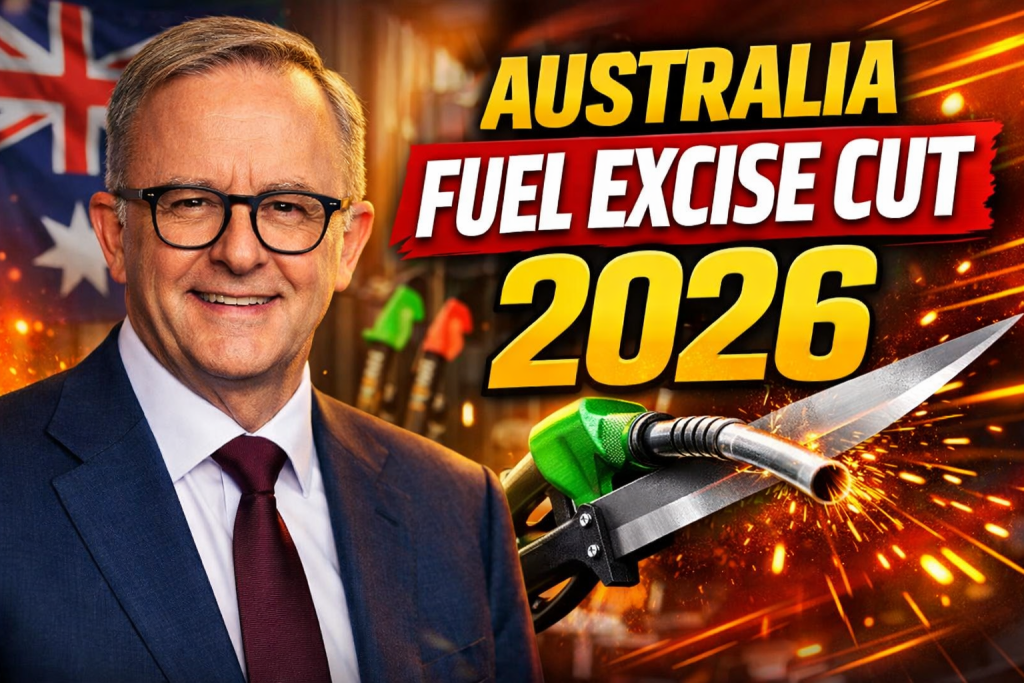
This mechanism is highly effective for rapid relief because it does not require complex calculations by retailers; they simply adjust their pricing based on the new tax rate. However, it is also a “blunt instrument.” It provides the same relief to a high-income earner driving a luxury SUV as it does to a low-income earner driving a small hatchback, leading some critics to suggest that targeted subsidies would be more equitable.
For those interested in how this fits into broader economic trends, a related explainer on inflation triggers provides further context on how energy costs drive the CPI.
Comparing the framing of fuel relief across sources
Different news outlets have highlighted different risks associated with the upcoming decision. The Australian Broadcasting Corporation focuses on the timeline, emphasizing the “early next week” deadline to keep the public informed of when the change will occur. In contrast, The Australian focuses on the possibility, framing the story around the Prime Minister “leaving the door open,” which suggests a political willingness to act.
Meanwhile, The Age and SMH.com.au shift the focus to the social and behavioral impact. By reporting on “panic-buying” and “calls for relief,” these outlets highlight the anxiety of the consumer and the pressure on the government. SBS Australia takes a macro-economic view, linking local pump prices to the geopolitical maneuvers of the U.S. and Iran, reminding readers that domestic tax cuts are only one part of a much larger global equation.
This divergence in reporting shows that the fuel excise issue is not just a matter of tax policy, but a intersection of global diplomacy, psychology, and domestic political survival.
Common misconceptions about fuel excise cuts
There is a common belief that a fuel excise cut is the only way to lower petrol prices. While it is the fastest way for a government to intervene, it is not the only factor. As noted by SBS Australia, an increase in global supply (such as the “let the oil flow” objective) can lower prices more sustainably than a tax cut, as it addresses the root cause of the price hike rather than just masking it with a subsidy.
Another misconception is that the excise cut is “free money.” In reality, the fuel excise is earmarked for road funding. A cut in the excise means that the government must either find funds from other parts of the budget to maintain roads or allow the quality of the road network to decline. This is the primary trade-off the Prime Minister must weigh before making the call next week.
Finally, some motorists believe that panic-buying will “lock in” a low price. However, since fuel is a commodity with a fluctuating market price, buying in bulk only saves money if the price actually rises by more than the cost of storing the fuel safely. If the Prime Minister extends the cut, those who panic-bought may find they paid a premium during a temporary spike caused by the rush.
Potential outcomes of the upcoming announcement
Analysts suggest three primary paths the Prime Minister could take early next week:
- Full Extension: The 50% cut is extended for another several months. This would likely be welcomed by the public and reduce the risk of panic-buying, but it would continue to drain the road infrastructure budget.
- Phased Return: The government could introduce a “tapered” return to the full excise—for example, reducing the discount to 25% for a month before returning to 0%. This would signal a return to fiscal normalcy while softening the blow for consumers.
- Allowing Expiration: The discount ends as scheduled. This would prioritize road funding and fiscal discipline but could lead to a short-term spike in retail prices and political backlash.
The timing of the announcement is also strategic. By waiting until early next week, the government can monitor the latest data on global oil prices and gauge the current mood of the electorate. If global prices are trending downward due to the U.S.-Iran dynamics mentioned by SBS Australia, the government may feel more comfortable letting the excise cut expire, as the market would naturally provide some relief.
For more on how government spending affects daily costs, see our analysis of cost-of-living subsidies.
Frequently Asked Questions
When will the Prime Minister announce the decision on the fuel excise?
According to the Australian Broadcasting Corporation, the Prime Minister is expected to make the call regarding the fuel excise early next week.
What happens if the 50% fuel excise cut is not extended?
If the discount expires, the fuel excise will return to its standard rate, which will result in an immediate increase in the price per litre of petrol and diesel at the pump.
Why are there warnings about petrol panic-buying?
The Age reports that warnings have been issued because motorists often rush to fill their tanks before a predicted price increase, which can lead to temporary fuel shortages and longer queues at service stations.
Does the U.S.-Iran relationship affect Australian petrol prices?
Yes. According to SBS Australia, diplomatic developments and U.S. efforts to increase global oil flow (such as potential peace deals with Iran) can increase the global supply of crude oil, which typically lowers the benchmark prices that Australia follows.
Where does the money from the fuel excise go?
The fuel excise is generally used by the government to fund the construction, maintenance, and improvement of the national road and highway network.
Is the fuel excise the same as GST?
No. GST is a percentage-based tax on the final price of the fuel. The fuel excise is a fixed amount charged per litre, regardless of the fuel’s retail price.
