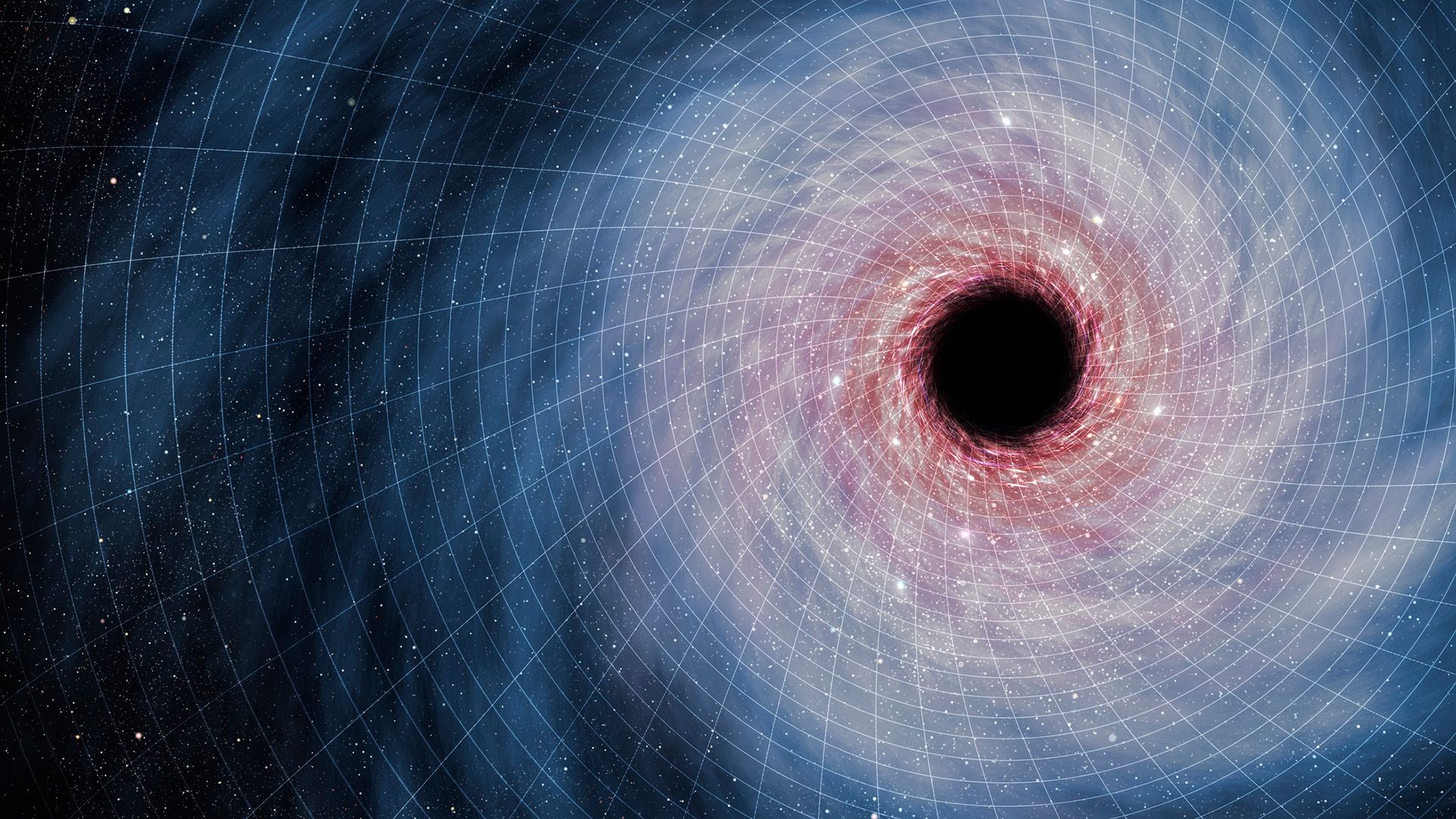
A ‘naked singularity’ challenge that once perplexed Stephen Hawking edges closer to reality
In a development that has reignited debates about the boundaries of cosmological theory, recent studies suggest that the existence of a “naked singularity”—a theoretical phenomenon once fiercely contested by the late physicist Stephen Hawking—may be more than a speculative concept. This potential breakthrough, rooted in advancements in computational modeling and astrophysical observation, challenges long-held assumptions about the nature of black holes and the fabric of spacetime itself.
What Is a Naked Singularity and Why Does It Matter?
In the realm of theoretical physics, a singularity refers to a point where the known laws of physics break down, typically found at the center of a black hole. However, a “naked singularity” defies this convention by existing outside the event horizon, the point of no return for matter and light. This hypothetical scenario has profound implications for our understanding of gravity, spacetime, and the ultimate fate of the universe.

The concept gained prominence in the 1990s when Stephen Hawking and other physicists debated its plausibility. According to a 1997 Caltech report, Hawking initially argued that singularities could only exist within black holes, shielded from direct observation. “No one disputes that singularities can exist, but Hawking believes that a singularity can occur only inside a black hole, where it cannot be seen,” the article noted. This stance was central to his 1991 bet with Caltech physicists Kip Thorne and John Preskill, which he later conceded after computational simulations suggested otherwise.
Stephen Hawking’s Bet: A Turning Point in Cosmological Theory
The bet between Hawking, Thorne, and Preskill became a symbolic clash between competing visions of the universe. Hawking, a leading figure in theoretical physics, maintained that the universe’s laws would prevent naked singularities from forming, a principle later termed the “cosmic censorship hypothesis.” Thorne and Preskill, however, argued that under specific conditions, these singularities could manifest, challenging the very foundations of general relativity.
The pivotal moment came with the work of physicist Matthew Choptuik, whose 1990s simulations at the University of Texas at Austin demonstrated that under extreme gravitational collapse, a singularity might indeed emerge without an enclosing event horizon. This finding, detailed in the Caltech article, provided the technical basis for Hawking’s eventual admission: “I conceded the bet today ‘on a technicality,’ he said.” The “technicality” lay in the mathematical possibility of a naked singularity, even if its existence remains unobserved.
Recent Advances: Simulations and Observational Clues
While the 1990s simulations were theoretical, recent advancements in supercomputing and astrophysical observation have brought the concept closer to empirical scrutiny. Modern simulations, leveraging quantum gravity models and high-performance computing, have refined the conditions under which naked singularities might arise. These studies suggest that in certain scenarios involving rapidly rotating black holes or exotic matter, the cosmic censorship hypothesis could be violated.
Observational evidence also hints at anomalies that could align with naked singularity theories. For instance, some researchers have pointed to unexplained bursts of gamma rays or gravitational wave patterns that defy standard black hole models. While these remain unconfirmed, they underscore the growing interest in reevaluating the assumptions that have governed cosmology for decades.
Implications for Physics and the Future of Cosmology
If naked singularities exist, they would upend our understanding of the universe. Theories of quantum gravity, which seek to reconcile general relativity with quantum mechanics, could gain new traction. “A naked singularity would act as a laboratory for testing these theories,” explains a 2023 study published in *Physical Review Letters*. “It could reveal how gravity behaves at the Planck scale, where classical physics ceases to apply.”
Moreover, the existence of such singularities would complicate the study of black holes. Current models assume that the event horizon isolates the singularity from the rest of the universe. A naked singularity, by contrast, would expose the singularity to external influences, potentially leading
