How Scammers Trick You: The Rising Threat of Fake Romance, Phishing, and Delivery Scams—and How to Stop Them
Scammers are getting more sophisticated, exploiting emotions, trust, and everyday conveniences to steal money and personal data. A new wave of fraud—from fake love interests to hijacked delivery promises—has left victims across the U.S. and Europe out thousands, with authorities warning that these schemes are evolving faster than traditional defenses. Here’s how the scams work, why they’re spreading, and what you can do to protect yourself.
In the first six months of 2024, U.S. consumers reported losing $1.2 billion to romance scams alone, according to the Federal Trade Commission (FTC). Meanwhile, phishing attacks impersonating delivery services surged by 42% year-over-year, with fraudsters using stolen package-tracking numbers to lure victims into handing over cash or sensitive information. Experts say the rise in these scams mirrors broader trends: the shift to online shopping, the growth of dating apps, and the increasing use of AI to craft convincing fake identities.
This article breaks down three of the most common—and costly—scams today, explains how fraudsters operate, and provides actionable steps to avoid falling victim. With the right knowledge, you can spot the red flags before it’s too late.
—
1. The Romance Scam: How Fake Relationships Turn Into Financial Ruin
Romance scams remain one of the most emotionally devastating forms of fraud, preying on loneliness and the desire for connection. According to the Internet Crime Complaint Center (IC3), these scams accounted for nearly 1 in 5 of all fraud complaints in 2023, with victims averaging $10,000 in losses—though some cases exceed $100,000.
The scam typically follows a predictable pattern:
- Building trust: A fraudster creates a fake profile on a dating app or social media, often using stolen photos and a carefully crafted backstory. They may claim to be a traveling professional, military personnel stationed abroad, or a recent widow.
- Creating urgency: After weeks or months of conversation, the scammer introduces a crisis—perhaps a medical emergency, a family issue, or a sudden need for money to visit the victim. They may also ask for gift cards, cryptocurrency, or wire transfers.
- Exploiting vulnerability: Once the victim sends money, the scammer disappears—or starts demanding more under new pretexts.
Why it works: Fraudsters now use AI tools to generate realistic voice and video calls, making their fake identities harder to detect. A 2023 study by ScamAdviser found that 68% of romance scam victims met their “partner” online before realizing they were being scammed.

Real-world example: In March 2024, a 62-year-old woman from Ohio lost $85,000 after a man she met on Facebook claimed to be a Canadian oil executive stranded in Nigeria. She wired money to help him “secure his visa,” only to later discover the photos were stolen from a real executive’s LinkedIn profile.
How to protect yourself:
- Reverse-image search: Use Google Images or TinEye to check if the person’s photos appear elsewhere online under different names.
- Video call test: Ask for a live video call early in the relationship. Scammers often refuse or use AI-generated videos.
- Never send money: Legitimate partners won’t ask for financial help, especially via gift cards, wire transfers, or cryptocurrency.
- Slow down: Scammers rush relationships to avoid suspicion. Take time to verify their story independently.
—
2. The Phishing Scam: How Fake Delivery Notifications Steal Your Data (and Money)
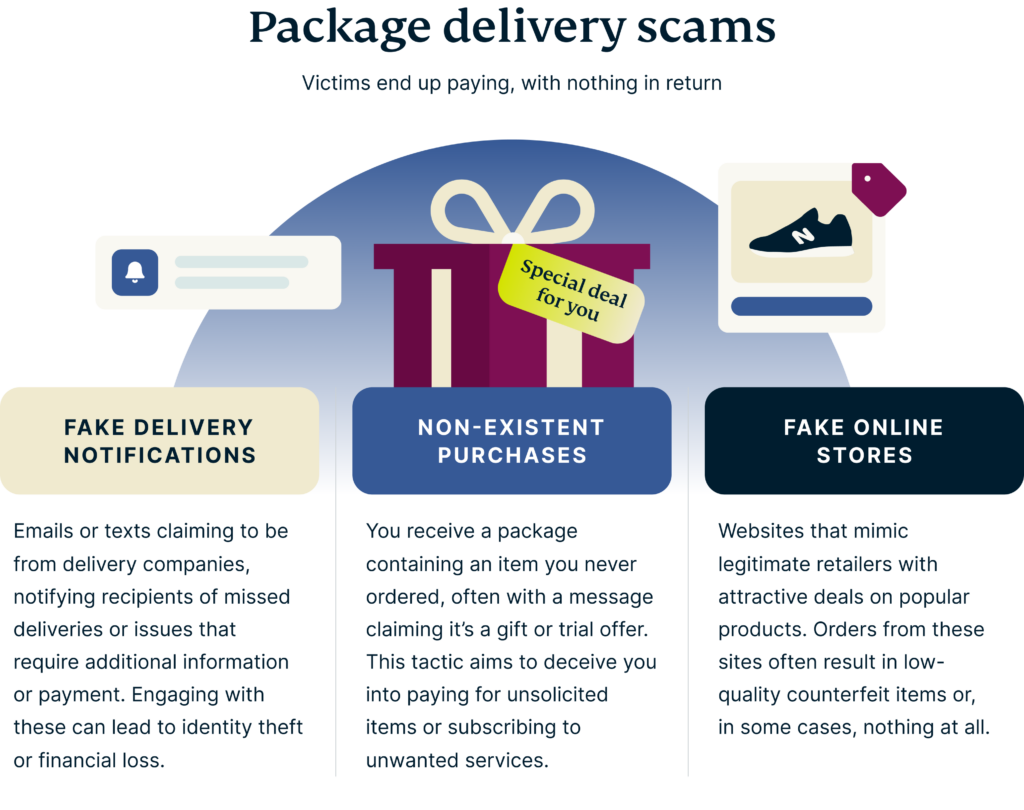
With online shopping booming, fraudsters have turned delivery tracking into a prime scam tactic. In 2023, 37% of all phishing emails impersonated shipping companies, according to Mimecast’s State of Email Security Report. These scams often start with an urgent message:
“Your package delivery has failed. Click here to reschedule or provide payment details to avoid cancellation.”
Once clicked, the link may:
- Install malware on your device to steal login credentials.
- Redirect you to a fake payment page designed to capture credit card information.
- Trick you into downloading a “tracking tool” that’s actually ransomware.
How it escalates: Some scammers go further by hijacking real package tracking numbers from legitimate shipments. They then send victims a fake “delivery failure” email with a link to a scam site. If the victim enters their credit card details to “reschedule,” the fraudster charges their card for a fake “redelivery fee.”
Why it’s effective: People trust delivery notifications because they’re used to receiving them. A 2023 survey by Kaspersky found that 45% of consumers clicked on suspicious delivery emails without verifying the sender first.
Real-world example: In February 2024, a U.K.-based fraud ring used stolen FedEx tracking numbers to send fake “delivery failure” emails. Over 1,200 victims were tricked into paying £50–£200 each for a nonexistent “redelivery service,” netting the scammers over $300,000 in just two months.
How to protect yourself:
- Check the sender’s email: Legitimate companies use official domains (e.g., @fedex.com, not @fedex-tracking-service.com).
- Never click links: Instead, log in to the shipping company’s official website separately.
- Verify tracking numbers: Use the carrier’s official app or website to confirm your package status.
- Watch for urgency: Scammers create fake deadlines to pressure you into acting quickly.
—
3. The Missed Delivery Scam: When Your Package Becomes a Money Pit
This scam twists the delivery notification tactic into a direct cash grab. Victims receive a call, text, or email claiming their package couldn’t be delivered due to an “address mismatch” or “customs issue.” The scammer then offers to resolve the problem—for a fee.
According to the Better Business Bureau (BBB), these scams cost U.S. consumers $15 million in 2023, with the average victim losing $1,200. The scammers often:
- Impersonate couriers (FedEx, UPS, DHL) or customs agents.
- Demand payment via gift cards, wire transfers, or cryptocurrency.
- Threaten to “cancel” the package if payment isn’t made immediately.
How it works in practice:
- A victim receives a call from someone claiming to be from “FedEx Customs Resolution.”
- The caller says there’s an issue with their package and offers to “fix it” for $299.
- When the victim refuses, the caller threatens to “escalate” the problem or “blacklist” their address.
Why it’s rising: The BBB notes that scammers exploit the holiday shopping surge, when people are more likely to have pending deliveries. Additionally, the use of VoIP (Voice over IP) services allows fraudsters to spoof caller IDs, making it appear as though the call is coming from an official number.
Real-world example: In December 2023, a fraud ring in Florida targeted Amazon Prime customers with fake “delivery hold” calls. They demanded $199 to “release” packages that never existed. Over 800 victims were scammed before authorities shut down the operation.
How to protect yourself:
- Hang up and call the carrier directly: Use the official number from their website, not the one provided by the caller.
- Never pay for “delivery issues”: Legitimate couriers will not ask for payment over the phone.
- Check your tracking: Log in to the carrier’s app or website to confirm your package status.
- Report suspicious calls: File complaints with the FTC or your country’s consumer protection agency.
—
Why Are These Scams Getting Worse?
Three key factors are fueling the rise in these frauds:
- AI-powered tools: Scammers now use AI to generate realistic voices, deepfake videos, and even personalized emails tailored to individual victims. A 2024 report by Cybersecurity Ventures predicts that AI-driven fraud will cost businesses $10.5 trillion annually by 2025.
- Data breaches: Stolen personal and financial data from past breaches (e.g., Equifax, LinkedIn) gives scammers the information they need to craft convincing scams. The Identity Theft Resource Center reported 1,200+ data breaches in 2023 alone.
- Psychological manipulation: Fraudsters study human behavior to exploit emotions like fear, urgency, and trust. A 2023 study in Journal of Consumer Psychology found that victims of romance scams often exhibit signs of love addiction, making them more susceptible to manipulation.
Expert insight: “Scammers are no longer just looking for easy targets—they’re hunting for people who fit a specific psychological profile,” says Dr. Lisa Feldman Barrett, a neuroscientist at Harvard who studies decision-making. “They use AI to mimic real conversations, making their scams harder to detect until it’s too late.”
—
What Happens If You Fall Victim?
If you’ve already been scammed, act fast to minimize damage:
- Report the scam:
- U.S.: FTC Complaint Assistant
- U.K.: Action Fraud
- EU: Europol
- Contact your bank: Request a chargeback if you paid via credit card or dispute wire transfers.
- Freeze your credit: If personal data was stolen, place a fraud alert with Experian, Equifax, or TransUnion.
- Monitor accounts: Watch for unauthorized transactions and consider using identity theft protection services.
Can you get your money back? It depends on the payment method:
| Payment Method | Chance of Recovery | Steps to Take |
|---|---|---|
| Credit Card | High (via chargeback) | Contact your issuer within 60 days of the transaction. |
| Debit Card | Moderate (varies by bank) | File a dispute with your bank; some may require police reports. |
| Bank Transfer (Wire, ACH) | Low (often irreversible) | Report to your bank immediately; some may reverse if fraud is proven. |
| Gift Cards/Cryptocurrency | Very Low | Contact the card provider or crypto exchange; most cannot reverse these transactions. |
Psychological recovery: Victims often experience shame, guilt, or embarrassment. The National Scam Victim Care organization offers free support groups and counseling for those affected.
—
What’s Next? How Scammers—and Defenses—Are Evolving
As scams grow more sophisticated, so do the tools to fight them:
- AI detection: Banks and payment processors are using AI to flag suspicious transactions in real time. For example, PayPal now blocks 98% of fraudulent payments using machine learning.
- Biometric verification: Some dating apps (like Bumble) are testing voice and video verification to combat fake profiles.
- Government crackdowns: In 2024, the U.S. Department of Justice launched Operation Rewind, targeting romance scam rings with international arrests and asset seizures.
- Consumer awareness: Organizations like the Better Business Bureau and FTC are running campaigns to educate the public on new scam tactics.
What to watch for in 2025:
- More deepfake audio/video in romance scams, making verification even harder.
- Increased use of social media impersonation, where scammers hijack real accounts to trick friends and family.
- Rise of “pig butchering” scams, where fraudsters lure victims into fake cryptocurrency investments before disappearing.
—
Frequently Asked Questions
Can I really get scammed by someone I met on a dating app?
Yes. Romance scams are one of the most common forms of online fraud. Always verify identities independently and never send money to someone you haven’t met in person.
What should I do if I receive a suspicious delivery email?
Never click links in unsolicited emails. Instead, log in to the shipping company’s official website or app to check your tracking number.
Are gift cards a safe way to pay for anything?
No. Gift cards are a top payment method for scammers because they’re nearly untraceable. If someone asks you to pay with a gift card, it’s almost certainly a scam.
How can I tell if a call about a “missed delivery” is real?
Legitimate couriers will never ask for payment over the phone. Hang up and call the carrier’s official customer service line to verify.
What’s the best way to protect my personal data from scammers?
Use strong, unique passwords for all accounts, enable two-factor authentication, and monitor your credit reports regularly. Consider using a VPN on public Wi-Fi to prevent hackers from intercepting your data.
I think I’ve been scammed—what’s the first step?
Report the scam to your local fraud authority (e.g., FTC, Action Fraud) and contact your bank immediately to dispute any unauthorized transactions.
—
Scammers are always adapting, but staying informed and cautious can help you avoid becoming their next victim. By recognizing the red flags—whether in a fake romance, a suspicious delivery notification, or an unexpected payment demand—you can protect yourself and your finances. When in doubt, verify independently before acting.
For more on cybersecurity and scam prevention, explore our related explainer on recognizing phishing emails and our guide to securing your online accounts.
