World-First: Therapy to Make Cells Young Again Given to a Person – Nature and the Future of Cellular Reprogramming
Life Bio, a longevity startup, has administered the first human dose of a cellular reprogramming therapy designed to reverse cellular aging, according to reports from WIRED and Longevity.Technology. The treatment, known as OSK therapy, targets age-related sight loss by attempting to reset the epigenetic clock of cells in the eye, effectively returning them to a more youthful functional state without converting them into stem cells.
What is the first human cellular reprogramming therapy?
The first-ever reverse-aging drug has been injected into a human patient as part of a clinical milestone reached by Life Bio, as reported by Business Insider. This therapy does not aim to stop aging in a general sense but specifically targets the biological age of cells to restore lost function. The initial application of this technology is focused on reversing age-related sight loss, a condition where cells in the eye degenerate over time.
According to Technology Networks, the therapy works by “re-setting the epigenetic clock.” Unlike traditional medicine, which treats the symptoms of age-related diseases, this approach targets the underlying cellular decay. By introducing specific genetic factors, the therapy encourages cells to regain the characteristics they possessed when the patient was younger.
The core components of this treatment are the OSK factors—Oct4, Sox2, and Klf4. These are a subset of the “Yamanaka factors,” named after Shinya Yamanaka, who won a Nobel Prize for discovering that these proteins could turn adult cells back into pluripotent stem cells. Life Bio’s approach, however, uses a modified version of this process called partial reprogramming.
“The goal is to move the cell back to a younger state without erasing its identity,” according to technical descriptions of the OSK process cited by Technology Networks.
How does the OSK therapy reset the epigenetic clock?
To understand how the OSK therapy works, it is necessary to distinguish between the genetic code and the epigenetic layer. While the DNA sequence (the genome) remains largely the same throughout a person’s life, the epigenetic layer acts as a series of switches that determine which genes are turned on or off. As humans age, these switches malfunction, leading to cellular senescence and organ failure.
The “epigenetic clock” is a measurable pattern of chemical modifications to DNA, specifically methylation. According to Nature, these patterns can be used to determine a person’s biological age, which may differ from their chronological age. The OSK therapy seeks to “wind back” this clock.
The Mechanism of Partial Reprogramming
Full reprogramming, as pioneered by Yamanaka, turns a specialized cell (like a skin cell) into a stem cell. While powerful, this is dangerous in a living human because stem cells can form teratomas—tumors containing multiple tissue types. Life Bio utilizes partial reprogramming to avoid this risk. The process involves:
- Controlled Expression: The OSK factors are activated for a limited time.
- Identity Preservation: The cell is pushed back to a youthful state but stops before it loses its identity as an eye cell.
- Functional Restoration: The “younger” cell resumes the protein production and metabolic activity it had in youth, potentially restoring vision.
This distinction is critical. The therapy is not creating new cells; it is rejuvenating existing ones. This minimizes the risk of tissue rejection and avoids the instability associated with full pluripotency.
Why was age-related sight loss chosen for the first trial?
Life Bio selected the eye as the primary target for its first human dosing for several strategic and biological reasons, according to WIRED. The eye provides a controlled environment that is ideal for early-stage clinical testing of reverse-aging drugs.
First, the eye is an “immune-privileged” site. This means the immune system is less likely to react aggressively to the therapy compared to other organs, reducing the risk of severe inflammation. Second, the eye is small and localized. If a complication occurs, the impact is contained within the ocular region rather than affecting the entire systemic circulation.
Furthermore, sight loss is a high-impact condition. Age-related macular degeneration and other forms of cellular decay in the retina lead to profound disability. By demonstrating that OSK therapy can restore vision, the company can provide a concrete, measurable “proof of concept” for cellular reprogramming.
| Feature | Full Reprogramming (Yamanaka) | Partial Reprogramming (OSK Therapy) |
|---|---|---|
| Outcome | Pluripotent Stem Cell | Rejuvenated Specialized Cell |
| Cell Identity | Erased | Preserved |
| Tumor Risk | High (Teratomas) | Significantly Lowered |
| Primary Use | Lab research/Stem cell lines | In vivo therapeutic reversal |
What are the risks of reverse-aging drugs?
While the prospect of making cells young again is promising, the scientific community remains cautious. The primary risk associated with any therapy using Yamanaka factors is the potential for uncontrolled cell growth. If the “off switch” for the OSK factors fails, or if the cells are reprogrammed too far, they could revert to a stem-cell-like state and form tumors.
Another concern is the potential for “off-target” effects. Although the therapy is delivered to the eye, researchers must ensure that the genetic modifications do not trigger unintended biological responses in surrounding tissues. According to reports in Nature, the precision of the delivery mechanism—how the OSK factors are introduced into the cell—is the most critical safety variable.
There is also the question of durability. It is currently unknown how long the “reset” lasts. Cells will continue to age after the therapy is administered, meaning the treatment might need to be repeated over several years to maintain the rejuvenated state.
Common misconceptions about this therapy include the idea that it is a “fountain of youth” pill. This is not a systemic treatment for the whole body; it is a targeted medical intervention for a specific organ. Related explainer on biological vs. chronological age.
How does partial reprogramming differ from stem cell therapy?
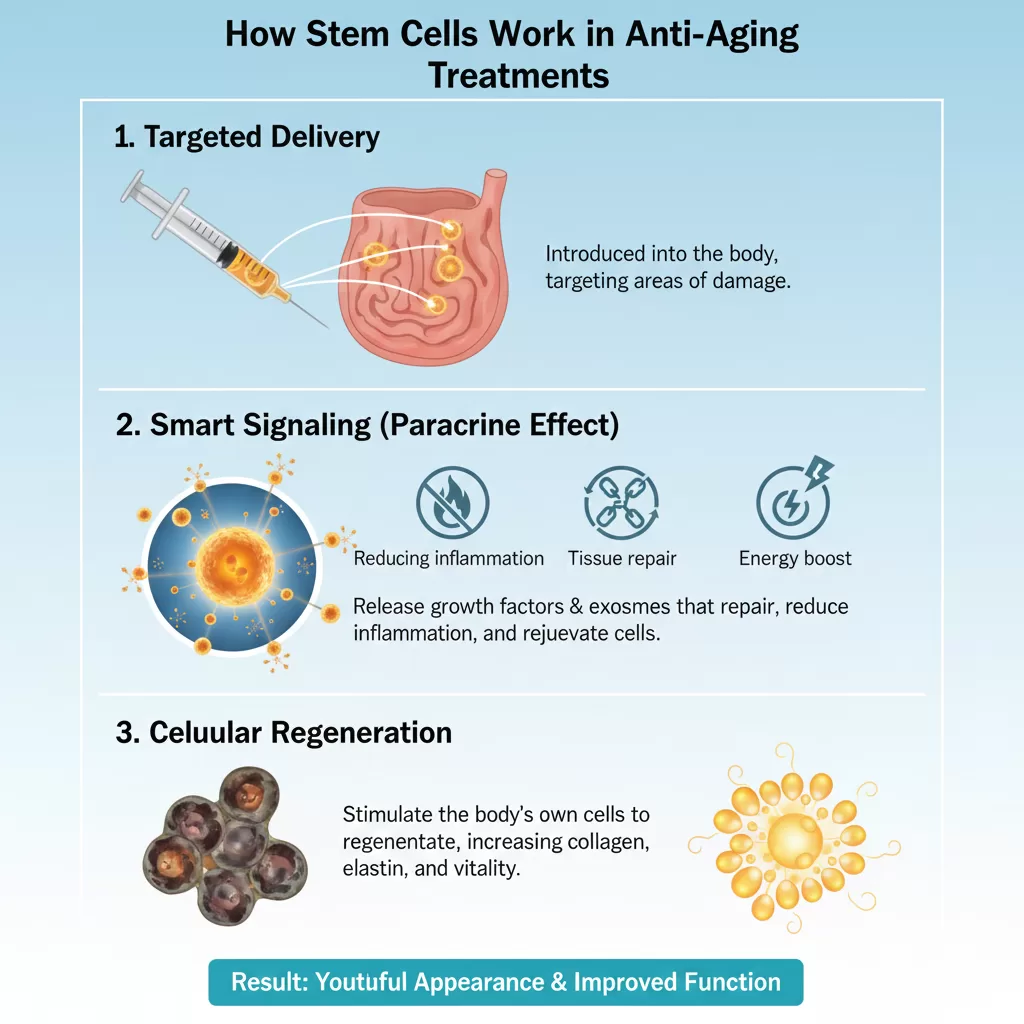
Many confuse cellular reprogramming with stem cell therapy, but they are fundamentally different biological processes. Stem cell therapy typically involves harvesting stem cells (either from the patient or a donor), growing them in a lab, and injecting them into the damaged area to replace dead tissue.
In contrast, the OSK therapy given to the first human does not introduce new cells. Instead, it modifies the cells already present in the patient’s body. As reported by Technology Networks, this is an “in situ” approach. The existing, aged cells are chemically signaled to change their epigenetic state.
The advantages of this approach over stem cell therapy include:
- No Donor Required: There is no need for external cell sources or complex lab-grown grafts.
- Integration: Because the cells are already integrated into the tissue architecture of the eye, there is no need for the new cells to “find their place” or integrate into existing neural networks.
- Reduced Rejection: Since the patient’s own cells are being used, the risk of immune rejection is virtually eliminated.
What is the timeline for longevity clinical trials?
The dosing of the first human marks a transition from preclinical research to clinical validation. The path to this milestone began decades ago with the discovery of the Yamanaka factors in 2006. Following this, years of animal studies—most notably in mice—demonstrated that partial reprogramming could restore vision and improve organ function without causing cancer.
According to Longevity.Technology, Life Bio has now reached its first major clinical milestone. The timeline for future development typically follows these stages:
- Phase I (Safety): Testing in a small group of humans to ensure the therapy is not toxic and does not cause tumors.
- Phase II (Efficacy): Testing in a larger group to see if the therapy actually improves vision.
- Phase III (Confirmation): Large-scale trials to compare the therapy against placebos or existing treatments.
- Regulatory Approval: Submission of data to bodies like the FDA for public use.
While the first dose is a historic event, the process of moving from a single patient to a widely available medical treatment usually takes several years of rigorous testing.
The broader implications for regenerative medicine
The success of the OSK therapy in the eye could open the door to treating other age-related conditions. If cellular reprogramming can work in the retina, researchers believe it could eventually be applied to other organs that do not regenerate well, such as the heart and the brain.
For example, heart failure is often the result of cardiomyocytes (heart muscle cells) becoming senescent and losing their ability to contract. Applying partial reprogramming to the heart could potentially “reawaken” these cells, improving cardiac output. Similarly, in the brain, reversing the epigenetic clock of neurons could theoretically combat the cognitive decline associated with Alzheimer’s or Parkinson’s disease.
However, the complexity of these organs is far greater than that of the eye. The brain, in particular, relies on precise synaptic connections. There is a theoretical risk that “resetting” a neuron could erase the memories or learned behaviors stored in those synaptic patterns. This is why the eye—which is primarily a sensory organ—was the logical starting point.
The entry of startups like Life Bio into human trials signals a shift in the longevity industry. The focus is moving away from supplements and “biohacking” toward legitimate genetic medicine and epigenetic engineering.
Frequently Asked Questions
Will this therapy make people immortal?
No. The OSK therapy is designed to treat specific age-related dysfunctions, such as sight loss, not to stop the aging process entirely or grant immortality. It targets the biological age of specific cells to restore function, but the body continues to age chronologically.
Is this the same as a stem cell transplant?
No. Stem cell transplants involve adding new cells to the body. OSK therapy uses partial reprogramming to rejuvenate the cells that are already present in the patient’s organ, avoiding the need for external donors or lab-grown cells.
What are the main risks of this treatment?
The primary risk is the potential for uncontrolled cell growth or the formation of tumors (teratomas) if the cells are reprogrammed too far. Life Bio uses “partial” reprogramming to mitigate this risk by stopping the process before the cell loses its identity.
How long does it take for the therapy to work?
The specific timeline for vision recovery in the first human patient has not been publicly detailed, but cellular reprogramming typically involves a period of gene expression followed by a period of cellular remodeling. Results are monitored over months and years.
Can this be used for other parts of the body?
While currently being tested in the eye, the underlying science of partial reprogramming could theoretically be applied to other organs like the heart, liver, or kidneys, provided that safety and identity-preservation can be guaranteed.
