Two of the Brightest Planets in the Night Sky Are About to Nearly Touch: June 2026 Viewing Guide
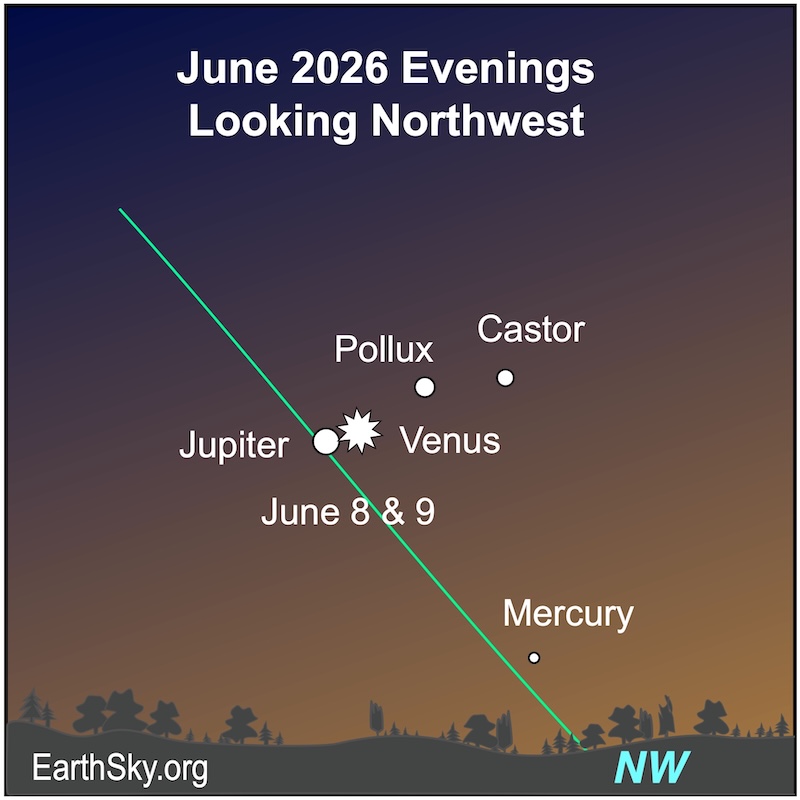
On June 9, 2026, Venus and Jupiter will appear exceptionally close to one another in the western sky shortly after sunset. According to NASA, this event is a planetary conjunction, an optical illusion where two planets seem to nearly touch from Earth’s perspective despite remaining millions of miles apart in space.
For those tracking the heavens, the phrase “two of the brightest planets in the night sky are about to nearly touch – newscentermaine.com” signals one of the most accessible celestial displays of the year. Because Venus and Jupiter are among the most luminous objects in the night sky, this alignment does not require specialized equipment to enjoy, making it a prime opportunity for casual stargazers and seasoned astronomers alike to witness the clockwork of our solar system.
What is the Venus and Jupiter Conjunction on June 9?
A planetary conjunction occurs when two or more celestial bodies appear close to each other in the sky from the vantage point of an observer on Earth. On June 9, 2026, this phenomenon will feature Venus and Jupiter, two of the most prominent planets visible to the naked eye. While they will appear as though they are nearly touching, this is a matter of perspective rather than physical proximity.
According to NASA, the planets are still separated by millions of miles of vacuum. The “meeting” is simply a result of our line of sight aligning with the positions of these two planets as they orbit the sun. To see this event, observers should look toward the western horizon shortly after the sun has set. Venus, being the brightest of the two, will be the easiest to identify, with Jupiter positioned closely nearby.
This specific alignment is a highlight of the June 2026 skywatching calendar because of the sheer brilliance of the participants. When the two brightest planets align, they create a striking visual pair that stands out even in areas with moderate light pollution, though a clear view of the western horizon is essential.
How Does a Planetary Conjunction Work?
To understand why these planets appear to gather, one must understand the ecliptic. According to NASA, the ecliptic is the nearly identical path that planets follow as they orbit the sun. Because the planets move along this shared plane, they frequently appear to line up or “meet” from our perspective on Earth.
Imagine the solar system as a giant, slightly tilted disk. The sun is at the center, and the planets orbit within that disk. When Earth, a closer planet (like Venus), and a more distant planet (like Jupiter) align along this plane, the closer planet appears to “overtake” or pass the distant one. This creates the visual effect of a conjunction.
The frequency of these meetings varies depending on the orbital speeds of the planets involved. Venus, being much closer to the sun, completes its orbit far faster than the gas giant Jupiter. This speed differential ensures that Venus periodically catches up to Jupiter in our field of vision, creating these recurring celestial pairings.
| Date (June 2026) | Event | Observation Window |
|---|---|---|
| June 9 | Venus and Jupiter Conjunction | Shortly after sunset (West) |
| June 11–15 | Mercury joins Venus & Jupiter | Low in the western sky |
| June 17 | Lunar Occultation of Venus | Varies by location |
| June 21 | June Solstice | Start of astronomical summer |
When Will Mercury Join the Planetary Parade?
The celestial activity does not end with the June 9 conjunction. From June 11 through June 15, 2026, the sky will host a “mini parade of planets.” During this window, Mercury will join Venus and Jupiter in the western sky.
Observing this trio requires more precision than the initial conjunction. According to NASA, Mercury will sit much lower toward the horizon than its counterparts. This means that the window for viewing is smaller, and any obstructions—such as buildings, trees, or mountains—to the west could block the view. To catch Mercury in the glow of twilight, observers will need a completely clear view of the western horizon.
The presence of three planets in one small sector of the sky is a vivid demonstration of the ecliptic in action. Because all three orbit the sun along nearly the same path, they occasionally cluster together from Earth’s point of view, creating a rare visual alignment of the inner and outer solar system.
What is a Lunar Occultation and Where Can You See It?
Following the planetary parade, another rare event occurs on June 17, 2026: a lunar occultation. While a conjunction is when two objects appear side-by-side, an occultation happens when one celestial body physically passes in front of another, blocking it from view.
On this date, the Moon will pass in front of Venus. For observers located within the correct viewing path, Venus will appear to vanish behind the Moon’s edge and then reappear shortly after. This event provides a dramatic sense of depth and scale, as the Moon’s transit confirms the distance between our satellite and the planet Venus.
According to NASA, the lunar occultation of Venus will not be visible globally. The event will be visible from specific regions, including:
- Parts of the United States
- Canada
- Brazil
- Venezuela
Because the Moon’s path is narrow, the “viewing path” is limited. Those in these countries should check local astronomical coordinates to determine if their specific city falls within the visibility zone.
“This is called a lunar occultation. For viewers in the right viewing path, Venus will look like it disappears behind the Moon, then reappears later.” — NASA
Other June 2026 Astronomical Events to Watch
The first half of June 2026 is exceptionally dense with astronomical milestones. Beyond the planetary alignments, the month marks a significant transition in the Earth’s orbit.
The June Solstice
On June 21, the June solstice occurs, marking the official start of the astronomical summer. This is the point where one of Earth’s poles is tilted most directly toward the sun, resulting in the longest day of the year for the Northern Hemisphere.
Deep-Sky Observing
As the season shifts, new targets become visible for those with telescopes or binoculars. Throughout June, the “Summer Triangle” and various deep-sky observing targets rise into view. These targets often include distant star clusters and nebulae that are best viewed during the clear, shorter nights of early summer.
For those interested in deeper exploration, this is an ideal time to look for related explainers on deep-sky objects to identify which nebulae are most prominent during the solstice window.
Viewing Tips for the June 2026 Events
Since the core of this news—that two of the brightest planets in the night sky are about to nearly touch – newscentermaine.com—centers on visibility, knowing how to prepare is key. You do not need an expensive observatory to see these events, but a few strategic choices can improve the experience.
- Timing is Critical: For the June 9 conjunction and the subsequent mini-parade, the window is narrow. Look west shortly after sunset. If you wait too long, the planets may sink too low toward the horizon.
- Find a Clear Horizon: Because Mercury and the conjunction occur low in the western sky, avoid city centers with skyscrapers. A beach, a hilltop, or an open field facing west is ideal.
- Identify the Planets: Venus will be the most brilliant object in the sky after the sun and moon. Jupiter will be slightly less bright but still very prominent. Mercury will be the smallest and lowest of the three.
- Use Basic Tools: While the naked eye is sufficient for the conjunction, a pair of standard binoculars can help you see the distinct separation between Venus and Jupiter and may allow you to see the Moon’s edge more clearly during the June 17 occultation.
Common Misconceptions About Planetary Conjunctions
A common point of confusion is the belief that a conjunction indicates a physical collision or a close approach in space. As NASA clarifies, this is an optical illusion. The planets are orbiting the sun at vastly different distances; they simply happen to align on our line of sight. There is no risk of collision, and the gravitational impact of this alignment on Earth is non-existent.
Another misconception is that these events are only visible with a telescope. In reality, the 2026 Venus-Jupiter event is one of the most visible because these two planets have high albedos (reflectivity), making them “brightest and easiest to spot” according to NASA’s guidance.
Frequently Asked Questions
When exactly can I see Venus and Jupiter “touch”?
The peak of the conjunction occurs around June 9, 2026. You should look toward the western sky shortly after sunset to see them at their closest apparent point.
Do I need a telescope to see the planetary conjunction?
No. Venus and Jupiter are two of the brightest planets in the sky. According to NASA, they are the easiest to spot, and the conjunction is clearly visible to the naked eye.

Which countries can see the Moon pass in front of Venus?
The lunar occultation on June 17, 2026, will be visible from parts of the United States, Canada, Brazil, and Venezuela.
What is the difference between a conjunction and an occultation?
A conjunction is when two objects appear near each other in the sky but do not overlap. An occultation occurs when one object (like the Moon) physically passes in front of another (like Venus), blocking it from view.
Why do planets appear to gather in the same part of the sky?
This happens because planets orbit the sun along nearly the same path, known as the ecliptic. From our perspective on Earth, this causes them to occasionally align in the same region of the sky.
With the June solstice on June 21 and the “mini parade” of planets preceding it, June 2026 offers a rare concentration of visible astronomy. Whether you are watching the brilliance of Venus and Jupiter on June 9 or tracking the lunar transit on June 17, the western horizon will be the place to be this month.
